State and federal officials have confirmed the first detection of emerald ash borer in Washington state, a milestone that conservationists and forestry experts have feared for years. The invasive beetle, which has killed hundreds of millions of ash trees across eastern North America since its accidental introduction from Asia in the 1990s, was found in Vancouver, Washington, on August 3, 2026, after residents reported a sighting to the Washington Invasive Species Council.
The discovery is significant for Whatcom County, where native and ornamental ash trees grow across urban neighborhoods, parks, and riparian corridors. Experts say ash tree populations can be effectively wiped out within a decade of emerald ash borer infestation becoming established in an area, and there is currently no proven method to eradicate the pest once it takes hold in a landscape.
What Emerald Ash Borer Does
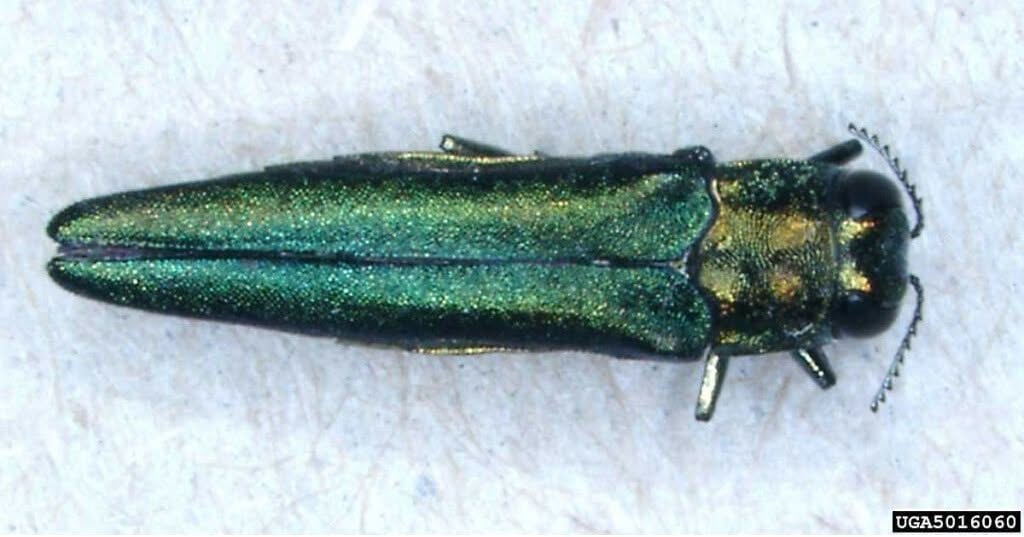
Emerald ash borer, known scientifically as Agrilus planipennis, is a metallic green beetle roughly half an inch long. The adult beetle causes only minor leaf damage when it feeds, but it is the larval stage that kills trees. Female beetles lay eggs in the bark of ash trees, and when the larvae hatch, they bore into the inner bark and feed on the tissue that moves water and nutrients between the roots and the canopy. That feeding disrupts the tree's vascular system and eventually girdles it, cutting off the flow of resources throughout the tree.
Infested ash trees typically show a distinctive pattern of dieback starting at the top of the canopy and progressing downward over two to four years. By the time die-off becomes visible, the infestation is often well established and the tree is beyond saving. In heavily infested areas in the eastern United States and Canada, the beetle has essentially functionally eliminated ash as a component of forests, woodlots, and urban tree canopies.
The beetle was first detected in North America near Detroit in 2002, likely arriving in wooden packing material from Asia. Since then it has spread to more than 35 states and several Canadian provinces, despite intensive quarantine and eradication efforts. In the Pacific Northwest, it was first detected in Oregon in 2022 and more recently in Vancouver, British Columbia, before the Washington state discovery this month.
What It Means for Whatcom County
The Vancouver, Washington detection is approximately 250 miles south of Bellingham, but the pattern of spread in other regions suggests the beetle can move faster than containment programs expect, particularly when people inadvertently transport infested firewood or woody material across geographic barriers.
Washington already has a ban on importing firewood from outside the state, specifically to prevent the spread of invasive forest pests like emerald ash borer. Residents who bring firewood to campgrounds, parks, or recreational properties from other states are violating that ban and potentially introducing pests that can devastate local tree populations. The rule applies to all firewood regardless of species, because beetle larvae are difficult to detect in cut wood.
Whatcom County's urban forest includes ash trees in Bellingham city parks, street tree plantings, and riparian areas. The County and City of Bellingham have both invested in urban forestry programs that would face difficult decisions if emerald ash borer were to establish itself locally. Treatment of individual high-value trees with systemic pesticides is possible but expensive and requires ongoing application. At the landscape scale, the only proven response is removal of infested trees to slow spread.
How to Help Slow the Spread
Officials are urging Washington residents to take several specific actions. First, do not transport firewood. Buy firewood locally or use certified heat-treated firewood when camping or recreating in areas where you might otherwise bring wood from home. Second, report suspected sightings. If you see a small, metallic green beetle on or near an ash tree, photograph it and report it to the Washington Invasive Species Council through their online reporting portal or the WA Invasives app.
Third, know what ash trees look like. In Washington, the most common ash species include Oregon ash, which grows naturally in riparian areas and wetland margins across western Washington including Whatcom County. Oregon ash has distinctive compound leaves with five to nine leaflets and develops furrowed gray bark as it matures. Learning to identify local ash trees makes it easier to monitor them for signs of infestation.
More information on emerald ash borer identification, reporting, and the Washington state response plan is available through the Washington Invasive Species Council and the Washington State Department of Agriculture. Related coverage of environmental and conservation issues in Whatcom County is available in our prior environmental reporting.