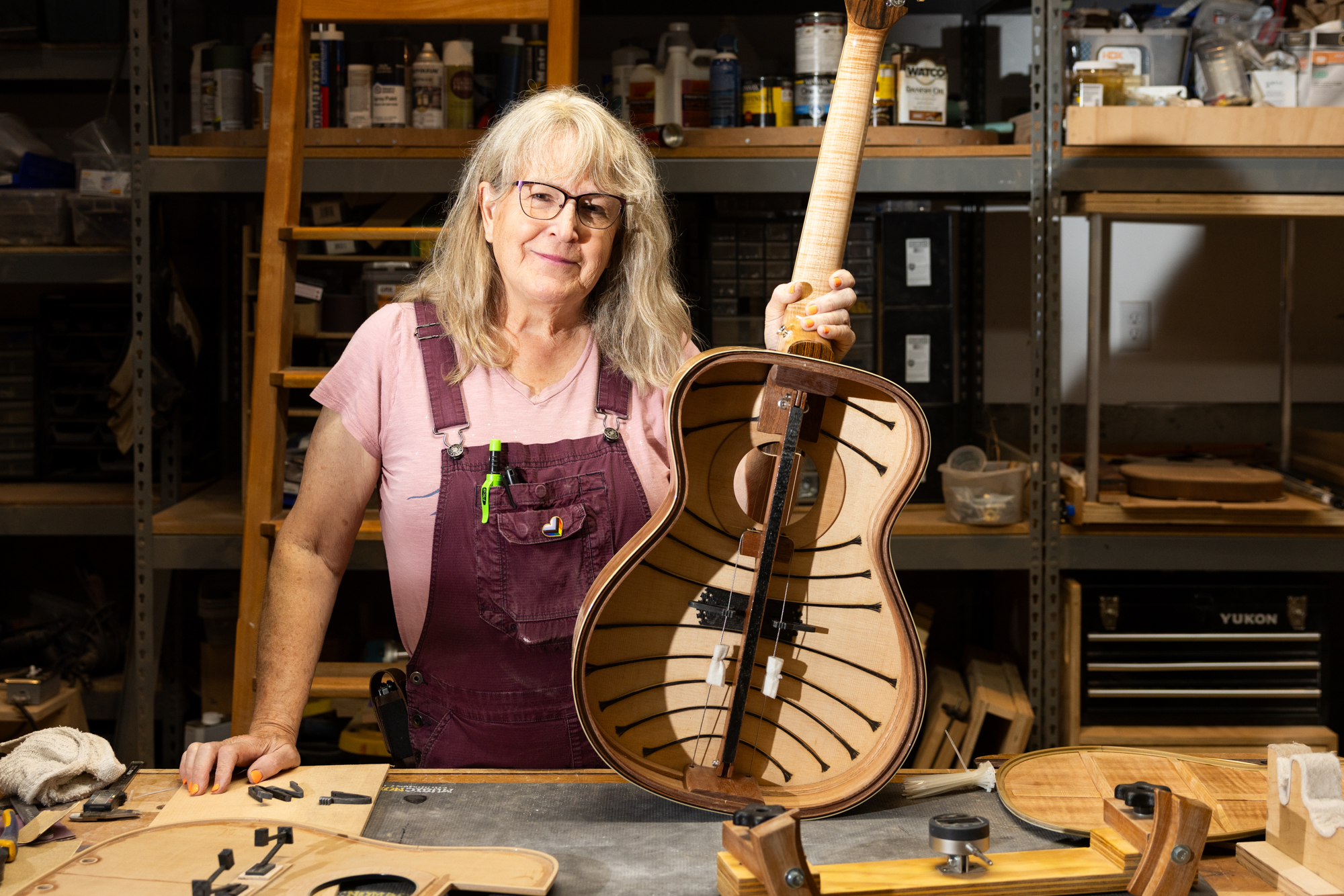
Breanna Anderson has spent most of her adult life working in two seemingly unrelated fields: building guitars by hand and running a radio station. But in a workshop in Van Zandt, a small community in the eastern foothills of Whatcom County, those two pursuits have converged in an invention she has spent four decades thinking about and is now working to patent.
Anderson, 68, who has lived in Van Zandt for nine years and manages a local radio station while working as a digital engineer, has developed what she calls the "evergreen-style guitar," a new instrument design intended to dramatically extend the lifespan of the acoustic guitar by fundamentally changing how string tension is distributed through the body of the instrument.
The Problem She Set Out to Solve
The core engineering challenge Anderson addressed is one that has troubled guitar makers and players for as long as steel-string acoustic guitars have existed. The six strings of a standard acoustic guitar exert roughly 160 pounds of tension on the soundboard, the thin, resonant top of the guitar that produces most of its acoustic character. That tension, sustained over years and decades, causes the soundboard to bow, warp, and eventually fail. A traditional quality acoustic guitar might last 80 years under the best conditions before structural degradation makes it unplayable.
"These strings produce a lot of tension: 160 pounds; it's like you're standing on the soundboard," Anderson explained. "The soundboard, to be very sensitive and responsive, needs to be very thin. So, 40 years ago, I came up with this idea, saying there must be a solution to this problem after seeing guitars self-destruct or become belly-up."
Her solution, which she has now built into a second prototype, transfers the string tension away from the soundboard entirely. Instead of anchoring strings at a bridge glued to the face of the guitar, where all that force pulls directly on the top, her design routes tension through cables inside the body of the instrument and into a tailpiece, similar in principle to the construction of archtop guitars and violins. The soundboard is relieved of the structural burden and can vibrate freely, which Anderson says also gives the instrument an unusually low resonance point and rich bass response even in a compact body size.
A Guitar Designed for Centuries
The implications of the design, if it performs as Anderson intends, are significant. Where a conventional guitar might be considered elderly at 80 years, Anderson believes an evergreen-style guitar could remain structurally sound and musically vital for 800 years. That claim sounds extraordinary, but it is grounded in a straightforward engineering logic: if the primary cause of acoustic guitar failure is string tension on the soundboard, removing that tension from the soundboard eliminates the primary failure mode.
"That's a hard selling point in an era when everything is disposable," Anderson acknowledged. The broader cultural moment may actually be on her side: growing interest in repair culture, instrument longevity, and sustainable manufacturing gives the concept of a guitar designed to outlast its owner by many generations a genuine market appeal that might not have existed a decade ago.
Anderson's workshop in Van Zandt is where she has built both prototypes, combining traditional luthiery techniques with the structural engineering concepts she developed through decades of thinking about the problem. The community of Van Zandt, nestled along the South Fork Nooksack River east of Bellingham, has a long tradition of attracting artists, craftspeople, and independent thinkers who find space in the rural landscape to pursue serious work outside the pressures of urban centers.
The Path to a Patent
Anderson is currently working toward a patent for the evergreen-style guitar design. The patent process for a musical instrument involves demonstrating both novelty, that no prior art covers the specific design, and utility, that the design performs as claimed. With a second working prototype in hand and enough documentation of the invention to have attracted profile attention from Cascadia Daily News, Anderson appears to be well along in that process.
She also brings an unusual combination of skills to the commercial challenge of bringing a new instrument to market. Her work as a radio station manager and digital engineer means she understands broadcasting, digital media, and the kind of storytelling that connects an inventor's vision to a public audience. Those skills will matter if the evergreen guitar moves from prototype to production and needs to find players willing to invest in an instrument built on unfamiliar principles.
Whatcom County has a small but active community of instrument makers and musicians, centered partly around Bellingham's music scene and partly around the creative communities in rural areas like Van Zandt. For more on Bellingham's arts and creative economy, earlier local coverage of community innovation is available here: Noisy Waters Mural Festival recent coverage. Anderson's work is a reminder that some of the most interesting creative and technical projects in the region happen far from downtown, in workshops and studios tucked into the foothills of the Cascades.