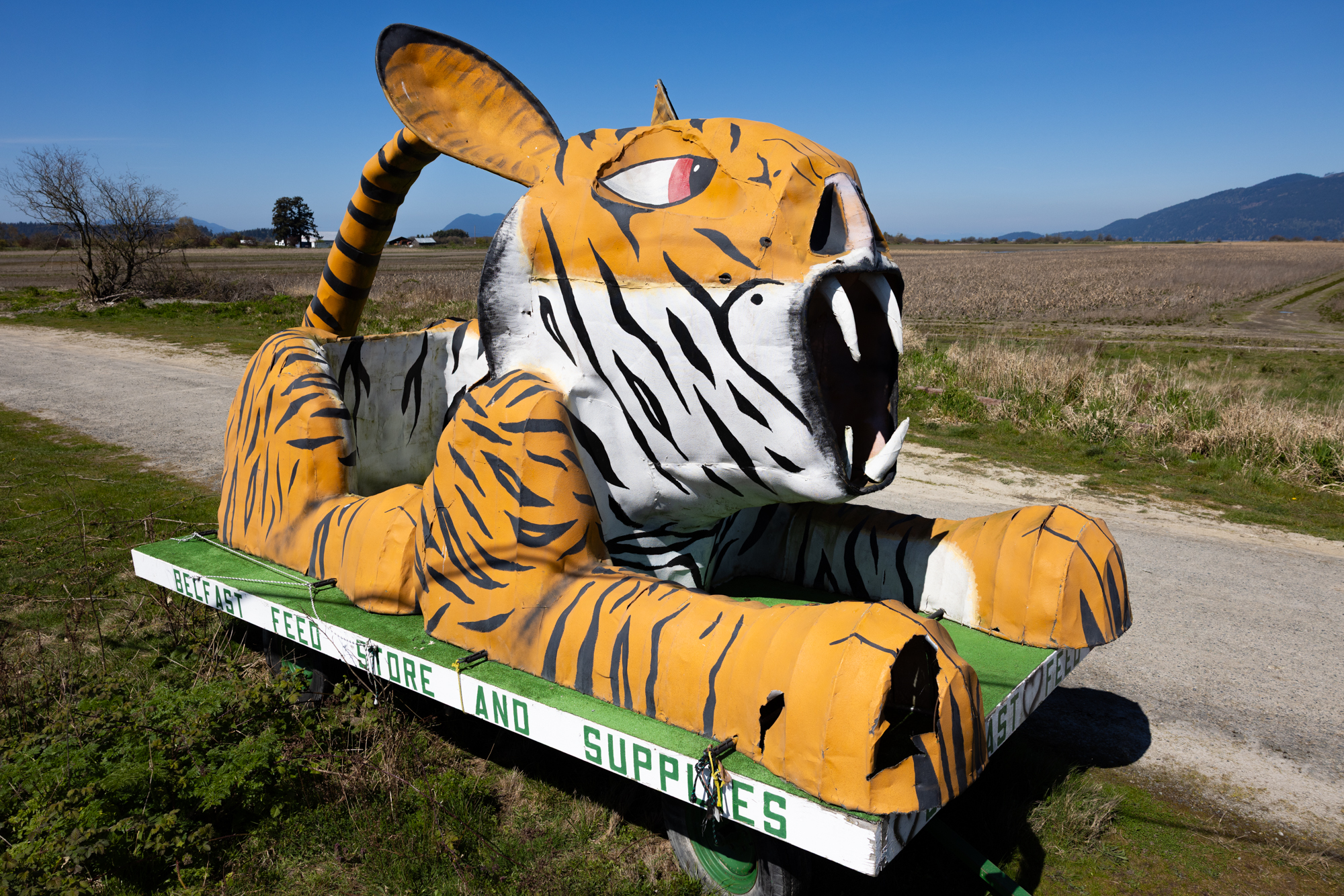
Along Bayview Edison Road, at the edge of the small farming community of Edison in Skagit County, a larger-than-life tiger sculpture sits frozen in a sphinx-like crouch, its gaping mouth aimed at passing traffic and its pointed tail breaking the flat farmland horizon behind it. The tiger has been there for years, inspiring Facebook posts, roadside photos, and a persistent low-level mystery among locals who pass it regularly. A closer investigation reveals a story that starts with a 30th high school reunion and ends with an act of quiet loyalty to a friend.
Born From a Reunion Parade Float
The tiger was built in 2010, not by artists or the town of Edison, but by members of the Burlington-Edison High School graduating class of 1980, celebrating their 30th anniversary reunion. Steve Stafford, owner of Glow Cleaners in Burlington and a proud member of that class, led the construction effort. The tiger is the mascot of Burlington-Edison High School, and the class wanted to make an impression at Edison's annual Berry Dairy Days parade float competition.
They did not underachieve. "We just got a little carried away, me and a bunch of classmates," Stafford said of the project. The construction took about three months. The team welded the tiger's frame from conduit pipe, stretched screen wiring over the structure, and then applied a specialized float covering sourced from a parade float company in Pasadena, California, that could be painted to look realistic. Stafford played drums in a live band accompanying the float, which was also fitted with a disco ball hanging from the tiger's tail, a nod to the class's graduation year in the height of the disco era.
The class of 1980 float won the Berry Dairy Days competition that year. It was a remarkable achievement for what had started as a reunion project. But the tiger's story was only beginning.
From Parade Float to Roadside Landmark
After the parade, the tiger needed a home. Float-sized sculptures are not easy to store, and few people have the land to host a welded, painted tiger on a trailer frame. That is where Tony Breckenridge entered the picture. A Skagit County public servant with deep ties to the community, Breckenridge offered his property on the edge of Edison as a permanent resting place for the sculpture.
The tiger has sat at the boundary of Breckenridge's land, right next to Bayview Edison Road, ever since. Its position there, visible from all three roads that lead into Edison, has made it an unofficial greeter for the town, a sphinx watching over the agricultural flatlands with a permanently open jaw. Visitors who stop for a closer look notice that the tiger still rests on its original trailer, which bears the name of a business located miles away on the other side of Interstate 5, adding another layer of mystery for those who try to decode the sculpture's origins from the outside.
Skagit County has no shortage of quirky roadside attractions, but the Edison tiger stands out for the depth of the story behind it. What appears to passersby as an inexplicable piece of outsider art is actually a hand-built community artifact, created collaboratively by a group of alumni who wanted to honor their school mascot and compete in a small-town parade. The fact that it has outlasted the reunion by more than 15 years, and outlasted its original creator's expectation of where it would end up, gives it a staying power that official public art rarely achieves.
Edison's Ongoing Charm as a Destination
Edison itself is a destination worth knowing for Whatcom County residents who have not made the short drive south on Chuckanut Drive into Skagit County. The unincorporated community sits among tulip fields and farmland, anchored by a cluster of bakeries, galleries, and restaurants that draw visitors from across the region, particularly during Skagit Valley Tulip Festival season in April. The tiger on Bayview Edison Road has become part of the town's informal identity, something locals point out to visitors the way other communities might gesture at a historic marker or a piece of public sculpture.
The Berry Dairy Days parade and festival, which gave the tiger its debut, has its own long history in the area. Burlington has hosted the event for decades as a community celebration tied to the agricultural heritage of the Skagit Valley, a region historically known for dairy farming, berry crops, and the bulb fields that now attract hundreds of thousands of spring visitors each year.
Steve Stafford's original clay mock-up of the tiger, created as a planning sketch before the welding began, still exists as a record of how deliberate the construction actually was. This was not a spontaneous project thrown together in a weekend. The class of 1980 planned it, built it over three months, sourced specialized materials from a float company in Southern California, and then executed it well enough to win a competitive local parade contest. That the result has become a permanent landmark is a testament to the craftsmanship behind what was nominally a one-day event float.
If you are looking for a low-key road trip from Bellingham on a summer afternoon, the drive south on Chuckanut Drive to Edison is one of the region's most scenic short routes, with views of Bellingham Bay and Padilla Bay along the way. The tiger will be waiting at the edge of town, watching the road with the same patient attention it has kept since 2010. For other local curiosities worth exploring in Whatcom County's natural landscape, the ongoing story of Highway 20 and the North Cascades offers a reminder of how dramatic the terrain between Bellingham and the mountains can be. More information about Edison's local businesses and the Skagit Valley region is available through the Skagit County community resources online.