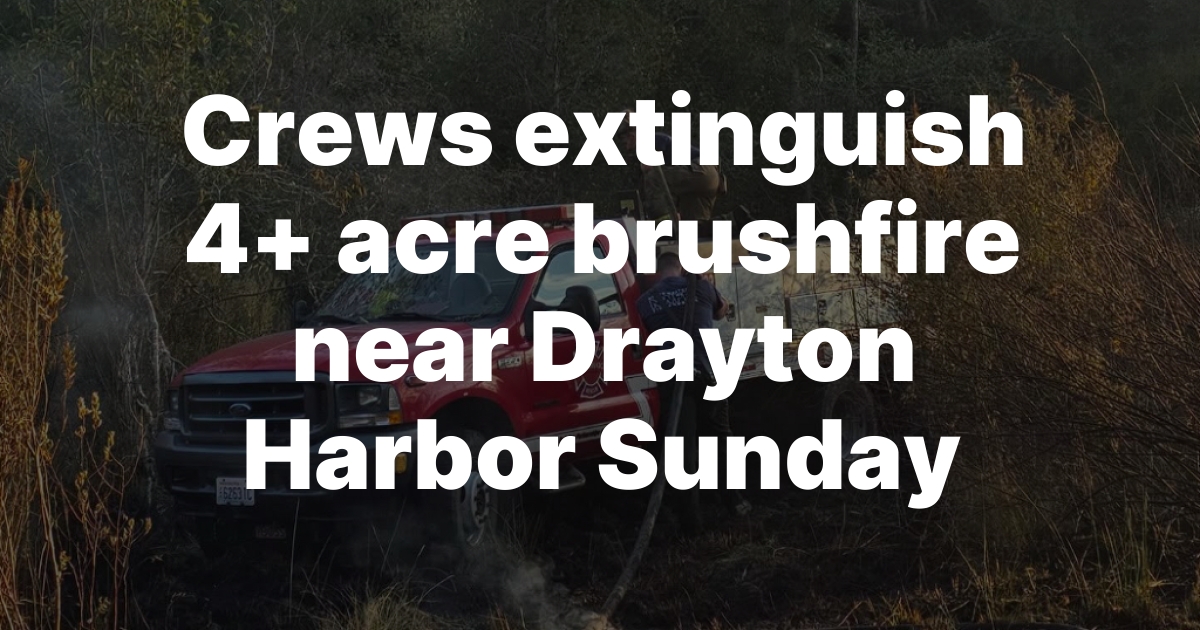
Firefighters from two agencies spent roughly five hours battling a brushfire that broke out Sunday afternoon near the intersection of Drayton Harbor Road and Harborview Road in Blaine, eventually containing a blaze that grew to more than four acres before crews got the upper hand. No structures were damaged and no injuries were reported, but access challenges at the scene complicated the suppression effort and required a coordinated multi-agency response that stretched well into the evening.
How the Fire Started and Grew
First responders were dispatched around 3:40 p.m. on Sunday, September 20, after reports of smoke in the Drayton Harbor area. North Whatcom Fire and Rescue crews arrived to find an estimated two acres already burning. Despite their rapid response, the fire continued to grow, eventually reaching a total of four or more acres before it was brought under control. The rate of growth in the early phase of the incident suggests the fire had been burning for some time before the first call came in, or that wind or fuel conditions in the area allowed it to spread quickly once ignited.
North Whatcom Fire and Rescue Fire Chief Jason Van der Veen told Whatcom News that access issues at the scene created significant challenges for firefighting operations. Brushfires in terrain with limited road access force crews to work harder to get equipment and water into position, slowing suppression and increasing the risk that fire will spread before it can be contained. The physical layout of the land near Drayton Harbor, which includes a mix of waterfront terrain, natural buffer areas, and vegetated open space, does not always lend itself to easy vehicle access, particularly for the heavy apparatus that fire departments rely on for water delivery. Water tenders staged on Drayton Harbor Road during the response to support crews working in the field, serving as mobile water supply points for the hose lines being deployed closer to the fire perimeter.
The suspected cause of the fire is a dirt bike that was reported riding in the area before smoke was first spotted. In the absence of any other obvious ignition source, Chief Van der Veen identified the dirt bike as the likely culprit. Whether the fire was caused by a spark from the exhaust system, a hot catalytic component making contact with dry vegetation, or another mechanism related to the bike's operation has not been officially confirmed. Off-road motorcycles and other motorized two-wheel vehicles generate significant heat during operation, and that heat can transfer to dry grass or brush through contact with the exhaust pipe, the undercarriage, or even through the displacement of hot gases near ground level during slow riding.
Mid-September in Western Washington falls squarely within the region's annual dry season, when soil moisture is at its lowest and fine fuels such as dried grass, fallen leaves, and light brush can ignite easily and carry fire across the landscape. The vegetation near Drayton Harbor, which had been through a full summer without significant rainfall, would have presented conditions favorable to rapid fire spread once a flame source appeared.
Two Agencies, Five Hours of Work
North Whatcom Fire and Rescue and the Washington State Department of Natural Resources both committed crews to the scene. NWFR units remained on scene for approximately five hours before completing their portion of the suppression work. DNR units, which specialize in wildland fire management and are equipped for extended operations in remote terrain, stayed on scene for several additional hours to ensure the fire was fully extinguished and would not re-ignite.
The DNR's involvement reflects standard practice for fires in or near forested or wildland-urban interface areas of Whatcom County. The agency maintains crews and air assets across Western Washington and responds to fires on state-managed land or in areas where the terrain and fuel load exceed the capacity of local fire departments to manage independently. DNR wildland crews are trained specifically in the tactics used for fighting fires in brush, grass, and mixed forest environments, including the construction of hand lines, the use of specialized wildland hose lays, and the application of mop-up techniques that ensure no smoldering material remains capable of rekindling after suppression crews leave the scene. That extended mop-up work is what kept DNR on scene after NWFR had completed its portion of the response.
No road closures were required during the response, though the water tenders staged on Drayton Harbor Road would have reduced available travel lanes in that stretch. Drivers in the area Sunday afternoon and evening may have encountered slower conditions near the scene, and residents living along Drayton Harbor Road would have seen the activity of emergency vehicles and personnel moving in and out of the area throughout the afternoon and into the night.
The fact that no structures were damaged is a significant outcome given the size of the fire and the access challenges crews faced. Four acres of burning brush in terrain with limited road penetration could easily have reached nearby buildings if wind conditions had been less favorable or if the response had taken longer to organize. The successful containment reflects the effectiveness of the multi-agency coordination between NWFR and DNR, which have established working relationships for exactly these types of incidents in Whatcom County.
Context: Fire Risk in the Drayton Harbor Area
The area around Drayton Harbor, located along the shoreline north of Blaine and south of the Canadian border crossing at Peace Arch, includes a mix of residential development, agricultural land, and natural open space near the water. The harbor itself is an important habitat area, home to migratory birds and marine life, and the surrounding upland areas include vegetated corridors that can carry fire if conditions allow. The proximity of natural open space to residential parcels creates the classic wildland-urban interface dynamic that fire managers across the Pacific Northwest have been grappling with for decades.
The late-season timing of this fire, in mid-September, reflects the extended dry period that much of Western Washington experiences each fall before the wet season fully establishes itself. While the region's reputation for rain is well-earned, the months of July through October regularly see extended stretches without meaningful precipitation, leaving vegetation dry and fire-prone. The fire risk during this window is often underestimated by residents who associate the Pacific Northwest primarily with its wet winters and springs.
Whatcom County has seen a number of brushfires and vegetation fires in recent years tied to dry conditions and human activity in outdoor spaces. Off-road vehicles operating in dry terrain are a known ignition source across the Pacific Northwest, and land managers regularly caution riders to be aware of fire risk when using bikes or other motorized equipment in or near vegetated areas during dry conditions. Some land management areas post seasonal closures or fire restriction notices specifically prohibiting motorized vehicle use when fire danger reaches elevated levels.
Residents who observe off-road vehicles operating in areas near sensitive habitat or dry brush are encouraged to note the location and contact local fire or law enforcement agencies if they observe behavior that poses a fire risk. The fire near Drayton Harbor was resolved without structural damage, but a shift in wind conditions or a delay in the response could have produced a much more serious outcome given the access challenges crews encountered. More information about fire safety and burn regulations in Whatcom County is available through Whatcom County. For coverage of a related fire incident in the region, the September waterfront fire in Bellingham provides additional context on how local fire agencies handle complex suppression operations.