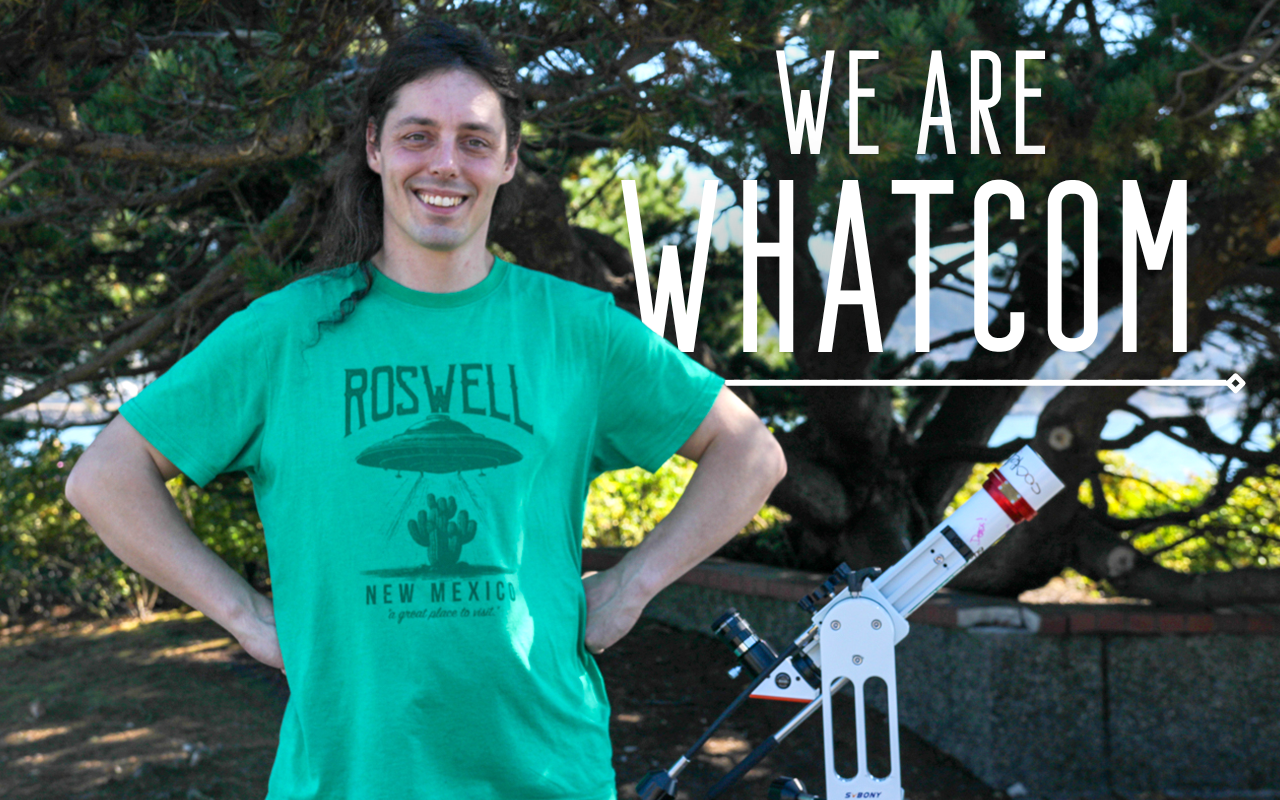
Every week, in parks across Bellingham and Whatcom County, a man named Robert Wilmore sets up his telescopes and waits to see who shows up. What began in 2017 as a simple act of bringing his equipment to a public park and inviting strangers to take a look has grown into "Space Time with Robert," a community gathering that draws upwards of 300 people on summer evenings.
Wilmore, a self-described space enthusiast, started the group out of a desire to connect with people in a meaningful way. "I don't want to make friends by going to bars and clubbing," he said. "I just felt like I wasn't connecting with people on the level that I wanted to connect with them on." His solution was characteristically direct: bring the telescopes to the park and see who is curious enough to stop.
From Taylor Dock to Zuanich Point Park
The group began meeting at Taylor Dock near the Fairhaven neighborhood, but popularity forced a move to a larger venue. As crowds grew and the gatherings shifted from monthly to weekly sessions, Wilmore relocated the primary meeting spot to Zuanich Point Park on Bellingham's waterfront, which offers more open space for the growing number of attendees and their equipment.
That growth has included an unexpected and welcome development: people have started bringing their own telescopes to share with other attendees. What once depended entirely on Wilmore's personal equipment has evolved into a collective experience where multiple instruments are available on any given night, broadening the range of objects the group can observe.
The gatherings operate without any formal membership, fees, or registration. Anyone who shows up is welcome. Wilmore has cultivated that open, informal spirit deliberately, and it appears to be a significant part of the group's appeal. Families, students, retirees, and longtime astronomy enthusiasts have all become regulars.
What They Look At and Why the Pacific Northwest Is Special
The group gazes at an impressive range of targets: planets, the moon, the sun during daytime sessions, nebulae, and distant galaxies. Wilmore uses a Seestar S50 smart telescope alongside his larger instrument, which he has named Vera. Recent images he captured on September 15, 2026, include the North America Nebula and the Crescent Nebula in the constellation Cygnus, as well as the M81 and M82 galaxies near Ursa Major.
Far from seeing the Pacific Northwest's famously cloudy weather as a drawback, Wilmore views it as something that makes clear nights more meaningful. "I think our weather and our longer nights just make the things that you see more enticing, more fleeting, something more challenging to go for, and so it makes these moments even more special," he said, drawing a contrast with stargazers in Arizona or New Mexico who have nearly unlimited clear skies.
The long summer days at this latitude offer extended hours to observe the sun safely through filtered telescopes, while the long autumn and winter nights provide time for some uniquely patient observations. Wilmore has his eye on an ambitious project coming up on November 11, when Saturn will be visible in the night sky for a full 14 hours after sunset. He plans to photograph the planet throughout the night in a series of images that will be assembled into a timelapse showing Saturn complete one full rotation, a process that takes about 10 and a half hours. "How cool is that?" he said.
A Counterintuitive Origin Story
Wilmore's path to becoming one of Bellingham's most enthusiastic science communicators came through an unlikely door. He was, in his own words, a moon hoax theorist in his early 20s, skeptical of the Apollo program. Digging into the evidence to support that skepticism led him in the opposite direction, and he emerged with a deep, evidence-based appreciation for space science and human spaceflight.
That origin story gives Wilmore an unusual ability to meet curious or skeptical newcomers where they are. He has built the kind of community that science educators and public outreach organizations aspire to create, without institutional backing or formal structure.
For residents who want to attend a Space Time with Robert session, the group meets regularly at Zuanich Point Park on Sunday evenings during the warmer months. Follow the group through local community boards and social media for current scheduling. The sessions are free, all ages are welcome, and no equipment of your own is needed.
Bellingham is home to a number of active science and nature communities, including astronomy clubs affiliated with Western Washington University and informal groups organized through the city's parks and recreation programs. Wilmore's group stands out for its size, accessibility, and the personal warmth its founder brings to every gathering.
For more community stories from around Whatcom County, read about other local community events bringing neighbors together.