Construction is underway on Salish Landing Park, Bellingham's newest public park and one of the most complex environmental remediation and public space projects the city has undertaken in decades. The park, being built on the site formerly known as Cornwall Beach Park on Pine Street, is in its first phase of development and will eventually offer trails, beach access, and a continuous recreational corridor along Bellingham Bay.
A Decade of Planning Behind the Project
The vision for Salish Landing Park dates back to 2014, when community planning efforts first identified the Pine Street waterfront as a priority for public access. The land had long been off-limits to the public because of severe contamination from two industrial sites: the R.G. Haley wood treatment facility, which operated on the property until 1985, and the Cornwall Avenue Landfill, which the city used from 1954 to 1965. Decades of industrial activity left the soil, groundwater, and bay sediment contaminated with chemicals associated with wood treatment processes and landfill waste.
Getting from community vision to active construction required coordination between the City of Bellingham, the Port of Bellingham, and the Washington State Department of Ecology to select and implement a cleanup strategy, secure funding, and design a park that could be built alongside ongoing environmental remediation without exposing workers or the public to hazardous materials. That coordination took the better part of a decade. Construction officially began in January 2026.
Phase I is expected to take three years to complete. Phase II, a larger portion of the site connected to the broader Waterfront District redevelopment, will follow and is part of the city's long-term vision for converting Bellingham's former industrial waterfront into a mixed-use, publicly accessible district stretching between downtown and Fairhaven.
What Is Being Built and How the Contamination Is Being Handled
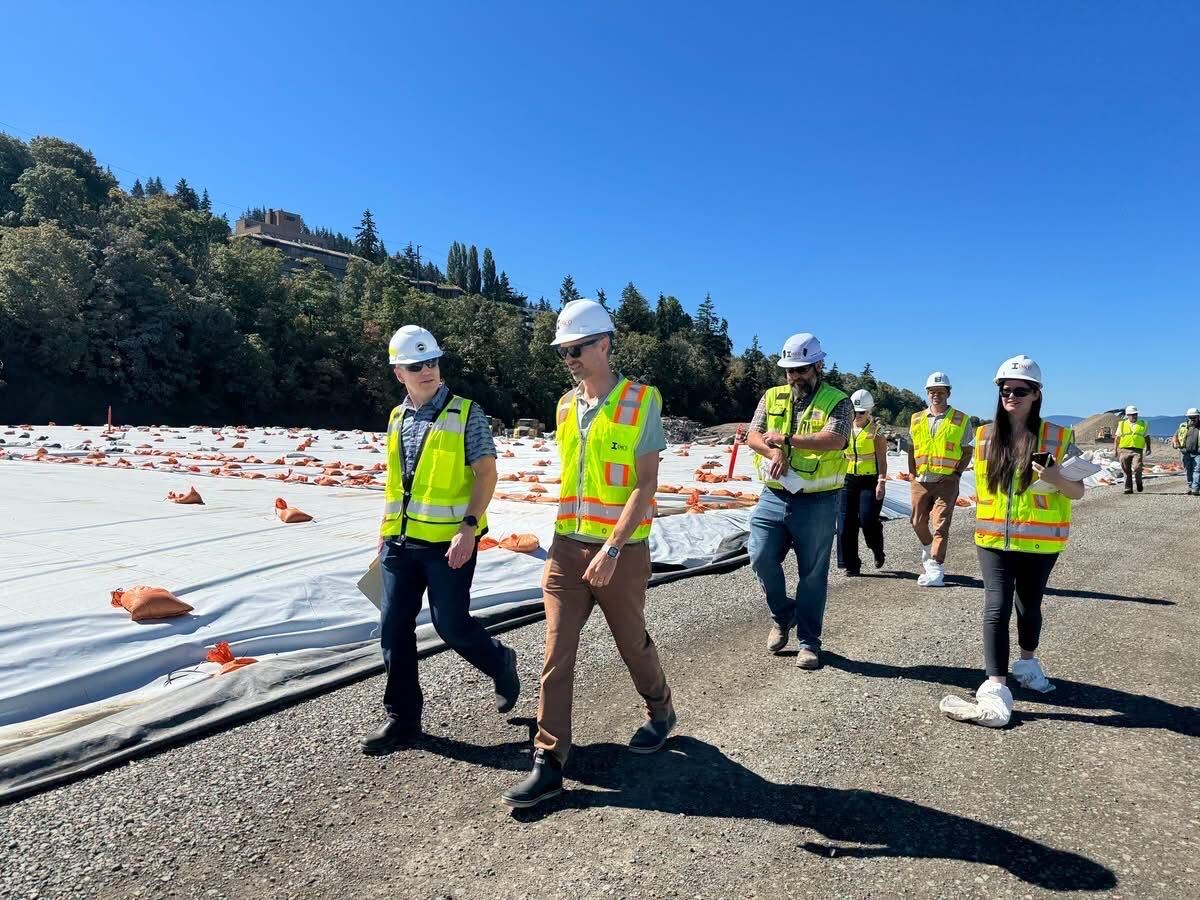
Current construction work includes shoreline armoring along the waterline to protect against erosion, excavation at the R.G. Haley site, and preparation for in-water work at the Cornwall Avenue location. One of the more technically complex elements of the project involves placing a sediment cap made of clean gravel, cobble, and sand over contaminated bay sediment. The cap materials are specifically sized to support eelgrass growth, providing habitat for intertidal organisms while sealing the contaminated material beneath.
On the upland portions of the site, all contaminated soils will be capped in place beneath a seven-layer system that includes a gas collection layer, a 40-millimeter-thick linear low-density polyethylene geomembrane, a drainage layer, and at least two feet of cover soil. The geomembrane is heat-welded to create an impermeable barrier that prevents stormwater from infiltrating the underlying waste and spreading pollutants into surrounding soils or Bellingham Bay.
The most heavily contaminated soil is being treated through in-situ solidification, a process in which contaminated material is mixed with concrete to lock pollutants in place and create a physical barrier. Craig Mueller, a project engineer with the city's public works department, described the approach in detail, noting that the geomembrane and cover soil system will be tightly sealed once complete. Underwater portions of the site will also be capped with about one foot of material containing activated carbon or organophilic clay to help trap any remaining pollutants.
The city, port, and Department of Ecology considered multiple cleanup strategies before selecting capping. Removing the contaminated material entirely was evaluated but ultimately rejected in part because of the logistics involved. Because of the specific contaminants present, the nearest facility capable of treating the waste is located in Utah. Excavating and transporting the material for off-site incineration would have been significantly more expensive and logistically complex than capping it in place, Mueller said.
What the Finished Park Will Offer
Once Phase I is complete, Salish Landing Park will become one of the largest public open spaces in the Waterfront District. It will reconnect Bellingham residents with a section of shoreline that has been inaccessible to the public for generations, offering trails, beach access, and views of Bellingham Bay and the San Juan Islands.
Parks and Recreation Director Nicole Oliver has emphasized that Phase I was intentionally designed to proceed alongside the environmental cleanup rather than waiting for cleanup to be fully completed. The scheduling approach keeps park workers out of areas where hazardous materials are actively being managed while still making progress on public space infrastructure. "Phase I is in conjunction with the cleanup," Oliver said, explaining that the phased approach avoids having park construction crews interact with hazardous materials.
The city's long-term vision for the waterfront includes extending a continuous recreational corridor that will eventually connect Fairhaven and downtown Bellingham along the bay, including a continuation of Taylor Dock. Salish Landing Park is a key link in that corridor. The City of Bellingham Parks and Recreation department is overseeing the project in partnership with public works and the port.
The broader Bellingham waterfront has a long history of industrial use that shaped the environmental conditions the city is now working to reverse. The Georgia Pacific pulp and chlor-alkali facilities, which operated on a separate waterfront site, were the subject of a 1990 Washington State Department of Ecology inspection that documented industrial wastewater and investigated associated environmental conditions. That site is distinct from the Salish Landing parcels, but reflects the wider pattern of industrial legacy affecting Bellingham Bay.
Residents interested in following the project's progress can monitor updates from the city at cob.org. For context on the broader environmental cleanup history of Bellingham's working waterfront, earlier reporting on the Harris Avenue Shipyard toxic metals cleanup illustrates the scale and complexity of remediation work that has been reshaping Bellingham Bay over the past several years.