The Bellingham City Council voted unanimously on Monday, September 14, to approve an ordinance that prohibits the sale, distribution, and preparation of kratom products within city limits. The measure moves forward following years of growing concern about kratom's health risks and a near-total absence of state or federal regulation governing how the substance is sold and labeled at retail.
What the Ordinance Covers and What It Does Not
Under the ordinance, selling or distributing kratom in Bellingham will be classified as a gross misdemeanor, punishable by up to one year in jail or a fine of up to $5,000. The ban covers the sale, distribution, and preparation of kratom products, targeting the supply side of the market rather than individual users. The ordinance explicitly does not ban the possession or purchase of kratom, meaning residents who currently use the substance can continue to do so legally under the city's rules, but they will no longer be able to buy it from local retailers if the ordinance takes effect as written.
The measure will return to the council for a final approval vote at a future meeting, meaning it is not yet in force. The initial vote establishes the council's intent and allows public comment and legal review before the ordinance becomes law.
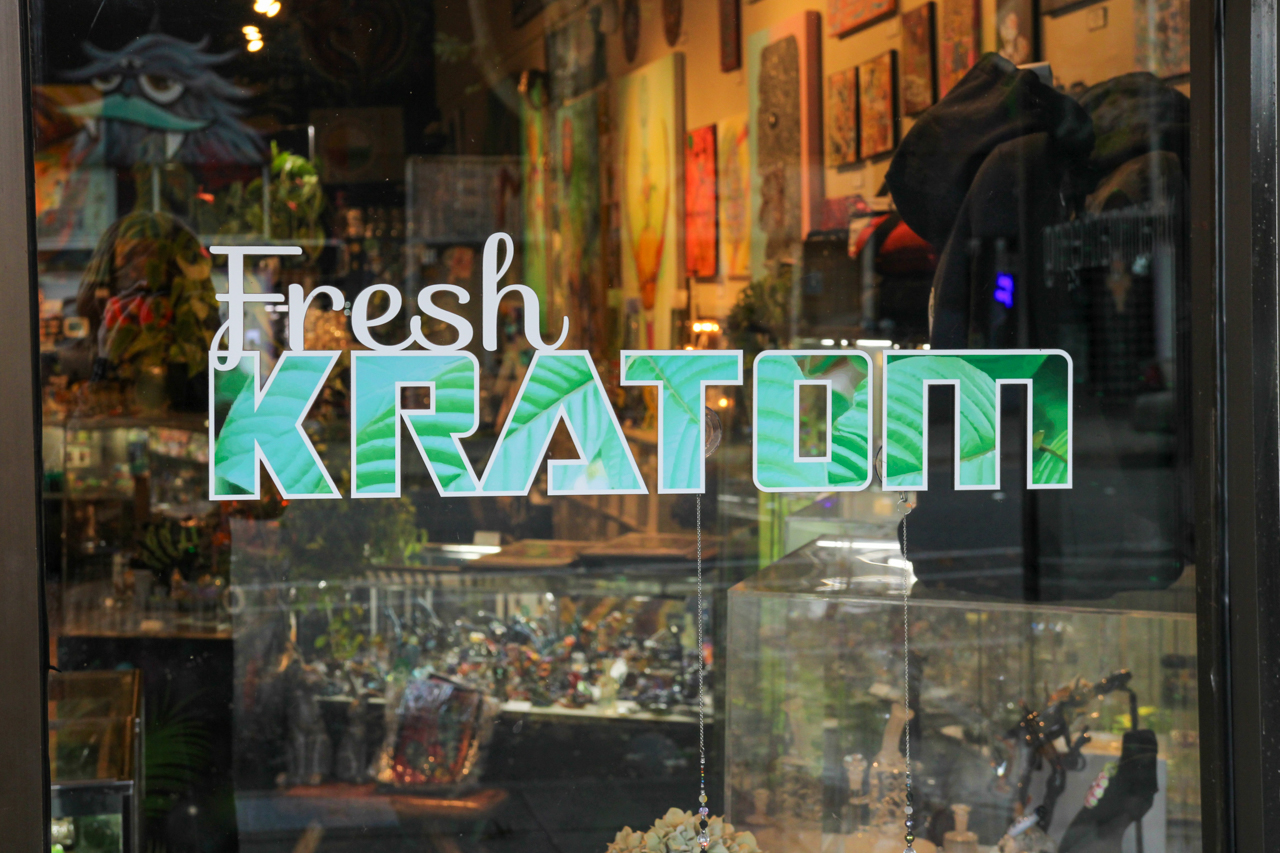
Signs at retail locations in downtown Bellingham advertising kratom and 7-OH products were visible as recently as September 15, reflecting how widely the substances have been marketed in the city before any ban took effect.
What Is Kratom and Why Is It Controversial
Kratom is a plant-based substance derived from the leaves of the Mitragyna speciosa tree, native to Southeast Asia. At low doses it can produce stimulant-like effects; at higher doses it acts more like an opioid, binding to opioid receptors in the brain. It has been sold in Bellingham and across Washington State in smoke shops, supplement stores, and gas stations, often marketed as a natural energy booster or pain reliever.
The substance that drew particular attention in Bellingham is 7-hydroxymitragynine, or 7-OH, a concentrated or synthetic compound derived from kratom leaves that is significantly more potent than the whole-leaf product. Community members who spoke during the public comment period at the council meeting urged the city to draw a distinction between traditional whole-leaf kratom and the highly concentrated synthetic 7-OH form. Clinicians in Whatcom County have reported seeing patients addicted to kratom and 7-OH products at increasing rates in recent years.
The U.S. Drug Enforcement Administration announced an emergency scheduling action last month that placed three 7-OH-related substances into Schedule I for a two-year period, making them illegal to sell or possess under federal law. That federal action applies nationwide, but enforcement at the local retail level has historically been inconsistent without clear state or local rules in place. The DEA's emergency scheduling can be reviewed through the DEA's official website.
Enforcement Challenges and Council Skepticism
Councilmember Michael Lilliquist, who voted for the ordinance, was candid about what he sees as its limitations. Without standardized testing requirements and a regulatory framework for distinguishing between whole-leaf kratom and synthetic 7-OH, enforcing the ban will be difficult in practice.
"There's no way that anyone who wants to enforce this could go into a store and know. They could guess, they could be told, it could say on the package, but there's no guarantee that any of that is true, because there's no regulation," Lilliquist said at the meeting. He described the city's ordinance as a "band-aid" in the absence of meaningful state or federal action.
Washington State's legislature considered a 95 percent excise tax on kratom and related substances during the most recent session, but the bill did not advance past its first committee hearing. Mount Vernon approved a similar sales ban last month, following the lead of several other Washington cities. Bellingham's move places it among a growing number of municipalities acting ahead of any statewide framework.
The City of Bellingham will need to determine how the Bellingham Police Department will enforce the ordinance at the retail level once it takes final effect. Enforcement approaches in other cities that have passed similar bans have varied, with some relying on complaint-driven inspections and others deploying proactive code enforcement checks at known retailers.
What Comes Next
The ordinance returns to the full council for a final approval vote at a future meeting, at which point it would take legal effect. Businesses currently selling kratom or 7-OH products in Bellingham will need to determine how to respond once the ban is final. Retailers who continue selling after the effective date would be subject to gross misdemeanor charges.
Residents who use kratom for pain management, energy, or to manage withdrawal from other substances may want to consult with a healthcare provider about alternatives, as access to the product within city limits will be restricted. Whatcom County Health and Community Services can connect residents with substance use treatment and support resources. More information on local health services is available at whatcomcounty.us.
For a broader look at how Bellingham's city council has been addressing public health and community safety questions this fall, including the concurrent vote on affordable housing incentives and utility project approvals, earlier coverage of Bellingham public safety investments provides useful background on how the city is building its response capacity alongside its regulatory framework.