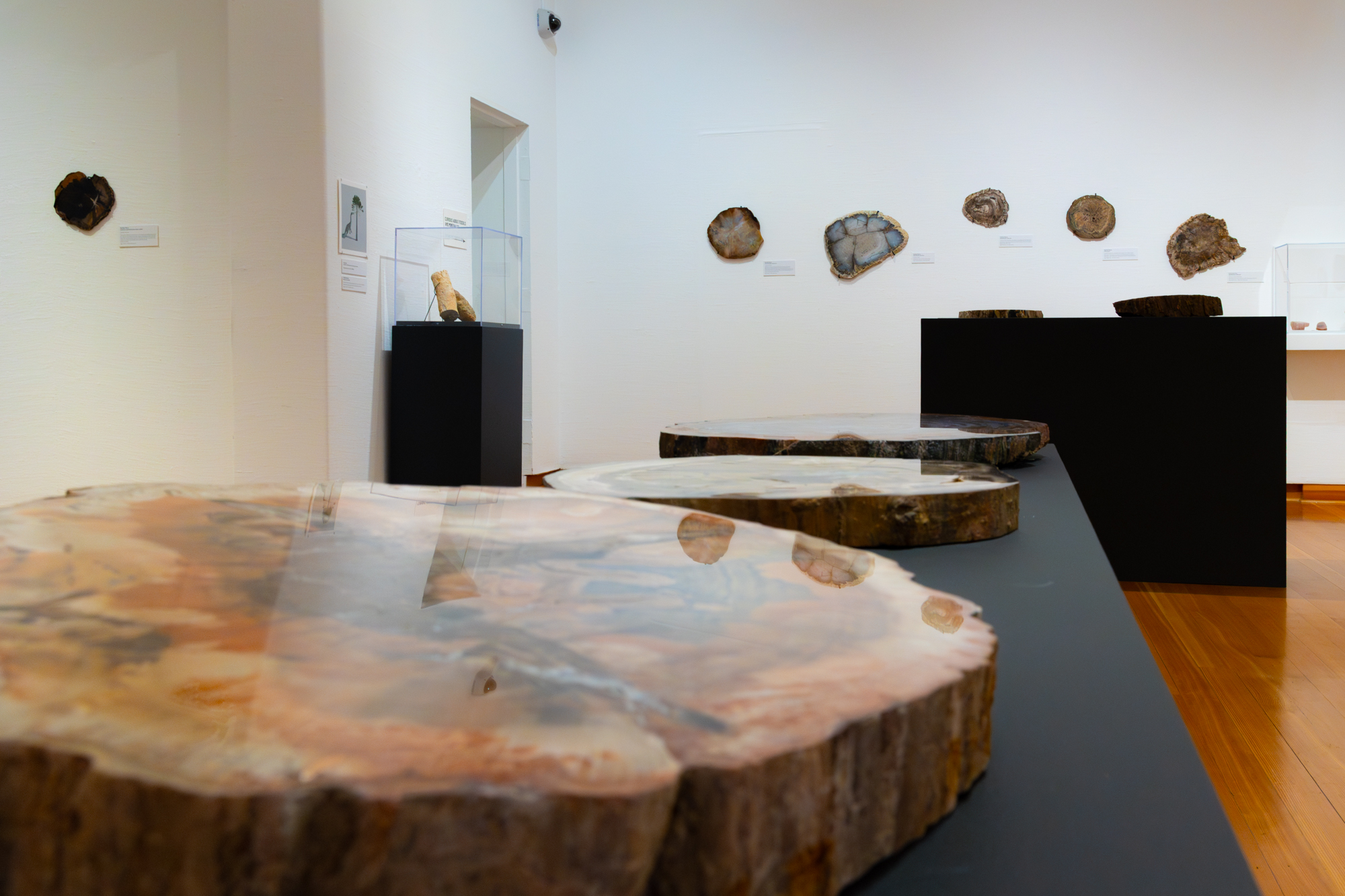
A new exhibition at the Whatcom Museum's Old City Hall location in downtown Bellingham is drawing visitors into the deep past, millions of years deep, through dozens of polished, glittering specimens of petrified wood mounted on walls, displayed on tabletops, and encased in glass vitrines. The show is called Painted Forest, and it will remain on view through April 2027, giving Whatcom County residents and visitors plenty of time to see it.
The exhibit is anchored by the life's work of George Mustoe, a retired Western Washington University researcher who spent decades collecting fossilized plant specimens from sites across the Pacific Northwest and beyond. The pieces were gathered primarily between the 1930s and 1960s, though Mustoe continued building the collection through subsequent decades of fieldwork. What resulted is a body of material that the museum's chief curator describes as among the most visually striking natural history specimens she has ever worked with.
What Petrified Wood Actually Is and Why These Pieces Are Stunning
Petrified wood forms through a process that takes place over millions of years. When vegetation, ranging from ancient ferns and pinecones to enormous tree trunks, becomes buried in mud or volcanic ash, it is cut off from the oxygen that would normally cause it to decompose. Instead, mineral-rich groundwater slowly percolates through the organic material, replacing the plant's cells with minerals like silica, iron, chromium, and nickel. Over time, the original wood structure is replaced almost entirely by stone while retaining the fine grain, growth rings, and structural details of the original plant.
The minerals responsible for the transformation are also the source of the colors. Iron produces warm reds and yellows. Chromium and nickel contribute greens. Manganese creates blacks and purples. The result, when polished, looks less like a rock than a gemstone, shimmering with internal color and pattern that can be traced directly to the specific chemistry of the soil and water the plant was buried in millions of years ago.
Amy Chaloupka, the chief curator at Whatcom Museum, organized the Painted Forest space to let visitors get close to the specimens rather than keeping them at a distance behind barriers. "There's such textural variation and interest in these pieces that you can see when you get up close to them," she said. Tree stumps, extinct ferns, and fossilized pinecones are among the most striking individual pieces in the collection.
The Collaboration Between Art Curation and Scientific Research
What makes Painted Forest distinctive among natural history exhibitions is the deliberate blending of scientific content with visual and aesthetic presentation. Chaloupka, who curates natural history shows for the museum, said she worked closely with Mustoe to understand not just what the specimens look like but why they are scientifically significant. That dual focus, on beauty and on meaning, shapes how the exhibit is organized and how individual pieces are labeled and contextualized for visitors.
George Mustoe spent his career at Western Washington University, where he built a reputation as one of the leading researchers on petrified wood in the Pacific Northwest. His work has appeared in scientific journals and contributed to a broader understanding of the paleoenvironments that once existed across the Cascadia region. The specimens in Painted Forest are not generic geological curiosities; they are tied to specific sites, specific geological formations, and specific periods in the region's deep past that Mustoe has spent decades studying.
The exhibit explains the science of fossilization in accessible terms while letting the visual impact of the specimens do most of the communicating. That balance makes it appropriate for school groups and curious adults alike, and it fits the museum's broader mission of making natural and cultural history available to the full range of Whatcom County residents.
Planning a Visit to Old City Hall
The Whatcom Museum's Old City Hall building is located at 121 Prospect Street in downtown Bellingham, a short walk from the Holly Street commercial corridor and within easy reach of the Bellingham Farmers Market site at Depot Market Square. The building itself is one of the more architecturally significant structures in Bellingham's downtown, a Victorian-era city hall that the museum has occupied since the 1940s and that gives the Painted Forest exhibit an appropriately historical setting.
Museum hours and admission information are available on the Whatcom Museum website. The museum offers free admission on certain days and has programs specifically designed for families with children, making it a practical destination for Bellingham families looking for a substantive outing during the school year or over summer break.
With Painted Forest running through April 2027, there is no urgency to visit immediately, but the exhibit is worth putting on the calendar before autumn transitions into the quieter indoor-activity season. Few things in the region offer quite the same combination of geological wonder and visual splendor as a wall of million-year-old fossilized plants, each one a record of a world that looked nothing like the Whatcom County we know today.
For other recent coverage of local arts and natural history programming in the region, this earlier look at a library natural history display shows the range of educational programming available to Bellingham residents throughout the year.