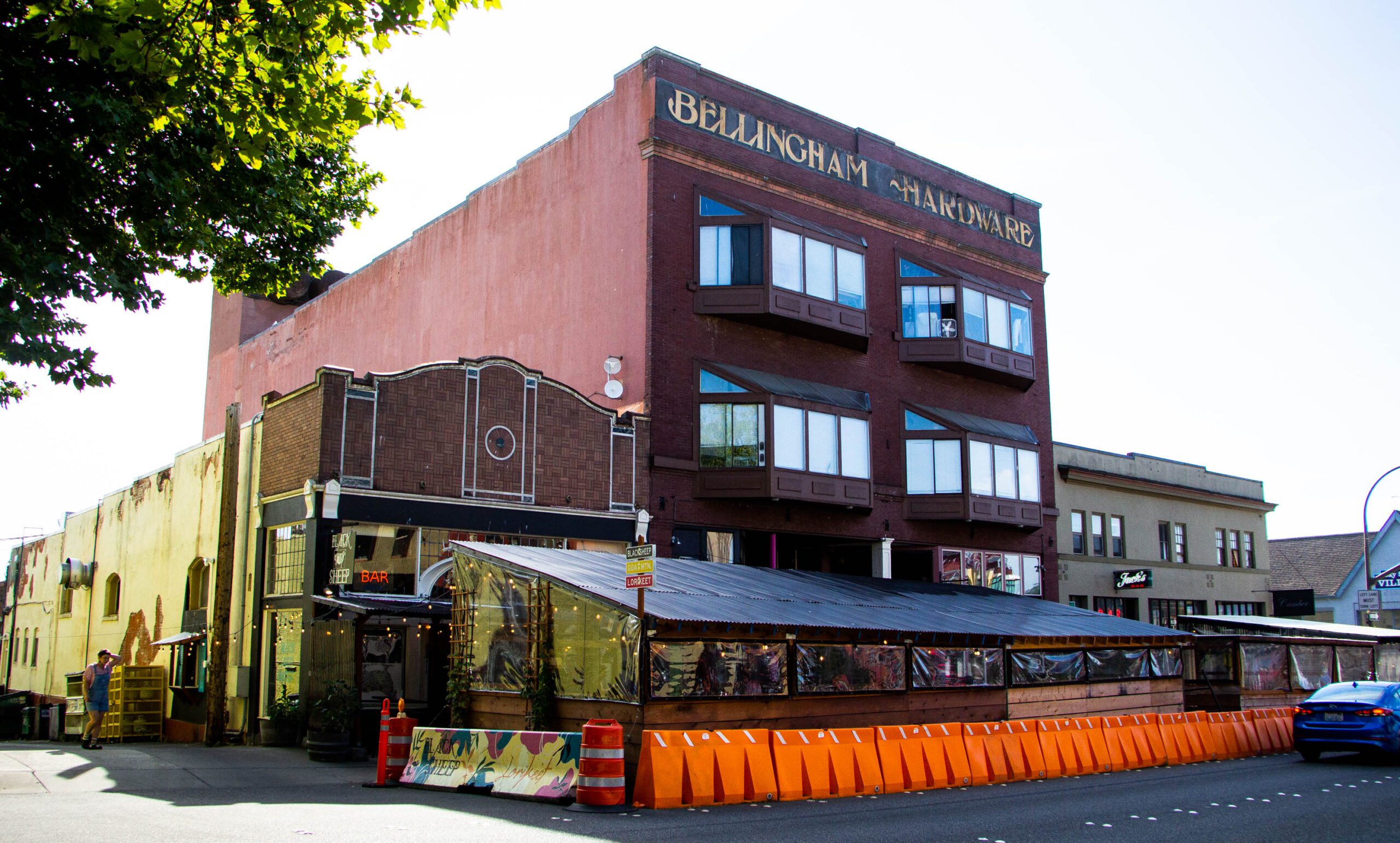
Anyone who has walked along Holly Street in downtown Bellingham has almost certainly glanced up at the bold, old-fashioned lettering that spells out "Bellingham Hardware" across the facade of one of the neighborhood's most distinctive buildings. The sign has been there for decades, long outlasting the business it once advertised. The hardware store closed in 1978, but the building itself has had several lives since then, and today it functions as a mixed-use complex housing apartments, retail storefronts, and office space. Understanding how it got there requires a walk back through more than a century of Bellingham commercial history.
How the Building Came to Be
In the early 1900s, the footprint now occupied by the Hardware complex was actually two separate structures. The building fronting Holly Street was designed by F. Stanley Piper, a well-known Bellingham architect, and was constructed around 1909. Piper was a prolific figure in early Bellingham's built environment, and his work can be found throughout the downtown core in buildings that still stand today.
From the time it opened, the Holly Street building operated as the Northwest Hardware Co., a business that would anchor that corner of downtown for decades. According to Jeff Jewell, research technician for the Whatcom Museum, the company held the property until 1944. The adjacent building on Bay Street was also owned by Northwest Hardware during that era, making the company a significant real estate presence in the heart of the city's commercial district.
A 1927 obituary in the Bellingham Herald for Frank H. Knight, who served as longtime president of Northwest Hardware Co., described him as "one of Bellingham's most reputable and prominent businessmen," a measure of how central the company was to the city's economic identity during the early twentieth century.
In 1947, the Bellingham Hardware Co. purchased the property from an interim owner, continuing the hardware trade at the same location. The store became a neighborhood institution over the following three decades. When it finally closed in 1978, a Bellingham Herald reporter captured the atmosphere of the closing in a passage that still resonates: "It's been a place to roam on Saturday morning," Joan Connell wrote, "where one can breathe in aromas of sawdust, paint and pipesmoke, and dream of castles yet unbuilt."
The 1980s Transformation Into a Mixed-Use Complex
The building's second act began almost immediately after the hardware store's closure. Developer Morris Piha, who was based in the Seattle area but at one point owned a substantial portion of historic downtown Bellingham, undertook a significant renovation in the early 1980s. The project combined the former Holly Street hardware building with the adjacent Bay Street property, creating what the Bellingham Herald described at the time as a "unique complex of stores."
Piha's renovation converted the combined footprint to mixed residential and commercial use, a development approach that was still relatively novel for downtown Bellingham in that era. The choice to retain the Bellingham Hardware name and signage rather than rebranding the complex was either a nod to the building's history or simply a decision that the bold lettering was too distinctive to remove. Either way, the name stuck, and four decades later it still serves as one of the most recognizable visual landmarks in the downtown streetscape.
Piha's 2013 obituary in The Seattle Times noted that he had owned most of historic downtown Bellingham at one point, reflecting the scale of his investment in the city during the urban renewal period of the 1970s and 1980s. His approach of combining historically significant structures and converting them to mixed uses helped set a template for how downtown Bellingham would evolve in the decades that followed.
Who Owns It Today and What Is There Now
Around the year 2000, Bob Hall, founder of Bellingham-based Daylight Properties, acquired the Hardware complex. Hall confirmed the acquisition in a recent interview with Cascadia Daily News reporter Sophia Gates, whose reporting provided the foundation for this account of the building's history.
Under Daylight Properties' ownership, the complex has continued to operate as a mixed-use destination. The ground floor hosts retail and commercial tenants, while upper floors contain residential apartments. The combination of uses reflects the kind of downtown density that urban planners have long promoted for Bellingham's core, where walkable streets and proximity to services make mixed-use buildings both economically viable and neighborhood-friendly.
The building sits within a stretch of Holly Street that anchors the transition between Bellingham's historic retail core and the Waterfront District redevelopment area to the west. Its preservation as a recognizable piece of the streetscape is one reason the downtown still feels grounded in its own history despite the significant amount of new construction that has changed the neighborhood over the past two decades.
Why Local Architecture History Matters
The Bellingham Hardware building is one of many structures in downtown Bellingham that carry the fingerprints of the city's early-twentieth-century boom years, a period when the region was growing rapidly on the strength of timber, fishing, and coal. Understanding the history of individual buildings connects residents to that longer arc, offering a sense of how the city's physical form reflects its economic and social evolution.
The Whatcom Museum, which holds extensive archives on Bellingham's architectural and commercial history, is a resource for anyone interested in digging deeper into the stories behind the city's built environment. The museum's research staff, including historians like Jeff Jewell, regularly assist journalists, researchers, and curious residents who want to trace the origins of specific buildings or neighborhoods.
For readers interested in other pieces of Bellingham's local history and how old structures find new purposes in the modern city, the ongoing transformation of the Harris Avenue Shipyard site offers another window into how Bellingham is reconciling its industrial past with contemporary development goals. The Hardware building on Holly Street, still bearing its century-old name, is proof that not every piece of that past needs to be erased to make room for what comes next.