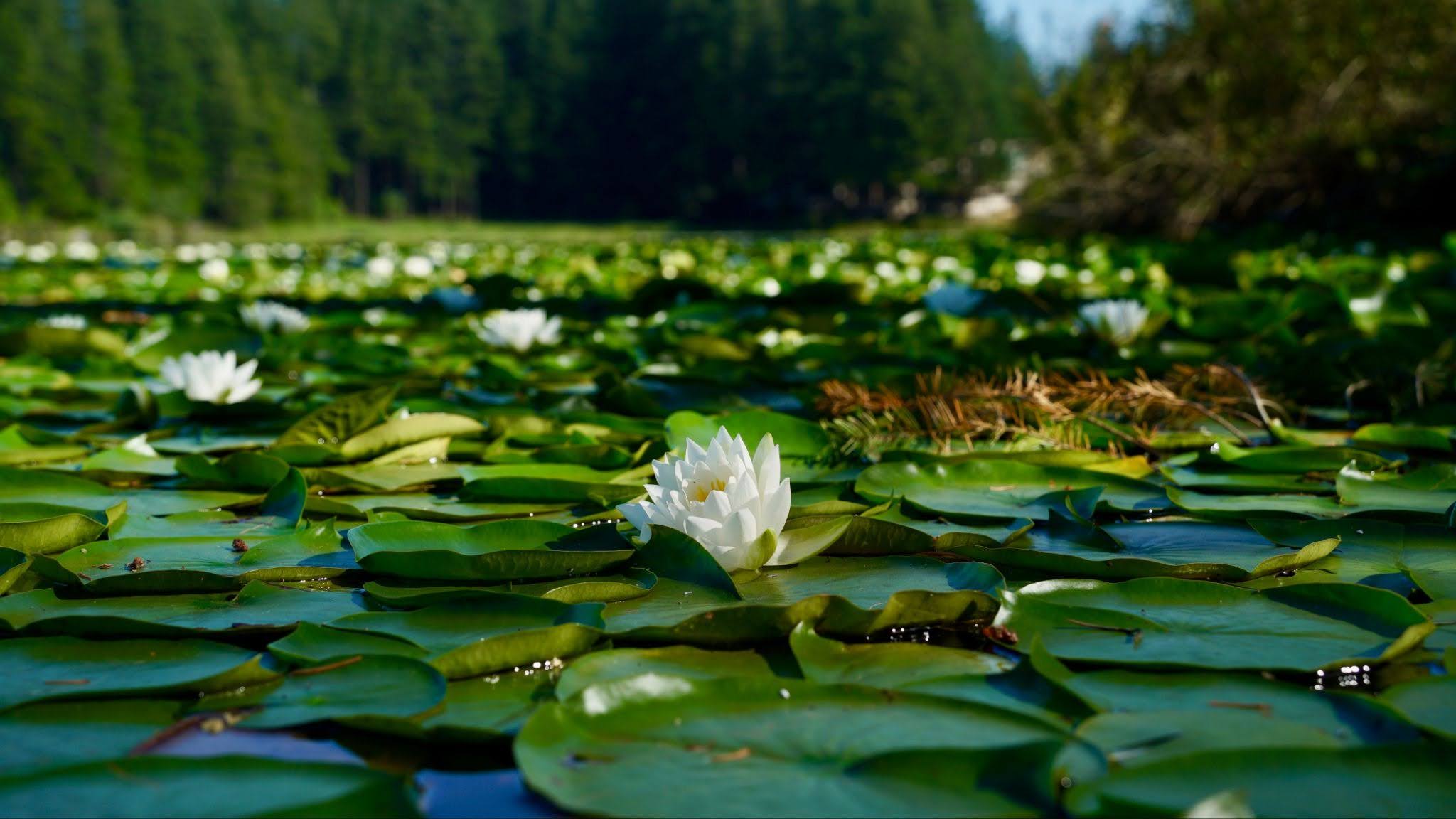
The invasive fragrant waterlilies blanketing Lake Louise in Sudden Valley are spreading again, and the community's homeowners association has approved a herbicide treatment that is drawing questions from residents who live near the lake, as well as from anyone who drinks Bellingham's tap water. The treatment is planned for October, using a glyphosate-based product applied by a professional aquatic management company.
Lake Louise sits in the Sudden Valley residential community in the hills southeast of Bellingham, within the Lake Whatcom watershed. Lake Whatcom is the primary drinking water source for the City of Bellingham and its surrounding service area. The proximity of the two water bodies, separated by fewer than 2,850 feet at their closest points, has put the planned herbicide application at the center of a neighborhood and water quality debate.
The Waterlily Problem and What It Is Doing to the Lake
Fragrant waterlilies are considered an invasive species in western Washington. Native to parts of Europe and Asia, they spread aggressively in the still and slow-moving waters of lakes and ponds, forming dense mats of lily pads that shade out native aquatic vegetation, reduce dissolved oxygen levels, and degrade habitat for fish and wildlife.
At Lake Louise, the infestation has reached a point where the bird sanctuary on the southeast end of the lake is so thickly covered that waterfowl commonly seen there in cooler months are now absent. Access to the water from two beaver lodges at the north end has also been blocked by the lily pads. The Sudden Valley Community Association said in an approval memo that "the current overgrowth has now impacted water quality, recreational use and aesthetic values of Lake Louise."
The scientific data backs up that assessment. Research by members of Western Washington University's Lake Whatcom Quality Team, published in the journal Aquatic Sciences in April 2025, found that the waterlilies would approximately double the amount of dissolved organic matter in Lake Louise over summer months. Data from WWU's Institute for Watershed Studies shows that dissolved oxygen in the lake fell roughly 26 percent between 2023 and 2024, dropping to 6.4 milligrams per liter. Most fish species cannot survive below 6.5 mg/l, meaning the lake is approaching the threshold for a significant fish kill if the trend continues.
Thomas Riley, a Sudden Valley resident who fishes Lake Louise several times a week, has noticed the effects firsthand. "This lake is weird," he said. "There are days when I get a 4- to 5-pound bass, but the other day I got one that was only about 6 inches." The waterlilies make it difficult to track what is happening beneath the surface, he said.
The Herbicide Plan and Its Risks
The Sudden Valley Community Association's board approved spending up to $8,400 for the herbicide treatment, contracted to AquaTechnex, a Pacific Northwest aquatic management company with experience treating invasive aquatic plants across the region. The product they plan to use contains glyphosate, the active ingredient in Roundup and the most widely used herbicide in the world.
AquaTechnex has acknowledged in writing that "glyphosate has a drinking water restriction that states potable water intakes from the lake should be turned off for 48 hours if they are within a half mile of the treatment area." The company added that Lake Louise's proximity to Lake Whatcom would make that restriction applicable.
The company also stated that "very little herbicide is actually getting into the water when applied to the lily pads" and that what does enter the water is broken down over time by microbial activity and sunlight. However, the U.S. Environmental Protection Agency notes that glyphosate breaks down more slowly in cool water, and the planned October treatment window coincides with declining water temperatures in the Pacific Northwest.
Bryan Burke, a Sudden Valley resident who has been fighting the waterlilies for years through physical removal, raised a timing concern. "This strikes me as nuts," he said, noting that the lilies begin to die off naturally in mid-September and are mostly dead by late October. Applying herbicide to plants that are already dying may reduce the product's effectiveness and extend the period during which glyphosate is present in the water without delivering the intended ecological benefit.
Manual Removal and Its Limits
Burke has organized volunteer crews to wade into the lake and manually remove waterlily rhizomes, the thick underground stems through which the plants spread and regenerate. The area near the Welcome Center that his team worked on is noticeably less dense this year, demonstrating that the method can work. But he estimated it would take at least 40 volunteers working once a week from May through September to make a meaningful dent in the full infestation. In practice, he had nine helpers in his best week and only four who continued for a few weeks after that.
The association's memo noted that "manual eradication of the water lilies was attempted for two summers with limited success," a characterization that reflects the scale of the problem relative to the volunteer capacity available. AquaTechnex brings professional equipment and expertise, but the herbicide approach comes with the water quality questions that manual removal avoids.
What Bellingham Residents Should Watch
The connection between Lake Louise and Lake Whatcom runs through a weir that periodically opens to Austin Creek, which drains into Lake Whatcom. A letter published in the Sudden Valley community newsletter last year questioned whether the Lake Whatcom Quality Team at Western Washington University had been consulted about the herbicide treatment given that drainage pathway. The association's response was that AquaTechnex is a professional company with extensive Pacific Northwest experience.
For Bellingham residents whose drinking water comes from Lake Whatcom, the planned October treatment is worth following. The City of Bellingham manages the Lake Whatcom watershed and monitors water quality at the intake. Residents with questions about the treatment and its potential effects on drinking water can contact the city's Public Works department. For background on watershed science in the region, earlier coverage of Bellingham's Padden Creek water use study offers useful context on how the city is thinking about water management challenges heading into drier future summers.