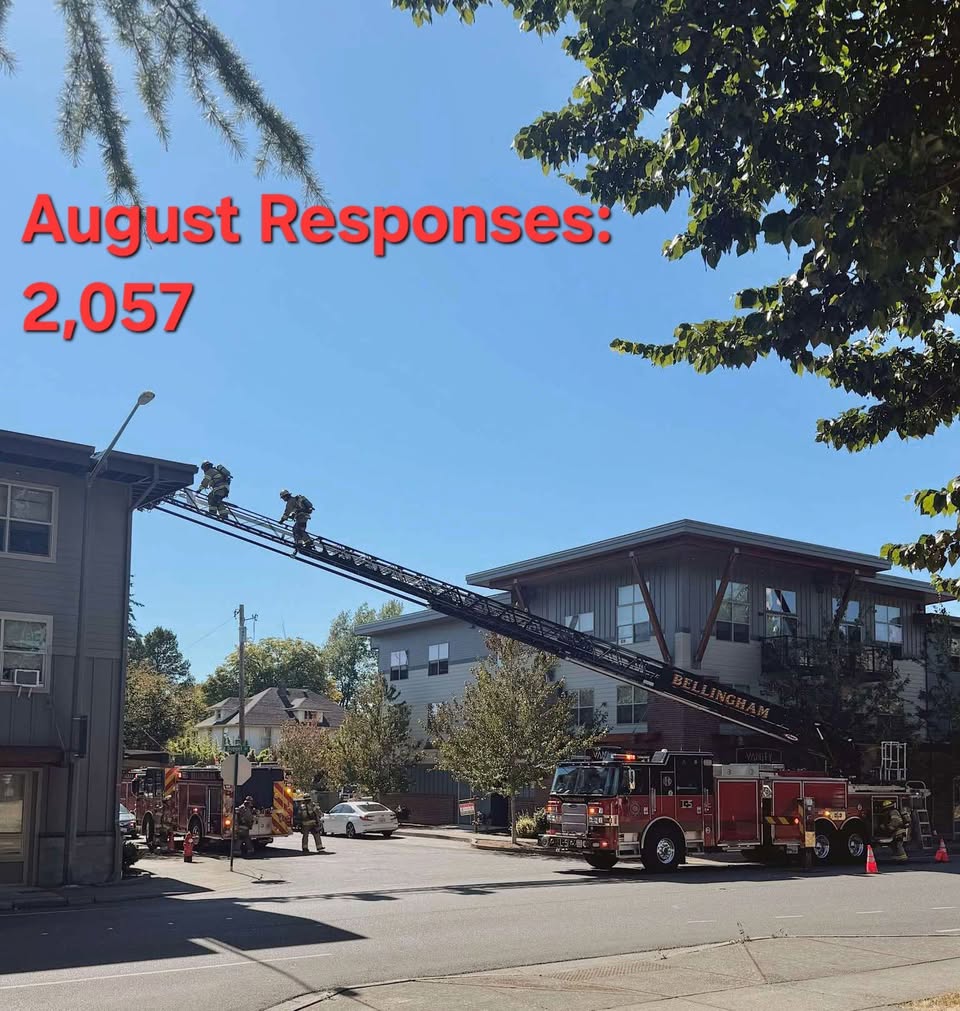
The Bellingham Fire Department logged 2,057 calls for service in August 2026, keeping crews busy across all four of their response categories throughout the month, according to figures released by the department on its official social media channels.
Of those calls, 1,595 were emergency medical services responses, making EMS the dominant workload by a wide margin. Fire responses accounted for 337 calls, while the department's Community Paramedic program handled 89 calls. The remaining 36 fell into an "other" category covering a range of non-emergency and specialty responses.
Where the Numbers Stand Year-to-Date
Through the end of August, Bellingham Fire crews have responded to a cumulative 16,096 calls for service since January 1, 2026. That pace puts the department on track to exceed 24,000 calls by year's end, a workload that reflects both the city's growing population and the expanding scope of services modern fire departments are asked to provide.
Bellingham has grown steadily over the past decade. The City of Bellingham now has a population approaching 95,000, making it the largest city in Whatcom County and one of the fastest-growing mid-sized cities in Washington state. That growth puts consistent pressure on emergency services to scale staffing, equipment, and specialized programs to meet demand.
The 2026 numbers also reflect the post-pandemic normalization of emergency call volumes. During 2020 and 2021, EMS calls dipped in some categories as residents avoided hospitals and delayed care. The steady upward trend since then is consistent with national patterns for urban fire departments serving growing communities.
Community Paramedic Program Fills a Distinct Role
The 89 Community Paramedic responses in August deserve a closer look. The Community Paramedic program is designed to bridge the gap between emergency medical care and social services, reaching residents who frequently call 911 for non-emergency needs or who lack access to routine health care.
Rather than dispatching a full engine company to situations that do not require immediate emergency intervention, the Community Paramedic model sends a specially trained paramedic who can connect callers with mental health resources, addiction treatment, housing assistance, and follow-up medical care. The goal is to reduce repeat 911 calls and improve health outcomes for Bellingham's most vulnerable residents.
The program reflects a broader shift happening in fire departments across the Pacific Northwest, where agencies are increasingly being asked to serve as a front line not just for fires and medical emergencies but for the social and behavioral health crises that drive a significant share of 911 call volume. Departments in Seattle, Tacoma, and Spokane have implemented similar models, and Bellingham's program has drawn interest from smaller Whatcom County agencies looking to develop comparable capabilities.
What the Fire Response Breakdown Tells Us
The 337 fire responses in August came during a month that brought elevated fire weather conditions to western Washington. Whatcom County Emergency Management maintained a Stage 2 burn ban throughout much of the month, prohibiting all outdoor burning amid very high fire danger ratings in both the lowlands and the Cascades. The ongoing Ptarmigan Fire near Ross Lake also drew regional attention, though the Bellingham Fire Department was not directly involved in that incident.
Nationally, fire departments track the ratio of fire responses to total calls as one measure of how their workload has shifted over time. Decades ago, structure fires made up a much larger share of responses. Today, EMS calls dominate at most urban departments, with fire responses representing roughly 15 to 20 percent of total volume. Bellingham's August numbers fit that pattern, with fire responses making up about 16 percent of the total call volume.
The department serves the City of Bellingham from multiple stations strategically located across the city's neighborhoods, from Sehome and Samish to Birchwood and Alabama Hill. Response time performance depends on maintaining adequate staffing at all stations, which is one reason the department tracks call volume data closely each month.
What Residents Should Know
For the public, the monthly call data is a useful reminder of the range of services Bellingham Fire provides. If you smell smoke, see flames, or face a medical emergency, 911 remains the right first call. But for situations involving a neighbor in a mental health crisis, an elderly resident who keeps calling for non-emergency help, or someone struggling with substance use disorder, the Community Paramedic program can be a more appropriate and effective resource.
Residents who want to learn more about the full range of Bellingham Fire services can visit the department's information pages through the city. The Northwest Clean Air Agency also maintains current burn ban status and air quality information relevant to fire risk conditions in Whatcom County.
The department acknowledged photo credit to Meighan McWilliams for the imagery accompanying its August report. A look at earlier 2026 staffing and training news, including the five firefighters who earned paramedic certification this spring, offers useful background on how the department has been building its advanced life support capacity heading into a busy response season.