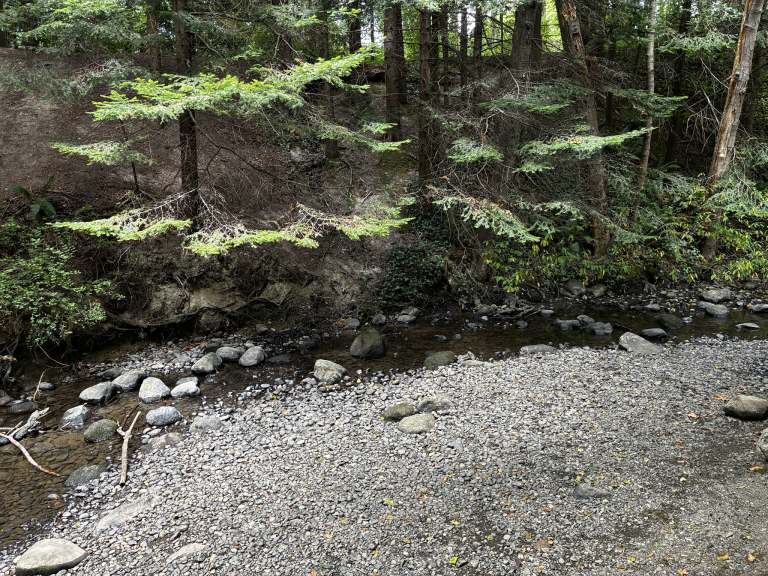
Padden Creek has been barely a trickle since early July. Even at its confluence with Connelly Creek in Bellingham's Happy Valley neighborhood, one of the points where the stream system is at its widest, the water level has dropped to a state that concerns ecologists, educators, and city planners alike. Now, the City of Bellingham is formally studying whether it can do something about it.
The city is working on a water budget that investigates the feasibility of using more water from Lake Padden to boost streamflows in Padden Creek, according to Jason Porter, the city's public works surface water manager. That study is expected to be completed in November. The findings will shape decisions about how Bellingham manages the balance between recreational use of Lake Padden and the ecological health of the creek that drains from it.
Why Padden Creek Is Running Dry
The creek's summer low flows are not a new problem, but they are getting worse. Bellingham's summer precipitation totals have declined approximately 8 percent per decade since the 1960s, according to Karin Bumbaco, deputy state climatologist at the Washington State Climate Office. Compounding that trend, much of western Washington has been in drought for the past four years, and dry soils rapidly absorb whatever rain does fall before it can run off into streams.
Outflow from Lake Padden is controlled by a concrete dam at the lake's northwest edge, a remnant of the era when South Bellingham used the lake as a reservoir for drinking water, a system that operated from the early 1900s until 1968. During wetter months, the lake spills over that dam and water flows into the creek at higher levels. But in early to mid-summer, the lake typically stops spilling, and the creek loses its primary source of consistent flow.
Several other factors have changed since the dam was built. Overall temperatures in the Pacific Northwest have risen between 1.5 and 4 degrees Fahrenheit since the late 1890s, depending on location. Higher air temperatures warm stream water, which is particularly damaging for salmon and trout when flows are already low. Padden Creek runs through a watershed that, prior to development, contained extensive wetlands in what is now the Happy Valley neighborhood. Those wetlands historically contributed water to the stream system throughout the summer. That natural buffering capacity is largely gone.
What's at Stake for Salmon and Schools
Padden Creek is home to chum, coho, and Chinook salmon, as well as steelhead and cutthroat trout. Each of these species has different requirements for how long they need flowing water in their nursery streams after hatching. Coho stay in their nursery creeks for up to a year. Chinook salmon and steelhead trout may remain for up to three years before heading to the ocean. Chum salmon leave within a few months of hatching.
The practical consequence of those timelines is that reduced summer flows do not just affect spawning adults. They affect juvenile fish that need consistent water quantity and quality for months or years. Salmon need water temperatures between 50 and 65 degrees Fahrenheit to survive, as that range holds the dissolved oxygen their bodies require. Shallow pools with warming water can become death traps for juvenile fish that have no way to move to cooler, deeper water.
Wendy Scherrer, who leads school-based Salmon in the Classroom Programs in 21 Bellingham schools and formerly directed the Nooksack Salmon Enhancement Association, has been watching Padden Creek's condition for decades. She noted that the programs using Padden Creek for salmon releases have gradually switched from coho to chum over the past 20 years, partly because chum's shorter residence time in streams reduces the exposure of young fish to low summer flows. That adaptation is a workaround, not a solution.
"We need to balance both recreation values and ecosystem values in our Bellingham lakes and creeks," Scherrer said. She described seeing dead salmon fry floating on the surface of Padden Creek about 15 years ago, downstream of Interstate 5, near the site of a major tunnel removal that daylighted a section of the creek in 2015.
The City's Study and What Comes Next
The water budget study the city is now conducting will assess whether releasing more water from Lake Padden through or around the existing dam is technically feasible and what the downstream impacts would be. That includes both the ecological benefits to the creek and any effects on the lake itself, which serves as a major recreational resource for Bellingham residents. Lake Padden Park, which surrounds the lake, opened in 1972 and draws thousands of visitors each year for swimming, fishing, and trail use.
The study's November completion date means decisions about any operational changes would come in late fall or winter, likely well before the following summer's critical low-flow period. If the city determines that managed releases are feasible, implementation could potentially begin in summer 2027.
According to the Wild Salmon Center, maintaining adequate streamflows in urban watersheds is one of the most effective interventions available for protecting salmon populations in developed areas. Padden Creek, running through the heart of South Bellingham and ultimately emptying into Bellingham Bay, represents exactly the kind of urban watershed where managed flow augmentation can make a meaningful difference.
For residents who want to stay engaged with this issue, the City of Bellingham Public Works department publishes updates on watershed management projects. The November study deadline is a key date to watch. Separately, this week's "Sharing Our Water" event at the Whatcom Museum on September 4 includes panels and discussions that directly address the waterways these questions involve, and is free to attend. More on that event and its connection to local water policy is available in coverage of the Free First Friday programming.