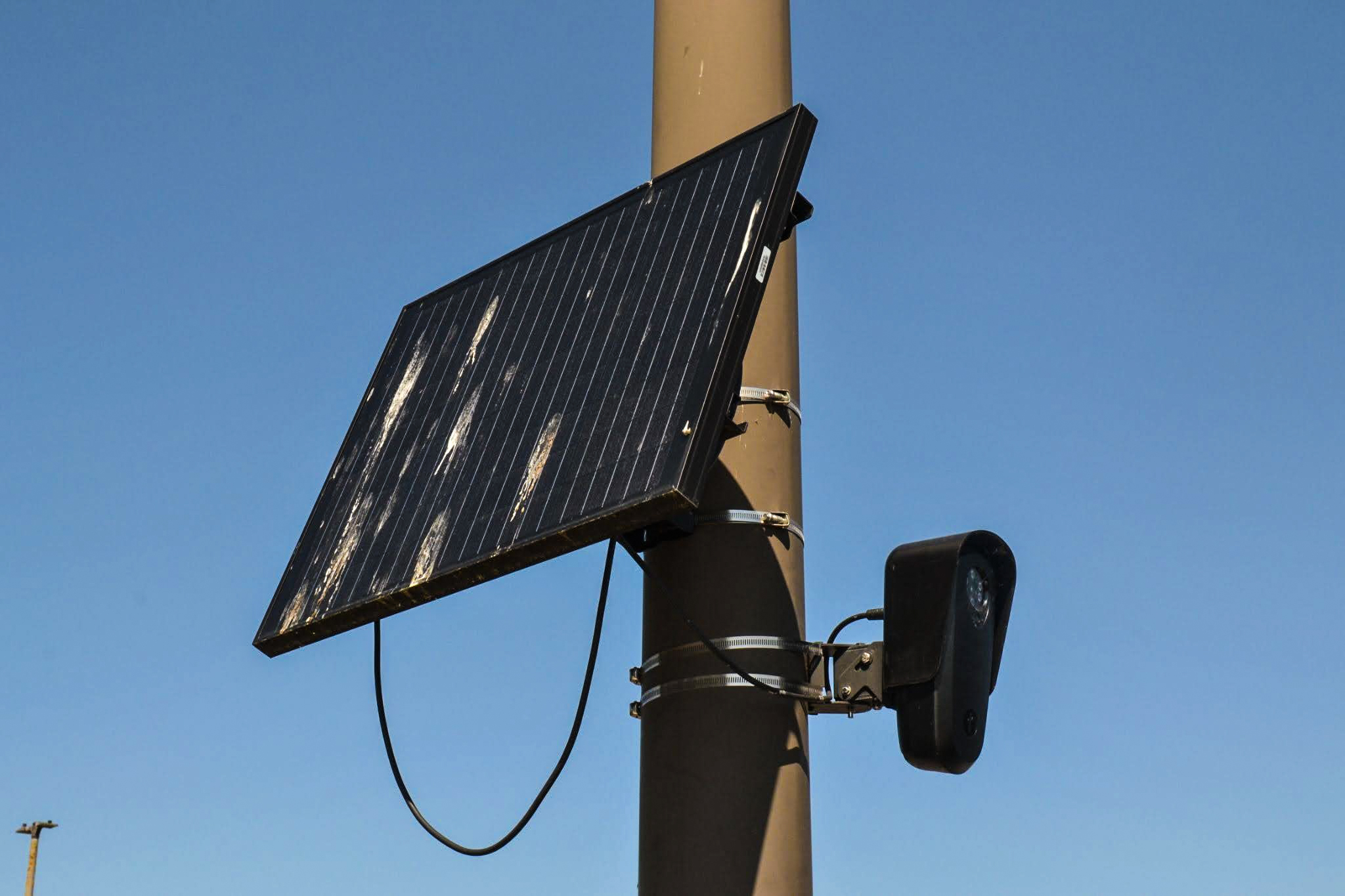
Two automated license plate recognition cameras at a Bellingham Home Depot were cut down this summer by an anonymous resident, part of a rapidly spreading national trend in which people use power tools to destroy the metal poles supporting the devices, often recording the action and posting it online where the videos regularly attract millions of views.
The cameras at the Home Depot on Telegraph Road were manufactured by Flock Safety, the dominant company in the automatic license plate reader market. The act of destruction reflects deep frustration among privacy advocates and ordinary residents about the proliferation of surveillance infrastructure that tracks vehicle movements without any mechanism for opting out.
What These Cameras Do and Why People Are Angry
Automatic license plate recognition cameras use artificial intelligence to scan every vehicle that passes within their field of view, recording make, model, license plate number, and even distinctive features like unique bumper stickers. That data is aggregated into a searchable database of vehicle movements over time.
For privacy advocates, the core objection is not just that the cameras exist but that they create permanent records of where people go without any consent or notification. Unlike a toll camera that captures a specific transaction, license plate readers are always on, recording movements of every vehicle regardless of whether the driver has done anything wrong or even been aware of the camera's presence.
David Birdsong, a Bellingham resident and software engineer who spoke to Salish Current about the issue, put it plainly: "The lack of awareness and lack of consent, and the broad vacuuming (of data) is a whole new realm of dystopia."
Birdsong also raised concerns about Flock's corporate connections. Flock Safety's investors include Peter Thiel's Founders Fund, which played a significant role in a $275 million fundraising round in 2025. Thiel is also a co-founder of Palantir, a data analytics company with deep contracts in government surveillance. "Flock and Palantir are very close," Birdsong said. "Palantir reaches into every single thing they can get their hands on, including our voter data, our tax data, our tax history."
The Scale of Flock's Presence in Washington
The site DeFlock, launched in 2024, provides a real-time map of every known active license plate camera in the United States and has become a central resource for those tracking the cameras' spread. According to DeFlock's data, over 94,000 of the roughly 114,000 license plate cameras in the United States are Flock cameras. In Washington State, 1,520 of the 1,676 total tracked license plate cameras are Flock devices.
Indigo Olson, a member of the Bellingham group Flock Off Bellingham, uses DeFlock to track local camera installations. They noted the timing: "It's interesting to see, right as we've been ramping up our efforts, that we happen to be coinciding with this national movement."
A 2025 audit of Flock's network activity raised additional alarms when researchers at the University of Washington found that the United States Border Patrol Agency accessed license plate camera data collected by at least 17 agencies in Washington State. In most of those cases, Border Patrol agents accessed the information without authorization from the agencies whose cameras generated the data. Ten of the 17 agencies had not permitted federal immigration enforcement to access their data. The finding has particular significance in Whatcom County, which sits on the Canadian border and has a significant presence of Border Patrol agents.
Washington's New Driver Privacy Act
Washington State took a step toward regulating automatic license plate readers with the Driver Privacy Act, which takes effect September 26, 2026. Law enforcement agencies have until that date to comply with the new requirements, which include obtaining a warrant before accessing data from private license plate readers. The act also imposes restrictions on data retention and sharing.
Privacy advocates see the Driver Privacy Act as a meaningful step but not a complete solution. The law regulates how police access data from private cameras, but it does not require the removal of cameras or prevent private businesses and organizations from installing them. The Home Depot cameras that were cut down were on private property, meaning decisions about whether to reinstall them rest with the business.
Flock Safety has maintained that its systems have never experienced a data breach by outside attackers. Critics point out, however, that the documented improper access by law enforcement personnel, including the cases in which officers used Flock data to stalk romantic interests, represents a different category of security failure, one that no data security guarantee can fully address.
For Bellingham residents concerned about surveillance in their community, the local group Flock Off Bellingham has been active in mapping cameras and organizing around privacy issues. The broader national movement that has made camera-destruction videos viral content reflects a segment of the public that has decided direct action is a more satisfying response than waiting for regulatory solutions. Whatever one thinks of cutting down cameras as a tactic, the underlying concerns about surveillance infrastructure in public spaces are ones that Whatcom County residents across the political spectrum have reason to take seriously. For more on local civic and governance issues in Bellingham, see coverage of Whatcom County's plans for a new jail facility.