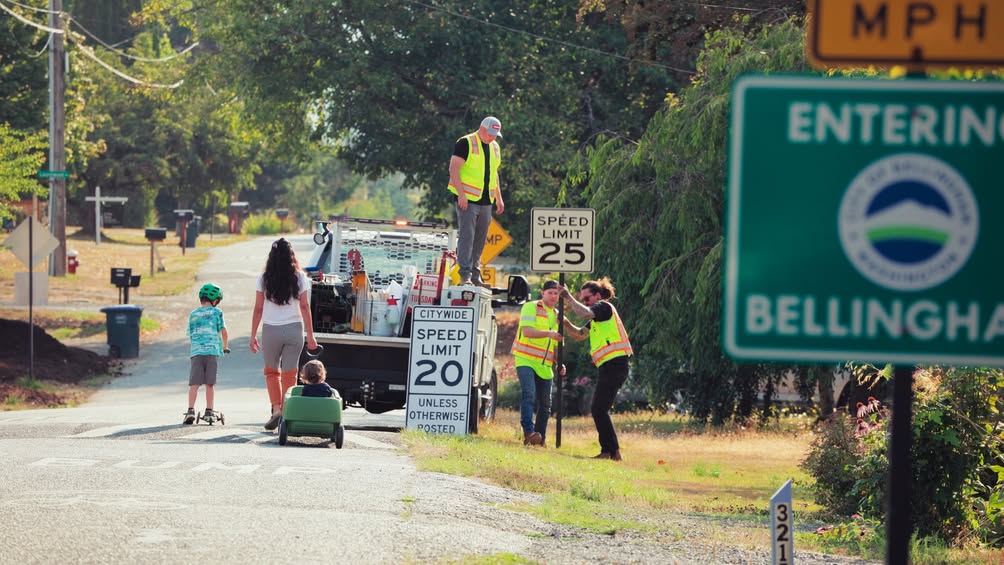
Drivers in Bellingham will need to ease off the accelerator starting this week. The City of Bellingham began installing new 20 mph speed limit signs on residential streets and throughout downtown on Tuesday, August 25, marking the start of a significant shift in how the city manages traffic speeds in neighborhoods and commercial corridors where people walk, bike, and gather.
The change was announced by the City's Public Works Department and written by Communications and Outreach Coordinator Connor Harron. Public Works Director Joel Pfundt framed the policy as a shared responsibility between the city and its residents. "We're lowering speed limits because slower speeds protect people," Pfundt said. "Slowing down is a shared responsibility, and it's an important way we can help keep our friends, family, coworkers, and neighbors safe."
What Streets Are Affected and When
The new 20 mph default applies to two categories of streets in Bellingham. The first category is non-arterial residential streets, meaning the local access roads that run through neighborhoods rather than the major arterials like Meridian Street, Bakerview Road, or Iowa Street. On these residential streets, the 20 mph limit now functions as the default even where no posted sign is visible. The second category is downtown Bellingham's business district, where the lower speed limit also now applies.
The City noted that traffic signals in the downtown core are already timed to 20 mph, meaning drivers who follow the signals as intended should already be traveling at roughly that speed between intersections. The signal timing change means residents who drive downtown regularly may not notice a dramatic difference in travel time if they are already following light cycles.
Arterial streets, which carry higher volumes of traffic across longer distances, are not included in this initial change. Roads like Samish Way, Sunset Drive, or Woburn Street retain their current posted limits. The change targets the slower-paced grid of neighborhood streets where children walk to school, residents bike to parks, and pedestrians cross without signals.
Why Bellingham Is Making This Change
The reasoning behind lower urban speed limits is well-documented in traffic safety research. At 30 mph, a pedestrian struck by a vehicle faces roughly a 45 percent chance of dying. At 20 mph, that fatality risk drops to under 10 percent. The physics of a crash change significantly with even modest reductions in speed, and cities across the country and around the world have moved toward lower default limits in areas with high pedestrian and cyclist activity.
Bellingham has been working toward this kind of change as part of broader transportation safety goals. The city's Complete Streets policies, adopted in recent years, prioritize designing and managing roads to work for all users, not just drivers. Lowering speed limits on residential streets aligns with that framework and with the city's goals around reducing serious injuries and fatalities in traffic crashes.
Nationally, the movement toward 20 mph zones in residential areas has gained significant momentum. New York City, Boston, and dozens of smaller cities have implemented similar or lower default speeds in residential districts and have seen measurable reductions in crash severity. In Washington state, Bellingham is among the cities moving early on this approach.
What Residents and Drivers Should Know
For most Bellingham residents, the practical impact of the change will be modest on any individual trip. On a typical residential block, the difference between driving 25 mph and 20 mph adds only a few seconds to travel time. The larger shift is behavioral: drivers moving through a neighborhood at 20 mph have more time to react to a child who runs into the street, a cyclist who is slower than expected, or a dog that pulls its leash into the road.
The City is installing new signs to make the new limits visible and enforceable. Drivers should expect to see 20 mph signs appearing on residential streets across all neighborhoods over the coming days and weeks as crews complete installation. The City of Bellingham's official announcement includes additional detail on which streets are covered and the phasing of the sign installation.
Enforcement is handled by the Bellingham Police Department. The department has not announced a specific grace period or enforcement ramp-up plan, but drivers should treat the new limits as in effect immediately once signs are installed on their street.
For cyclists and pedestrians, the change is straightforwardly good news. Bellingham's network of neighborhood streets is the primary route for most non-motorized travel, and lower vehicle speeds reduce the consequence of any conflict between a driver and a person on foot or on a bike. The City of Bellingham's transportation pages cover the broader network of bike routes, pedestrian improvements, and street projects underway across the city.
For context on other recent transportation changes in the area, Whatcom Transit's recent bus route overhaul serving Western Washington University also reshaped how many residents move through the city's street grid.