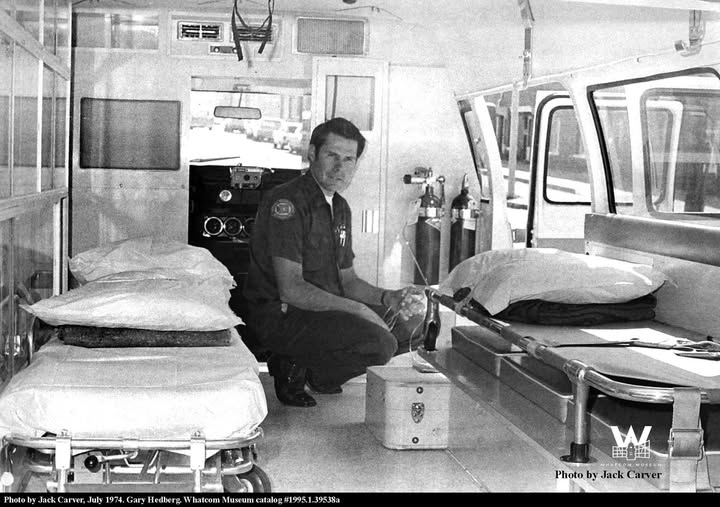
A black-and-white photograph published in the Bellingham Herald on July 26, 1974, shows Firefighter Gary Hedberg leaning into a demonstration model ambulance, checking supplies. The county was considering purchasing the unit for its city-run ambulance service. Flash forward to this week, and a Bellingham Fire Department paramedic is doing almost exactly the same thing: inspecting the supplies loaded into one of the department's newest paramedic units. The image is nearly identical. The reality behind it is transformed.
Where It Started: 1974 and the Push for Modern EMS
In the early 1970s, emergency medical services in most American cities were at a turning point. The 1966 National Academy of Sciences report "Accidental Death and Disability: The Neglected Disease of Modern Society" had exposed how poorly equipped the country was to handle trauma and cardiac emergencies outside hospital walls. Bellingham and Whatcom County were not exceptions. The push to acquire and staff dedicated ambulances was part of a national wave of change that fundamentally reoriented how fire departments thought about their mission.
That 1974 photograph captures Firefighter Hedberg in a moment of evaluation, a department weighing an investment in equipment that would define its next chapter. The ambulance being considered would have been a significant step up from what most departments were operating at the time, often repurposed hearses or basic transport vans with limited medical capability.
The City of Bellingham has operated municipal fire and emergency services for well over a century, with the department evolving steadily from a volunteer bucket-brigade era to today's full-service professional department covering not only fire suppression but advanced pre-hospital medicine.
What Has Changed in Half a Century
The mission, as the Bellingham Fire Department put it this week, remains the same: provide emergency medical care to the community. But nearly everything else about how that mission is carried out has changed dramatically.
Modern paramedic units carry equipment that would have seemed like science fiction to Firefighter Hedberg in 1974. Today's rigs are stocked with 12-lead electrocardiogram monitors capable of transmitting heart data to a receiving hospital before the patient even arrives. Paramedics carry medications for cardiac arrest, stroke, severe allergic reactions, and pain management. They carry video laryngoscopes for difficult airways, portable ultrasound in some systems, and point-of-care blood glucose testing. The ambulance itself is built to specific federal standards for crew protection, patient workspace, and equipment mounting.
The people staffing those units have changed just as dramatically. In 1974, many ambulance crew members had basic first aid training at best. Today's paramedics complete roughly 1,200 to 1,800 hours of training before certification, including clinical rotations in emergency departments and intensive care units. In March 2026, the Bellingham Fire Department celebrated five of its own firefighters earning Advanced Life Support certification after an 18-month training program, an indication of how seriously the department takes ongoing development of its medical capability.
For a deeper look at that milestone, the story of those five new paramedics illustrates exactly how much goes into building a modern fire-based EMS system.
The Human Side of an Evolving Service
What the department's then-and-now post captures well is not just a technology story. It is a story about institutional continuity. The act of checking supplies before a shift is one of the most fundamental rituals in emergency services: a quiet, methodical accounting of what is on hand in case everything goes wrong. It has not changed in 50 years, even as everything inside those bags and cabinets has.
Bellingham Fire responds to thousands of calls per year, the majority of which are medical rather than fire-related. That ratio has held true for decades across North American fire departments as building codes improved, smoke detectors became standard, and cardiovascular disease, overdoses, and fall injuries generated rising call volumes. The department today is, in practical terms, a medical response agency that also fights fires, rather than the reverse.
The National Highway Traffic Safety Administration's Office of EMS tracks the evolution of emergency medical services nationally and notes that the field has undergone more transformation in the last 50 years than in all prior history combined. Bellingham's trajectory reflects that national arc closely.
What Comes Next for BFD
Bellingham Fire has continued to invest in its paramedic program in recent years. The department operates multiple advanced life support units across its stations, and city budget discussions in recent cycles have centered on maintaining staffing levels sufficient to keep those units in service around the clock. As Bellingham grows, particularly on its northern and eastern edges where new development has added call volume, the pressure on response capacity only increases.
The next 50 years will likely bring continued advances in pre-hospital care, from telemedicine links that allow emergency physicians to guide paramedics in real time, to community paramedicine programs where crews make preventive home visits to high-risk patients between emergencies. Bellingham, like departments around the country, is already exploring some of these models.
For now, the image of a paramedic checking a drug box in 2026 next to a 1974 photo of Firefighter Gary Hedberg doing the same thing is a useful reminder: the tools and training have leapt forward, but the commitment has stayed steady. You can follow Bellingham Fire Department updates through the City of Bellingham at cob.org.