A new self-guided cycling route is inviting Bellingham residents and visitors to experience the city's Indigenous cultural heritage from the seat of a bicycle. The Salish Tribute route, created by Sarah Birch through her project BIKE Bellingham, winds 25 miles through the city and connects 18 public art installations honoring the history, art, and ongoing stewardship of the Coast Salish peoples, including the Lummi Nation and the Nooksack Tribe. The service is completely free to use.
The route launched this past spring and is the latest in a growing collection of themed bike tours Birch has developed since founding BIKE Bellingham through her LLC, Curioocity. Each route pairs a GPS-guided path with downloadable audio and visual navigation so riders receive turn-by-turn directions and contextual information about each stop during the ride, turning a regular Bellingham outing into something closer to a living field trip.
What the Route Covers
Riders begin at Waypoint Park on the Bellingham waterfront, where they access the route through a GPS app provided by BIKE Bellingham. The full 25-mile loop takes between three and five hours to complete at a relaxed pace, though a shortened 13-mile version called the Salish Tribute Lite allows riders to skip three of the more distant installations: the "It's Mine" Story Pole at Bellingham International Airport, the ININYAX'A7N (Thunderbird) sculpture at Whatcom Community College, and the House of Healing at the Seahome Arboretum.
The 18 stops include some of Bellingham's most significant and visually striking works of public art. Near the starting point at Waypoint Park, riders encounter the first of three Indigiversal Collective mural installations in the waterfront area, located at the corner of Granary Avenue and Chestnut Street. These murals were created at the Noisy Waters Mural Festival across three consecutive years, 2023, 2024, and 2025, and represent the work of First Nation artists from across North America.
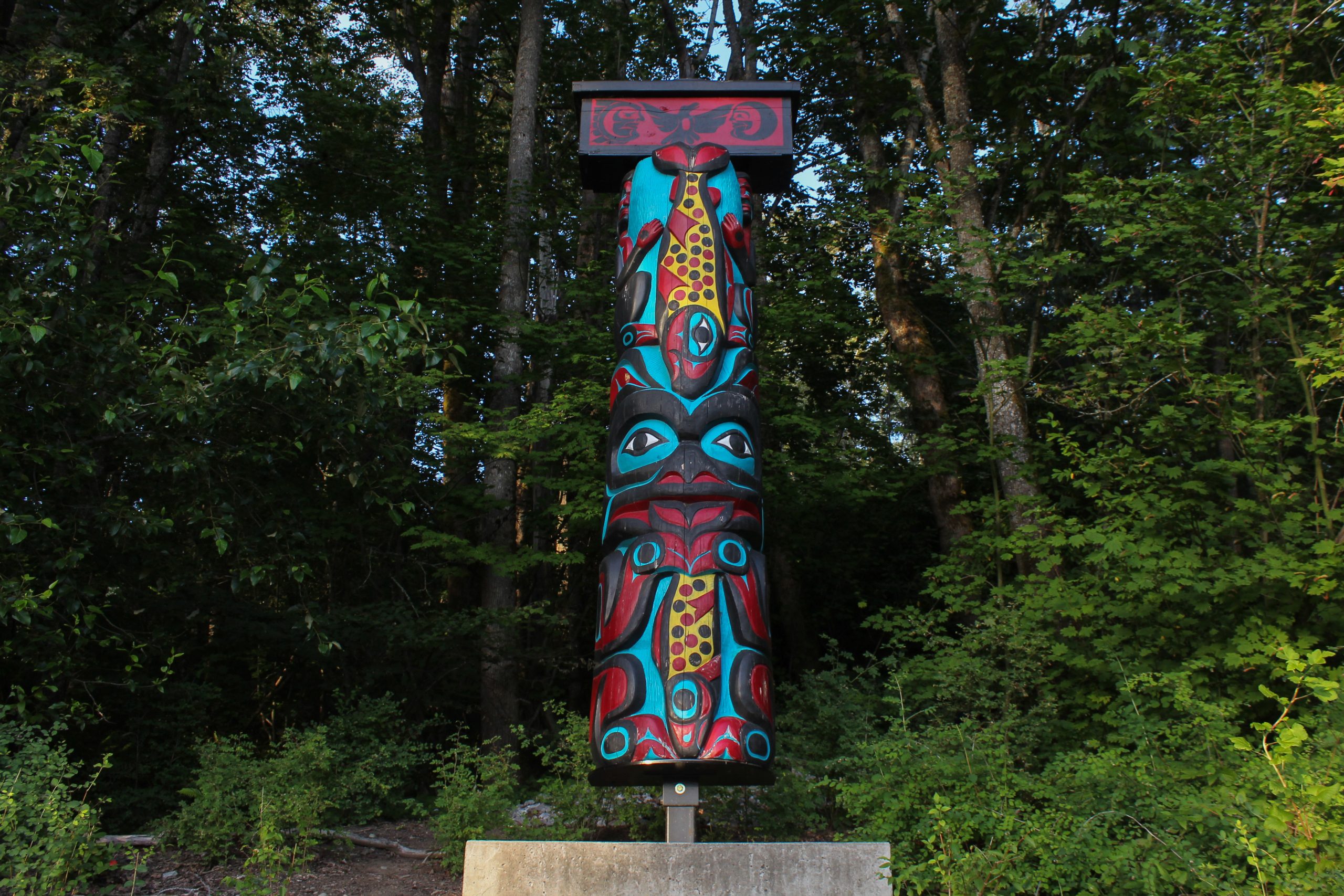
Further along the route, riders pass the Salmon Woman Story Pole created by Lummi House of Tears carvers in 1997, and the Coast Salish Living Mural at 210 West Holly Street, created in 2025 by artists Free Borsey (Tsx'vilum), Raven Borsey (Xwesultun), and Roy Nicol (De'sh'he'um). The route also takes riders to the Salmon Run mural along North Forest Street, a collaborative work by Gretchen Leggitt and Jason LaClair completed in 2021. LaClair has described it as the first piece of public art by a Coast Salish artist in Bellingham, and his message for riders is direct: "My message would be, number one, to appreciate this area we're in because our ancestors took such good care of it. But also, we need to protect the natural resources and protect the Salish Sea."
The Story Behind BIKE Bellingham
Sarah Birch spent 12 years traveling and leading cycling trips around the world before settling in Bellingham. After arriving, she wanted to keep the eyes of a traveler even while living in one place. "I very much have the eyes of a traveler," Birch said. "When I see something, I want to know the 'how,' the 'what,' the 'why,' the 'where,' and the story behind that thing."
With a background in designing bike tours for travel companies, Birch began creating custom routes for Bellingham that could give both new arrivals and long-time residents the experience of discovering the city as if for the first time. The Salish Tribute route required an estimated 40 to 60 hours of work per week from Birch since March, covering route design, audio production, research into each artwork and its creators, and coordination with the GPS navigation platform she uses to deliver the guided experience to riders.
The project is free to users by design. Birch built BIKE Bellingham as a community resource rather than a commercial product, aiming to make the routes accessible to anyone with a bike and a smartphone regardless of budget. That commitment to accessibility aligns with the spirit of the Salish Tribute route itself, which frames the city's Indigenous public art not as a niche interest but as essential context for anyone who lives here.
Why This Route Matters for Bellingham
Bellingham has invested significantly in public art honoring Coast Salish cultures over the past decade, and the Noisy Waters Mural Festival has accelerated that process in recent years by bringing First Nation artists to the waterfront each summer to create new works. The Salish Tribute route is the first effort to connect those scattered installations into a coherent, navigable journey that helps riders understand how they relate to each other and to the broader history of Lummi and Nooksack presence in this place.
The route's webpage frames its purpose directly: "Today, ecosystems are under strain, and communities continue to reckon with the legacy of colonization, exclusion and injustice. Centering Indigenous voices, honoring traditional knowledge and restoring our relationship with the Earth offer pathways toward healing."
For cyclists who have ridden past these murals and poles dozens of times without knowing their full context, the Salish Tribute offers a way in. The route is available now through BIKE Bellingham's website and app. Riders looking to make a day of it should plan to start at Waypoint Park, download the GPS route before setting out, and bring water for what is a moderately long urban ride. The full Salish Tribute route details, including the app link and a map of all 18 stops, are available at the BIKE Bellingham website. For more on Bellingham's Indigenous public art scene, see the Noisy Waters Mural Festival coverage from earlier this month.