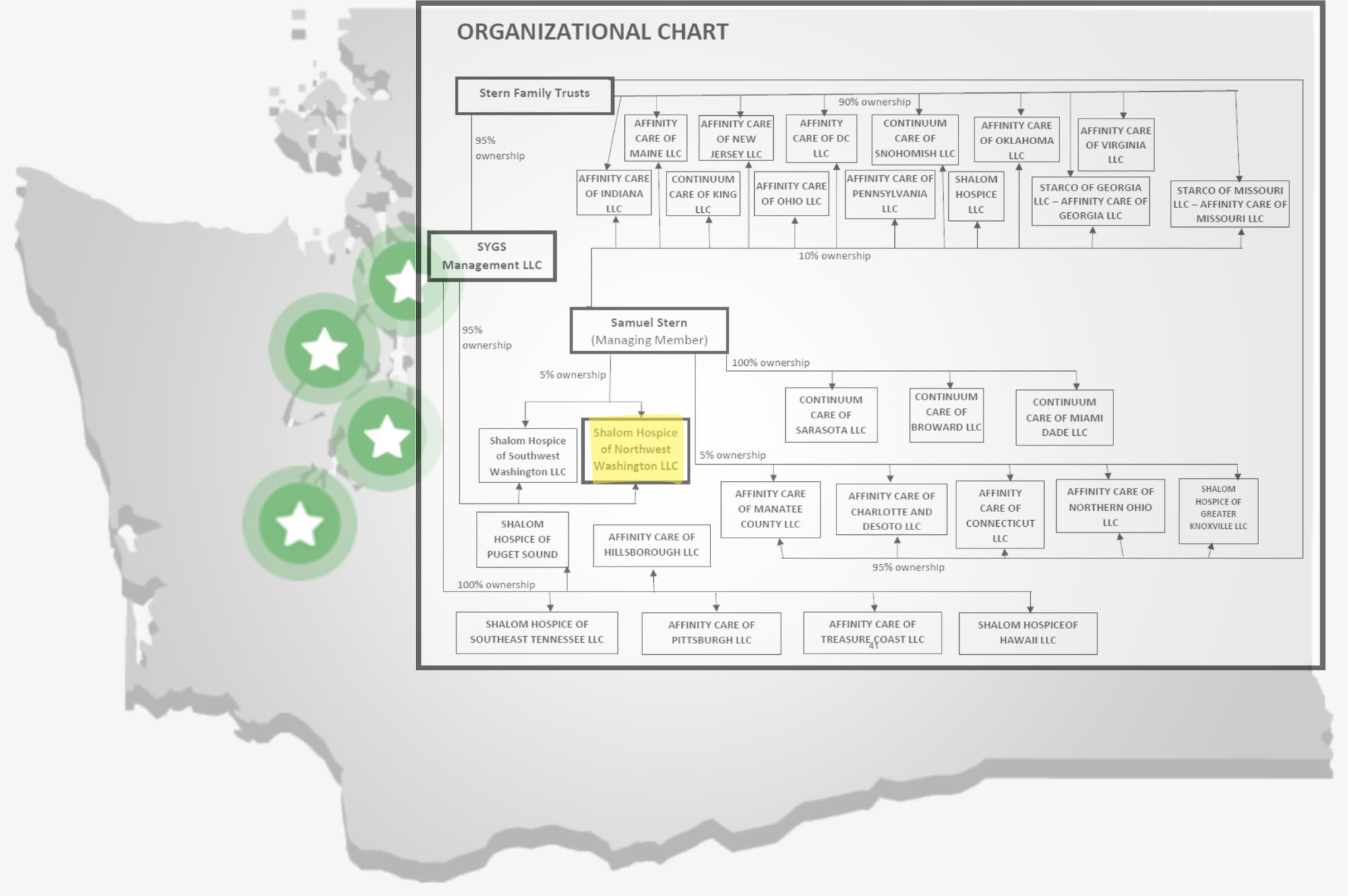
A new for-profit in-home hospice company has received Washington State approval to begin operating in Whatcom County, adding a provider to a market that some community members say does not need one. The company, Shalom Hospice of Northwest Washington, is tied to a broader network of out-of-state affiliates and plans to begin serving local patients by May 2027.
The Washington State Department of Health approved the company's certificate of need application in July 2026. Shalom Hospice is affiliated with companies connected to Samuel Stern and the Stern Family Trusts, which operate similar hospice operations in other states. The Whatcom County approval expands the Washington presence of those affiliated entities.
The Case Shalom Made to the State
To receive a certificate of need in Washington, a new hospice agency must demonstrate that the community it proposes to serve has unmet needs that existing providers are not addressing. Shalom Hospice argued in its application that Whatcom County's Jewish population has been underserved when it comes to culturally appropriate end-of-life care.
Specifically, the company said it would offer "culturally appropriate end-of-life care that honors Jewish traditions and rituals." It also stated plans to serve other populations it characterized as underserved, including LGBTQ+ individuals, people experiencing homelessness, and others who may face barriers to accessing conventional hospice services.
The application was not unopposed. Rabbi Joshua Samuels of Congregation Beth Israel, Whatcom County's main synagogue, submitted a public comment opposing the expansion. His objection was direct: he said he is not aware of evidence that Jewish residents of Whatcom County currently lack access to hospice care that respects Jewish practice or ritual.
"In my pastoral experience working with Jewish families during illness and bereavement over the past 15 years, local hospice providers, particularly Whatcom Hospice, have been attentive and responsive when religious needs or customs are raised," Rabbi Samuels wrote in his public comment to the state.
What the Approval Means for Whatcom County
Whatcom County's hospice landscape is not large. Whatcom Hospice, the county's primary nonprofit provider, has served the community for decades and is well established in both home-based and inpatient settings. The addition of a for-profit competitor raises questions that are familiar from other healthcare markets: will the new entrant draw from the same limited pool of patients, create staffing competition that strains both organizations, or genuinely expand access to people not currently being served?
Hospice is a Medicare and Medicaid-covered benefit for patients with a terminal diagnosis and a prognosis of six months or less if the disease runs its normal course. Patients who elect hospice care give up curative treatment in exchange for comfort-focused care at home or in a facility. In-home hospice, which is what Shalom proposes to offer, brings nurses, aides, social workers, chaplains, and other support to patients in their own residences rather than requiring them to move to a dedicated facility.
For Whatcom County families navigating end-of-life care, the approval means a new option will be available starting in spring 2027, assuming Shalom Hospice follows through on its timeline. The company will serve all of Whatcom County, not just the Bellingham city core, meaning rural and semi-rural communities including Lynden, Ferndale, Blaine, Birch Bay, and eastern Whatcom County will also fall within its service area.
Questions About For-Profit Hospice Models
The entry of for-profit hospice companies into local markets has drawn scrutiny from patient advocates and researchers nationally. Studies have found that for-profit hospice agencies on average spend less per patient on nursing visits, aide hours, and social work compared to nonprofit providers, while enrolling higher proportions of patients with longer-than-average prognoses, which generates more Medicare revenue per patient. The federal government has tightened hospice auditing in recent years in response to billing irregularities identified at some for-profit chains.
None of this necessarily predicts how Shalom Hospice of Northwest Washington will operate in Whatcom County. Certificate of need approval means the state concluded the company met the statutory requirements for demonstrating community need and organizational capacity. It does not guarantee quality of care, which is overseen separately through licensing surveys and Medicare certification processes administered by the Department of Health and the Centers for Medicare and Medicaid Services.
Families choosing between hospice providers are encouraged to ask detailed questions about staffing ratios, response times for after-hours crises, the availability of inpatient respite care, and whether the agency has faced any state or federal enforcement actions. The Medicare Care Compare website, maintained by CMS, publishes quality metrics for certified hospice providers and is a useful starting point for comparison.
As Shalom Hospice moves toward its projected May 2027 launch, residents can expect more information about its local operations, staffing, and intake process to become available. Anyone with questions about existing hospice options in Whatcom County can contact Whatcom Hospice directly or reach the Washington State Department of Health's licensing division for information about certified providers in the area.