As August temperatures climb across northwest Washington, residents in Whatcom County face an increased risk of ground-level ozone, a harmful air pollutant that forms when sunlight and heat combine with emissions from vehicles, lawn equipment, and common household products. Unlike the protective ozone layer high in the atmosphere, ground-level ozone forms right where people breathe, and the health consequences can be serious, particularly for children, older adults, and anyone with a respiratory condition.
How Ground-Level Ozone Forms
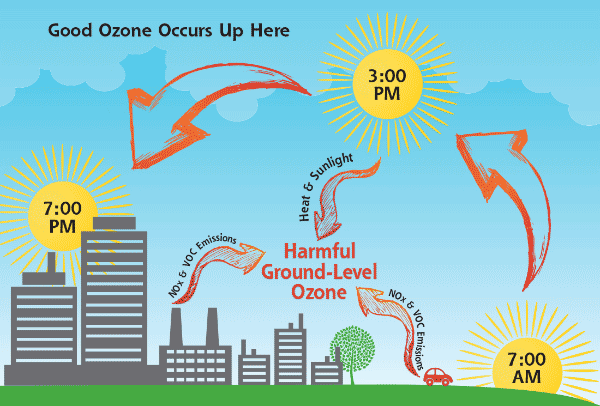
Ground-level ozone is not emitted directly from any single source. It forms through a chemical reaction: nitrogen oxides and volatile organic compounds, when exposed to sunlight and heat, react to produce ozone near the Earth's surface. The nitrogen oxides come primarily from vehicle exhaust, diesel engines, and industrial facilities. The volatile organic compounds come from a wider range of sources: gasoline vapors, oil-based paints, solvents, degreasers, aerosol sprays, and even some natural sources like vegetation.
On hot, sunny days with little wind, these precursor chemicals accumulate near the surface rather than dispersing into the atmosphere. Ozone levels can rise to unhealthy concentrations quickly under those conditions, even in areas that are not heavily industrialized. The Pacific Northwest's reputation for clean air can mask the fact that ozone events do occur here, and Whatcom County's mix of agricultural activity, vehicle traffic on Interstate 5, and summer tourism creates real exposure risk during heat events.
The Northwest Clean Air Agency, which oversees air quality regulation in Whatcom, Skagit, San Juan, and Island counties, monitors ozone levels and issues forecasts during periods of elevated risk. Their Air Quality Center publishes daily readings and forecast conditions, allowing residents to check before heading outside for extended exercise or outdoor work.
Who Is Most at Risk
Short-term ozone exposure causes coughing, throat irritation, chest tightness, and shortness of breath. For most healthy adults, these effects are temporary and resolve when ozone levels drop. But for people with asthma, bronchitis, or COPD, even moderate ozone events can trigger serious flare-ups. Children are particularly vulnerable because their lungs are still developing and they tend to spend more time outdoors being active during summer. Older adults face elevated risk because cardiovascular and respiratory systems become less resilient with age.
Long-term or repeated ozone exposure carries more serious consequences, including reduced lung function and increased susceptibility to respiratory infections. Whatcom County has a substantial population of outdoor workers, including agricultural laborers who spend full days in fields during the hottest part of summer. For those workers, ozone exposure is an occupational health concern as much as a personal one.
What You Can Do to Help and Protect Yourself
Individual actions actually matter for ozone formation because the precursor chemicals come from so many distributed sources. The Northwest Clean Air Agency recommends several practical changes during hot, sunny weather when ozone risk is elevated.
Limit driving when possible. Combining errands, carpooling, or using Whatcom Transportation Authority bus service on high-ozone days reduces vehicle emissions during the hours when ozone forms most readily. Avoid using gas-powered lawn equipment during the hottest part of the day, typically between 10 a.m. and 6 p.m. Mowing or trimming in the early morning or evening keeps VOC emissions out of the peak ozone formation window.
Delay painting or applying solvents, degreasers, and aerosol sprays until cooler hours for the same reason. Refueling vehicles after sunset rather than in the afternoon heat prevents gasoline vapor from contributing to daytime ozone formation. Keeping vehicles well-maintained ensures that emissions systems are functioning properly and releasing fewer pollutants overall.
For residents who need to be outside during high-ozone periods, the practical advice is to schedule strenuous activity for early morning before ozone levels build, and to reduce intensity if you notice throat irritation or chest tightness. Bringing exercise indoors on days when the air quality forecast flags elevated ozone is the safest option for sensitive individuals.
Checking Conditions Before You Go Outside
The Northwest Clean Air Agency's Air Quality Center provides current readings and forecasts for the four-county region, including Whatcom County. The site uses the Air Quality Index, with color-coded categories ranging from green (good) through yellow (moderate) to orange, red, and purple for increasingly hazardous conditions. On days rated orange or higher, sensitive groups should limit prolonged outdoor exertion.
The agency also issues air quality alerts through its website and social media channels when conditions are forecast to reach unhealthy levels. Signing up for those alerts is a straightforward way to stay informed without checking the site daily. For households with asthmatic children or family members with respiratory conditions, having a plan for high-ozone days, including keeping inhalers stocked and knowing when to stay indoors, is practical preparation for Whatcom County summers.
This year's warm August follows a summer that has already seen elevated fire danger and smoke events in Whatcom County. Smoke from wildfires adds particulate matter to the air quality picture alongside ozone, and the two pollutants can compound each other's health effects. Staying current on regional fire conditions alongside ozone forecasts gives the most complete picture of what you are breathing when you step outside this month.