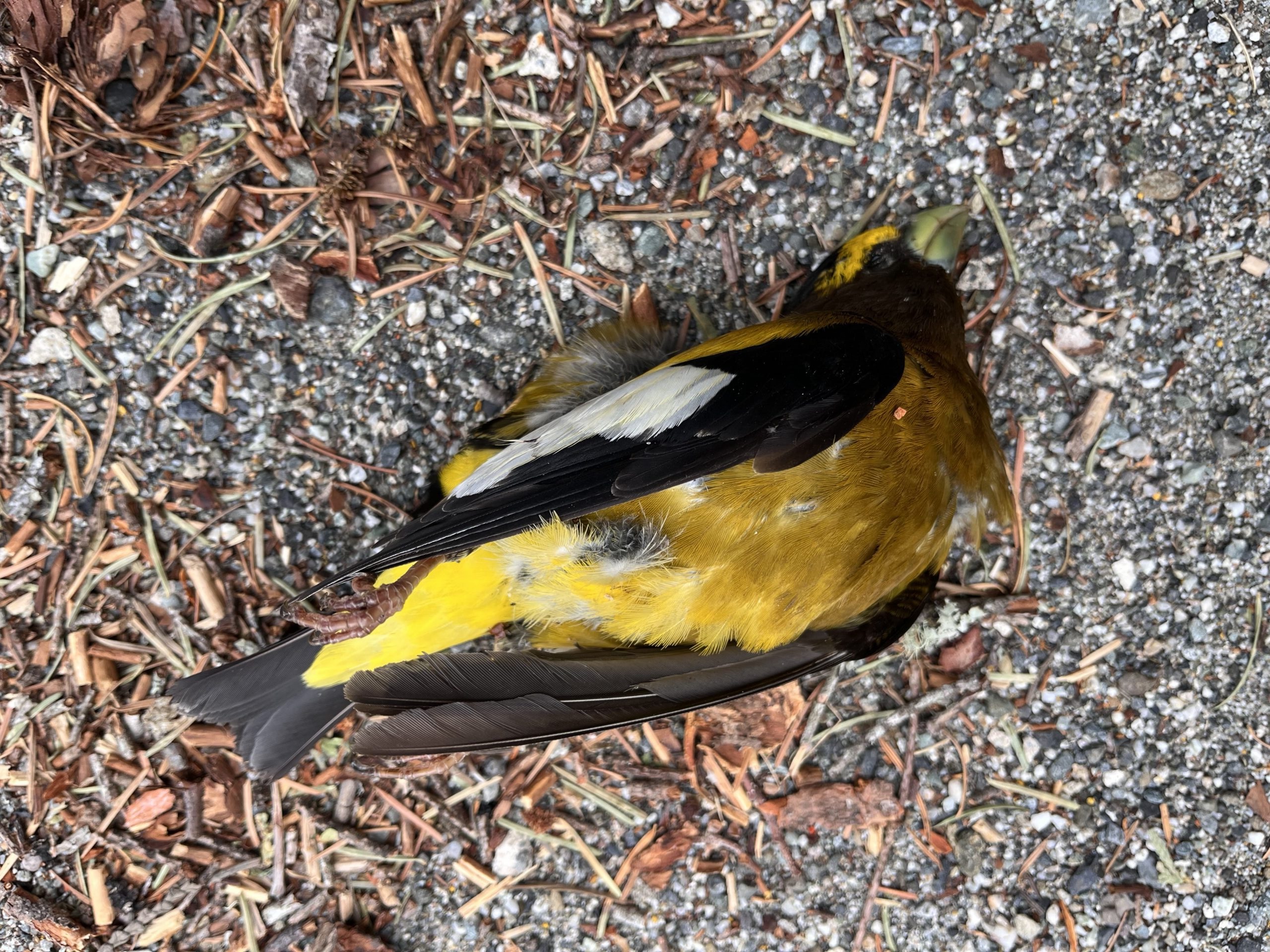
Dozens of evening and pine grosbeak carcasses have been found on State Route 20 near Colonial Creek Campgrounds in the North Cascades in recent weeks, a puzzling and troubling development for birdwatchers, hikers, and wildlife officials. The birds, which are a threatened species whose population has declined by 92 percent over the last 50 years, have been struck by vehicles at an unusual rate this summer, leaving researchers and observers struggling to explain why.
Nikita Kozhekin, a resident who was hiking the area in late June, described finding dead birds on the road every 100 feet or so. Kozhekin raised awareness of the incident on Facebook and in an online birding forum, and the reports quickly drew attention from the broader birding community. Christian Martin, the communications manager at the North Cascades Institute and an amateur birder, called it a "grosbeak massacre" after observing a large flock of the birds over Diablo Lake on July 1. He identified them by their yellow feathers and their distinctive, alien-like calls.
A Threatened Species at Risk
Grosbeaks are federally protected birds, and the scale of the deaths this summer is especially alarming given the trajectory of their population. Evening grosbeaks are listed as one of 91 species on the brink of endangerment in North America. Their 92 percent population decline over the past half century reflects broader trends in forest bird species across the continent, driven by habitat loss, climate change, and shifts in food availability.
North Cascades National Park is actually a stronghold for grosbeak sightings, which makes the roadside carnage on State Route 20 all the more unusual. The birds are not rare in the area itself, but mass vehicle strikes of this kind have not been reported here before at this scale. Both evening grosbeaks and pine grosbeaks have been found among the casualties.
Matt Young, the president and founder of the Finch Research Network and the lead on a pilot project for grosbeak population recovery, has offered one piece of the puzzle. Grosbeak populations tend to fluctuate with the natural cycles of spruce budworm outbreaks, because the budworm is a major food source for the birds. A spruce budworm outbreak was reported last year in North Cascades National Park by the Washington Department of Natural Resources. If the outbreak drew unusually large numbers of grosbeaks into the park this season, that would help explain why so many birds are concentrated along the Highway 20 corridor.
Bugs, Rockslides, and Fast Cars
The working theory emerging from ornithologists and park officials involves a combination of factors. The spruce budworm outbreak likely drew large numbers of grosbeaks to the area around Colonial Creek and Diablo Lake. Rockslide debris and gravel along the shoulder of State Route 20 may be attracting the birds to the road surface, where grit and mineral deposits in the rock can supplement their diet. Grosbeaks are known to consume grit and minerals from road surfaces, a behavior that puts them in close proximity to passing vehicles.
State Route 20 through the North Cascades is a popular recreational route, particularly in summer, and vehicles often travel at speeds that leave little time for birds on the road surface to react and fly clear. The combination of high bird concentrations, roadside foraging behavior, and vehicle speeds creates a dangerous intersection that appears to have resulted in significant losses this summer.
North Cascades National Park Service Complex encompasses a large swath of the Cascade Range in Whatcom and Skagit counties. The Colonial Creek area, where many of the carcasses have been found, sits along the north shore of Diablo Lake, a turquoise glacially-fed reservoir that is one of the most photographed locations in Washington State. The area is accessible via State Route 20, which serves as the primary east-west mountain highway through the northern Cascades and is typically open from approximately April through November before winter snowpack forces its seasonal closure.
What Can Be Done
Visitors and travelers on State Route 20 near the Colonial Creek Campgrounds area are being asked to slow down and watch for birds on the road surface, particularly in early morning and evening hours when grosbeaks are most active at ground level. The park service has been monitoring the situation, and wildlife officials from state and federal agencies are investigating the cause.
For birdwatchers visiting the area, the grosbeak activity, however grim, does represent a rare opportunity to observe these striking yellow-and-black birds in unusually high numbers. Reporting additional sightings of dead or injured birds to North Cascades National Park staff helps wildlife managers track the scope of the problem. The park service has contact information on its website, and visitors can also report observations through the North Cascades Institute, which works closely with park management on education and conservation programs in the area.
The grosbeak deaths are a sobering reminder of how quickly road mortality can affect populations of already-threatened species. With evening grosbeaks already at 8 percent of their historic population levels, every individual loss matters. Slowing down on mountain highways, giving wildlife time to move off the road, and reporting unusual wildlife mortality are small steps Whatcom County visitors can take to be part of the solution rather than part of the problem.