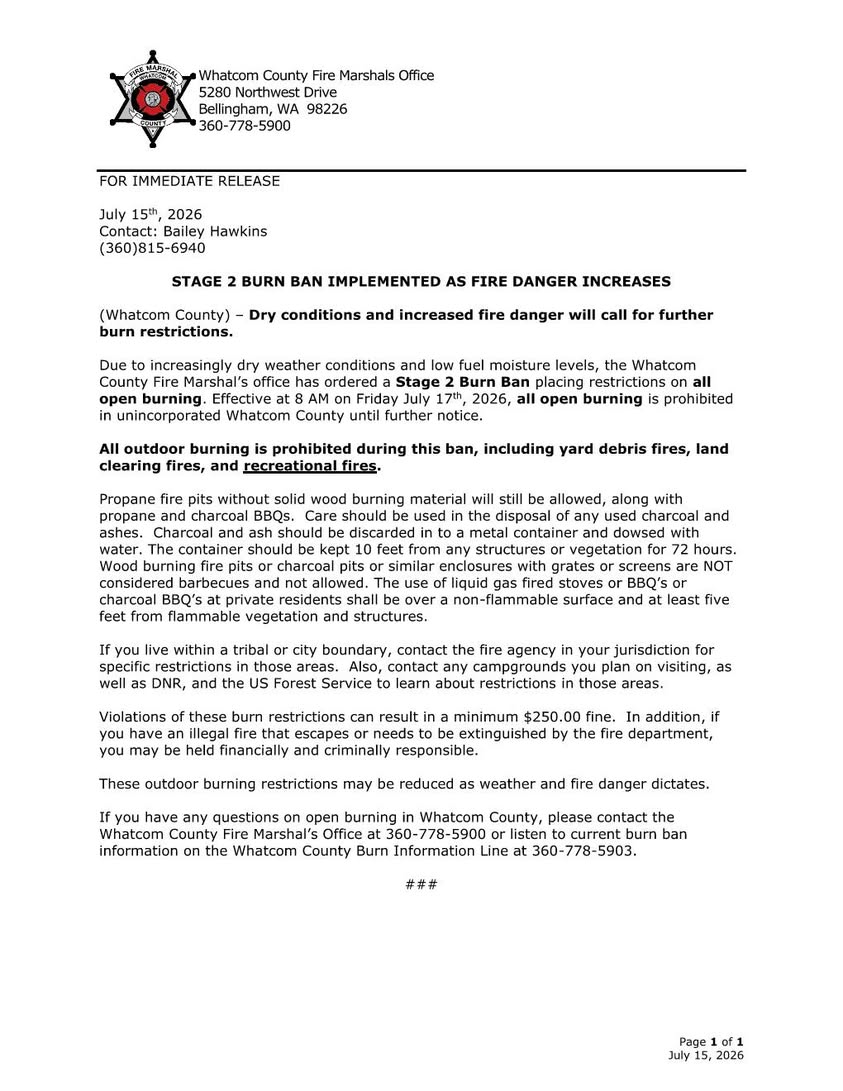
Whatcom County is escalating its fire restrictions as dry summer conditions intensify across the region. Effective 8 a.m. on Friday, July 17, 2026, the existing burn ban for unincorporated Whatcom County will be upgraded to a Stage 2 Burn Ban, prohibiting all open burning without exception.
The announcement came from Whatcom County Government on July 15, citing increasingly dry weather and dangerously low fuel moisture levels as the driving factors behind the escalation. County officials described wildfire conditions as rapidly intensifying and warned that even a small spark could lead to a fast-moving, uncontrollable fire.
What the Stage 2 Ban Covers
Under Stage 2 restrictions, all open burning is prohibited in unincorporated Whatcom County. That means no campfires, including those in designated fire rings at campgrounds and parks. No debris burning or brush pile burns. No recreational fires of any kind, regardless of size or location.
The escalation from Stage 1, which has been in effect since June 15, reflects a significant change in conditions. Stage 1 bans had already restricted many forms of outdoor burning, but Stage 2 closes remaining exceptions and applies the strictest limits available under county fire ordinance.
Some activities remain permitted under Stage 2, though with requirements for extreme caution. Gas or propane stoves and grills with a shutoff valve are allowed in areas clear of vegetation with proper clearance around them. Propane and charcoal BBQs may continue, but users must take extreme care when discarding ash and charcoal, ensuring both are fully cooled before disposal. Propane fire pits without solid wood burning material are also allowed.
Activities that could generate sparks are strongly discouraged even where not explicitly prohibited. County officials specifically called out welding, mowing dry grass, and driving vehicles on tall vegetation as activities that have ignited wildfires and should be avoided under current conditions.
Why Conditions Are So Dangerous Right Now
The combination of factors driving the Stage 2 declaration is particularly concerning. Following a relatively wet early summer that stimulated heavy grass and brush growth, recent heat and the absence of rainfall have rapidly dried that vegetation. The result is an unusually large volume of dry fuel spread across the county, from the lowland areas near Bellingham and Ferndale to the forested foothills and Cascade foothills east of the county.
The National Weather Service issued a Red Flag Warning for eastern Whatcom County covering much of July 15 and 16, citing high temperatures, low humidity, dry fuels, and the potential for afternoon thunderstorms with lightning and gusty winds. That combination, hot and dry air, abundant fuel, and possible ignition from lightning or wind-blown sparks, is precisely what fire managers describe as critical fire weather.
According to the Whatcom County Division of Emergency Management, the Washington Department of Natural Resources has rated fire danger in the lowlands at High, with the Cascades remaining at Moderate. A drought declaration issued by the Washington Department of Ecology in April 2026 for Whatcom County and surrounding regions has contributed to the drawn-down soil moisture that makes fuels so ready to burn.
What Residents Should Do
County officials are asking residents to take the restrictions seriously and to watch for conditions that could contribute to fire starts even beyond open burning. Anyone planning a camping trip in Whatcom County should contact their campground directly to learn about site-specific restrictions, which may go beyond county requirements in some cases.
Residents are urged to stay updated through local fire agency websites, the Washington Department of Natural Resources, and the U.S. Forest Service, which manages significant acreage in the Mount Baker-Snoqualmie National Forest east of the county. Air quality conditions are being monitored actively; the eastern portions of the county have already seen some degraded air quality days this week.
For questions about the burn ban or fire restrictions, residents can reach the Whatcom County Fire Marshal's office at 360-778-5900. The Washington Department of Natural Resources also maintains updated fire danger maps and burning restriction notices online.
Whatcom County has experienced significant wildfire smoke impacts in past summers, including smoke from fires in British Columbia and eastern Washington that periodically pushed air quality into unhealthy ranges over Bellingham and the western lowlands. With local fire danger now elevated and Red Flag Warnings in place, this summer's risk is not limited to distant fires. The conditions for local ignition are present, and the Stage 2 ban is a direct response to that reality.
Anyone who spots a fire or suspects illegal burning during the ban period should contact 911 immediately. The Washington State Department of Ecology also has a reporting system for burn ban violations available online. During periods of critical fire weather, rapid reporting of new fire starts is one of the most important things a community member can do to help prevent small ignitions from becoming large emergencies.