The newsroom that covers Whatcom County for the Bellingham Herald has a new contract, and it includes some of the strongest protections against artificial intelligence use in any McClatchy unionized newsroom in the country. The deal was ratified following a one-day strike in May and months of contentious negotiations with McClatchy Media, the hedge fund-owned chain that publishes the Herald along with dozens of other papers across the United States.
The new three-year agreement covers Herald journalists along with reporters at four other Pacific Northwest newspapers negotiating jointly. It includes guaranteed raises of between 7.2% and 15.5% over the life of the contract, with immediate raises ranging from 3% to 11.1% depending on the employee. A minimum salary floor of $52,000 has been established for current employees.
The AI Language That Makes This Contract Notable
The most significant provisions in the new contract may be those governing artificial intelligence. Under the agreement, AI cannot be used to replace staff, decrease pay, or reduce working hours. Union members cannot be forced to use AI as a source of fact. Nothing generated by AI can be published without human review. McClatchy must disclose its use of AI to readers and cannot impersonate journalists using AI-generated content. Staff cannot be disciplined for errors made by a chatbot, and the company cannot put a union member's byline on an AI rewrite of original work.
Kristine Sherred, chair of the Washington State News Guild and the Tacoma-based lead for the negotiations, described the AI language as the best in McClatchy's unionized newsrooms and among the best in the country. The provisions respond directly to documented problems with McClatchy's AI deployment, which according to a union press release led to false information being published about Washington businesses and AI-generated content being published under reporters' names without their knowledge or consent.
"It's not everything we wanted, but I guess we'll take it," said Jack Belcher, a Bellingham Herald reporter who was among those who picketed in May. "The AI language is pretty good. We're still getting some money, but not much that we wanted. All in all, I think it's just a rough compromise."
The Strike and How It Shaped the Deal
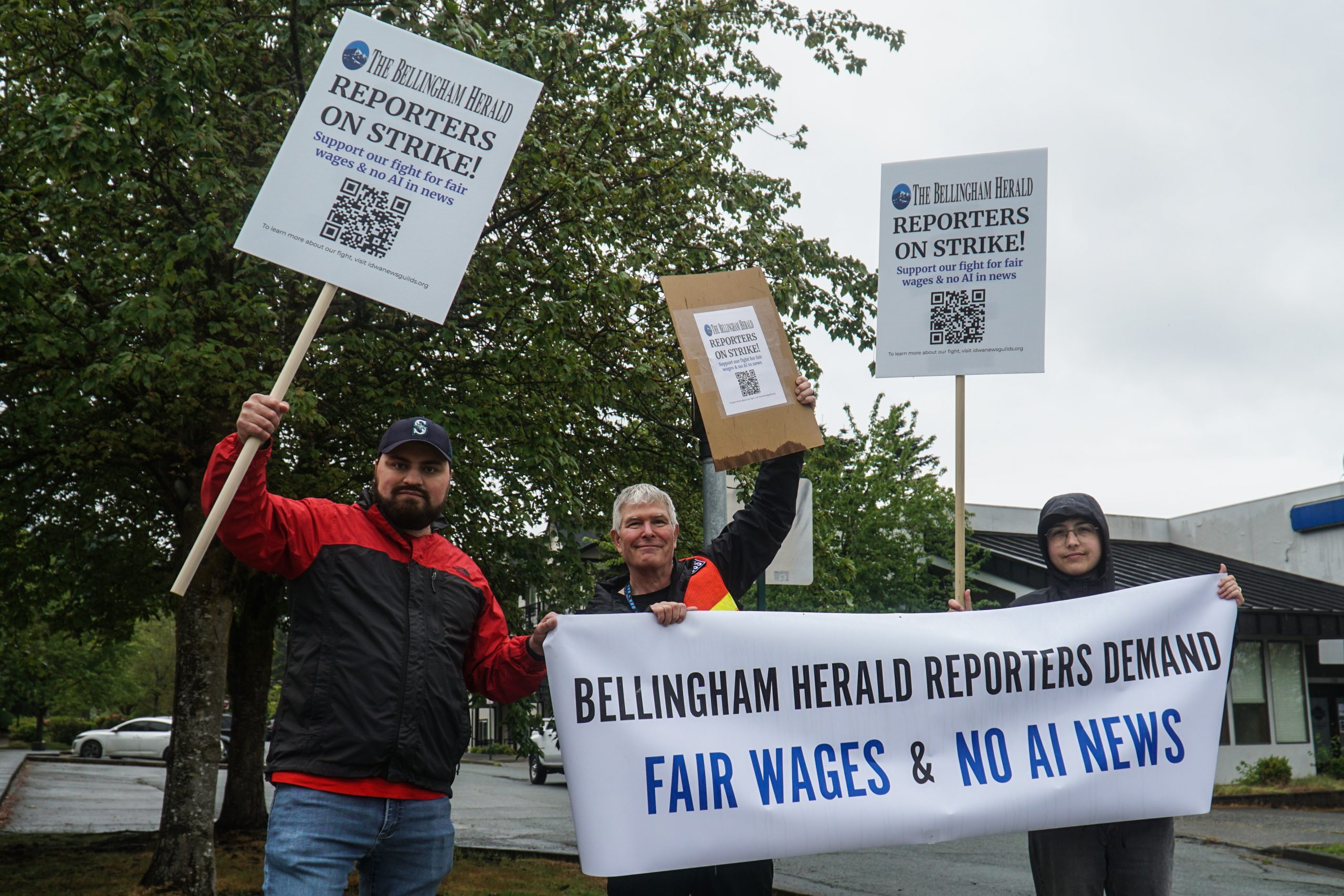
Herald reporters Jack Belcher and Robert Mittendorf picketed on the corner of Holly Street and Lakeway Drive in Bellingham on May 26, joining a one-day work stoppage that was part of broader action across the McClatchy Pacific Northwest newspapers. The strike came after more than a year of negotiations in which, according to union representatives, McClatchy repeatedly made the same insufficient offer: a 3% sign-on bonus and a 1% annual raise.
The new offer arrived immediately after the strike. Belcher said he believes the work stoppage was effective. "I feel the strike was impactful. I think it sends a message that we aren't going to go down from a fight every time. And I think it was impactful, especially if there's a lot of young people in the offices that this was one of their first strikes. And so if we need to fight harder in the future, we have some experience under our belt."
Negotiators spent considerable time, including what Sherred described as months of delays, getting McClatchy to engage meaningfully on the AI provisions. "Last summer into fall, it took months to get them to discuss AI in any sort of meaningful way," she said. "And when we finally reached the point of introducing wages, they came at us with a pretty insulting initial offer."
What Was Not Won and What It Means for Local Journalism
The one major ask that went unmet was the minimum salary floor the union had sought. While the contract establishes a $52,000 minimum for current employees, the union had pushed for a higher threshold that would have addressed what Sherred described as ongoing wage inequities, particularly for mid-career journalists who have been squeezed as raises at the bottom have not been matched by comparable increases in the middle of the pay scale.
"When you raise the bottom, but you don't raise the middle, the people in the middle start to get squeezed, and there's a lot of our group that's in that boat," Sherred said. "There are many journalists in our newsrooms, both in Idaho and in Washington, who will continue to question whether they can afford to stay in these jobs because their wages are really stagnating."
McClatchy Media is owned by Chatham Asset Management, a New Jersey-based hedge fund. The company did not respond to requests for comment from the Salish Current, which first reported the contract ratification. The ownership structure, a financially struggling newspaper chain held by an investment firm, is familiar across American local media and creates inherent tension between the financial expectations of investors and the resources available to sustain reporting.
For Bellingham readers, the Herald's health matters directly. The paper covers courts, city hall, schools, and county government, providing a layer of accountability journalism that affects how residents understand and engage with local institutions. The new contract's AI protections, which require human review of any AI-generated content before publication and ban mandatory reliance on AI as a factual source, are a meaningful safeguard for the integrity of that coverage.
The contract also includes improved just cause and discipline protections, guaranteed first consideration for open positions for current staff, increased pay for interns and late-night work, and a minimum annual training budget of $7,500 in Washington state. The training provision is notable given how rapidly journalism tools and platforms are changing.
The Salish Current, the nonprofit news organization that reported this story, covers the San Juan Islands and Whatcom County with a focus on in-depth local journalism. The NewsGuild, which represents Bellingham Herald journalists, provides resources and support for union newsrooms navigating contract negotiations. For readers interested in the state of local news in Whatcom County more broadly, this contract represents one data point in the larger story of how newsrooms are adapting to financial pressure and technological change. For more recent community and civic coverage from around Whatcom County, see the latest local government and election updates.