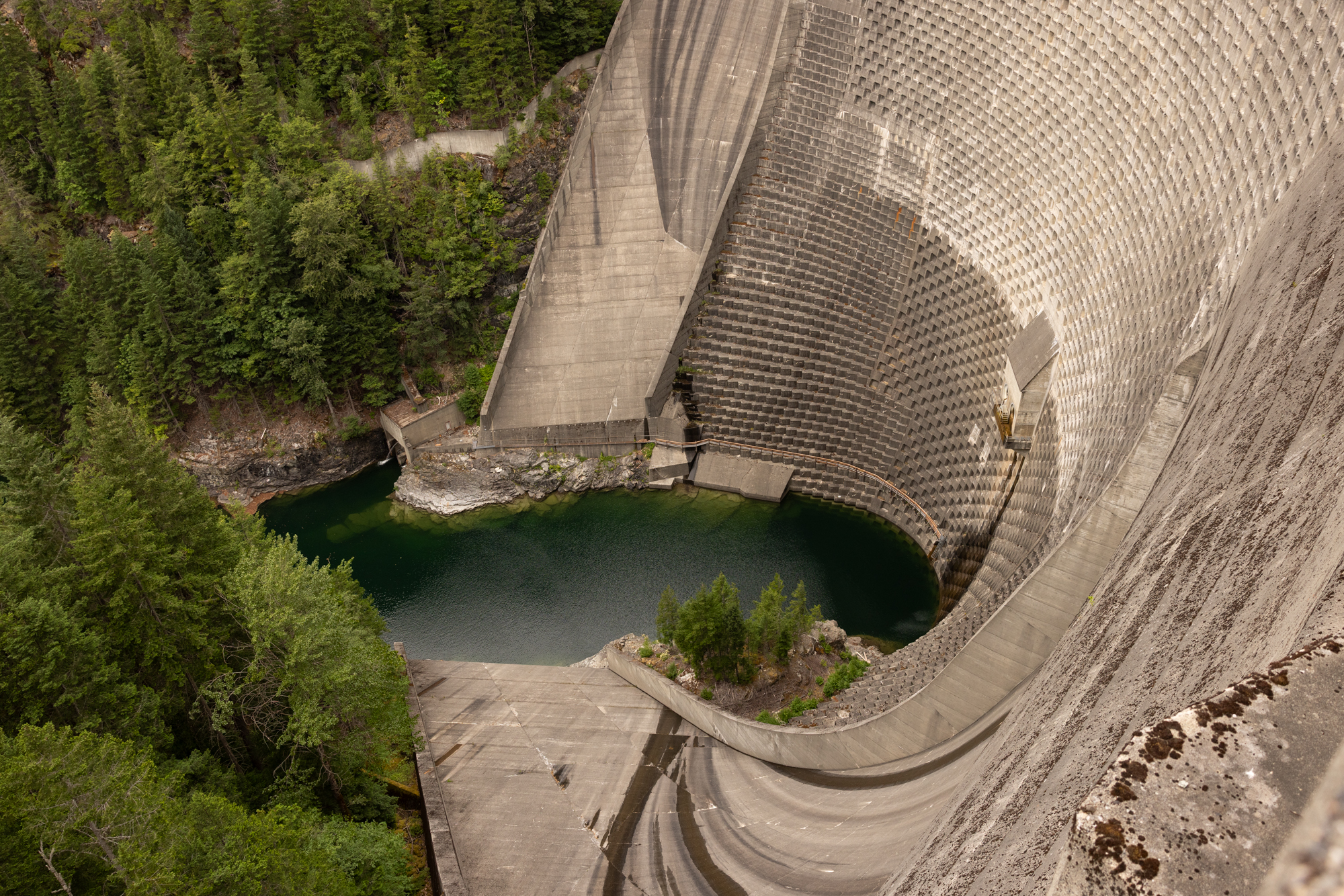
The push to restore salmon to the upper Skagit River is gaining momentum, but a proposal to build a road through the wilderness near Ross Dam is drawing resistance from conservation advocates who say the cure could be nearly as damaging as the disease. Seattle City Light, the municipal utility that operates three hydropower dams on the Skagit River, has committed nearly $1 billion to fish passage as part of a federal relicensing process. But getting fish past Ross Dam, the uppermost of the three, will require building access infrastructure in a stretch of wilderness that environmentalists have long worked to protect.
Phil Fenner, president of the North Cascades Conservation Council, walked the trail to Ross Dam with a Cascadia Daily News reporter in late June. "There's less and less of this sort of land anywhere," he said, describing how the quiet natural area around the dam could soon be filled with the sound of blasting rocks and falling trees. A 2024 report prepared by consulting firm Stantec identified a new road from State Route 20 to the dam as offering "the greatest amount of convenient access and flexibility" for fish passage construction and operations.
The $979 Million Settlement and What It Means for Salmon
Seattle City Light's prior Federal Energy Regulatory Commission license for its Skagit project expired April 30, 2025. The utility has been operating under annual licenses while a complex relicensing process unfolds. In March 2026, City Light signed a comprehensive settlement with the Sauk-Suiattle Indian Tribe, the Swinomish Indian Tribal Community, the Upper Skagit Indian Tribe, federal fisheries agencies, and Skagit County, capping spending on fish passage at roughly $979 million over a proposed 50-year license.
The Skagit project's three dams, Gorge, Diablo, and Ross, collectively power about 20% of Seattle's electricity. They have also blocked anadromous salmon and steelhead from reaching hundreds of miles of historic upstream habitat since their construction in the early and mid-twentieth century. Fish passage here will most likely involve a trap-and-haul approach: facilities that capture fish below each dam and transport them by truck upstream and back downstream, similar to programs used on other heavily dammed rivers in the region.
The settlement requires that "access to Ross Lake" be constructed within eight years of FERC issuing new licenses for the dams. That deadline is the direct driver behind the current access road discussion. Unlike Gorge and Diablo dams, which sit relatively close to SR 20, Ross Dam is currently inaccessible by road from the highway. Visitors reach it only on foot, via a steep trail roughly one mile long.
Why the Conservation Council Objects
The North Cascades Conservation Council does not oppose fish passage for salmon. What the group objects to is the specific plan for a constructed road, which it argues would disturb what Fenner called "a little buffer of wilderness" between the highway and the reservoir. The group also cites significant landslide risk in the area near the dam, which is prone to slope failures.
City Light spokesperson Julie Moore wrote in an email that relevant government agencies will use an upcoming National Park Service report on means of access to the Ross reservoir to inform their review of environmental impacts and mitigation measures. That review process is ongoing, and no final decision has been made on the road. The settlement was filed with FERC as part of an Amended Final License Application in June 2026; formal review and license issuance will follow in the coming years.
Conservation groups that are not signatories to the settlement, including the North Cascades Conservation Council, retain the ability to raise formal objections during FERC's review. The settlement was explicitly designed to head off such challenges, but key details of implementation remain unsettled, and advocates who disagree with specific choices have avenues to be heard.
Tribal Voices: Fish Passage as a Matter of Sovereignty
Not everyone shares the conservation council's concern. Scott Schuyler, policy representative for the Upper Skagit Indian Tribe and a signatory to the settlement, views the landscape through a fundamentally different lens. The dams are "fish killers, that's what they do," he told Cascadia Daily News. "You want a pristine environment? Well, remove the dams."
For Upper Skagit Tribal members, fish passage is not an abstract conservation goal. The Upper Skagit Tribe holds treaty-guaranteed fishing rights on the Skagit River, rights that have been severely constrained by the hydropower dams for generations. Restoring salmon to the upper river represents a return of cultural practice, subsistence, and sovereignty that was taken when the dams were built without meaningful Tribal consultation.
The Skagit is one of the last rivers in the contiguous United States with all five native Pacific salmon species still present. For the Tribes who have fished its waters since long before the dams were built, the $979 million commitment to fish passage represents a historic acknowledgment of what was lost. The debate over how exactly to implement it reflects the difficulty of balancing competing values in a landscape that has already been deeply altered by human infrastructure.
What Comes Next for the Skagit
Early implementation steps are already underway. Biological studies, cost assessments, and access planning are proceeding through 2026. Construction of early-phase infrastructure, including road access to Ross Dam, is targeted for completion within roughly the first 11 years of the new license, giving stakeholders several more years of planning and environmental review before ground is broken.
The settlement also covers estuary and mainstem habitat restoration totaling over $200 million, flood risk management at Ross Dam, cultural resource protection, and recreation enhancements along the river corridor. The agreement with Canadian First Nations, who have concerns about the impact of salmon introduction on trout populations in Ross Lake, which extends into Canada, is a separate ongoing negotiation.
For Whatcom County residents, the Skagit relicensing process will shape one of the region's most important natural systems for the next half-century. More information about the process is available from Seattle City Light's Skagit relicensing page and FERC's public docket. Local water infrastructure issues remain a priority across Whatcom County this summer, as seen in ongoing repair work on Bellingham stormwater systems as well.