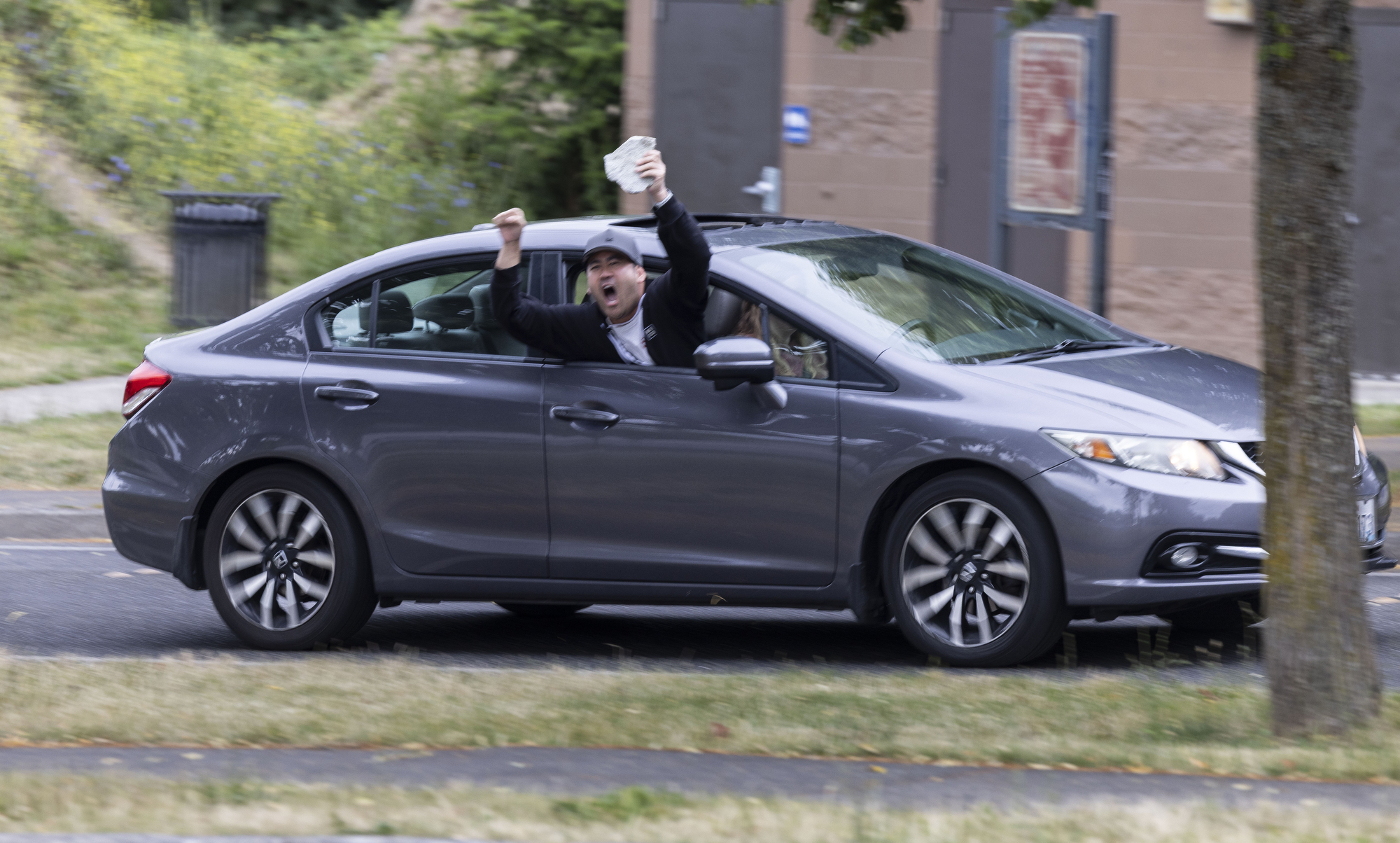
Cars snaked through the parking lot at Civic Field in Bellingham on Saturday morning, July 11, as people waited in line for a chunk of local history. They came from inside the city, from as far away as King County, and from across the generations. One older woman in a navy American flag sweater walked straight to the table piled with granite fragments and picked up a large piece without hesitation. "My daughter painted the rock when she was at Sehome High School in the 1980s," she said, grinning. "I was the getaway driver."
The Washington State Department of Transportation gave away thousands of pieces of the Bellingham Rock on Saturday, the final chapter for a roughly 100-ton glacial erratic boulder that sat along northbound Interstate 5 near Lake Samish for more than five decades and served as one of the region's most idiosyncratic landmarks. The rock was demolished earlier this year as part of a major I-5 fish passage project. Abatement and removal cost $646,784 in total. Crushing it into an estimated 2,000 to 4,000 pieces cost an additional $5,000 to $10,000.
Why the Rock Had to Go
The Bellingham Rock's end came not from neglect but from construction. The Washington State Department of Transportation needed the rock removed to make way for a fish passage project replacing culverts that had blocked salmon migration at Friday, Lake, and Chuckanut creeks along the I-5 corridor near Bellingham. The rock sat directly in the construction zone, and state regulations prohibited relocating it intact within the highway's limited-access right-of-way due to safety concerns about encouraging unofficial stops along the freeway.
Paint contamination added another complication. Decades of layers applied by local artists, teenagers, sports fans, and community members had left behind paint containing lead and cadmium, requiring professional remediation of the soil around the rock before any removal could proceed. Abatement of the rock and surrounding area cost $252,597. Rock removal cost $394,187. The Civic Field parking lot rental for Saturday's giveaway cost $1,000.
WSDOT initially explored relocating the intact boulder to private Bellingham property for public display, but the rock proved too large and too contaminated for meaningful relocation as a single piece. By May 2026, the agency confirmed the rock would not be moved whole. Instead, the agency developed plans to share limited pieces with the public, requiring an online waiver by noon July 10 for anyone who wanted to attend the giveaway.
A Rock With Deep Roots in Bellingham History
This is not the first time Bellingham has had to say goodbye to a beloved roadside boulder. Back in the 1960s, construction crews building Interstate 5 had to demolish a 300-ton rock that had sat for thousands of years on Donovan Avenue in Fairhaven after being deposited there by a glacier that slid from Jackass Mountain in the Fraser Canyon. That rock was one of many glacial erratic boulders left across the Puget Sound region when ice sheets retreated roughly 15,000 years ago. Pieces of the Donovan Avenue rock, complete with its own graffiti legacy, still reside in Fairhaven and on the Western Washington University campus.
A few years after that first rock's destruction, Bellinghamsters found the replacement: the I-5 boulder that locals started painting around 1969. Over the following five-plus decades, the rock became a canvas for generations of community expression. High school sports champions painted it. Locals left messages. Artists added layers. The rock became a kind of slow-motion community mural that everyone drove past, even if most never stopped to look closely.
Jason Cooper, a cultural resources specialist for WSDOT, put it plainly: "My feeling is that there is a little bit of the counter culture, it's graffiti. I think from a social-cultural point of view, it's the easy object to see." The rock was visible, accessible in a visual sense even from a car traveling at 70 miles per hour, and it accumulated meaning precisely because it did not belong to any institution or authority.
What People Took Home
At Saturday's giveaway, pieces averaged roughly three inches in size, small enough to fit in a pocket or sit on a shelf. Ryan Zakerski of WSDOT was photographed hoisting a larger chunk above his head. Christian Urcia rode away on his bicycle with the first piece handed out, cheering as he went. Chris Hartman and Sandi Heinr held their pieces with the care of people who understood they were holding something irreplaceable.
The rock's final form, scattered across hundreds of households from Bellingham to King County, echoes what author John Green wrote in "The Anthropocene Reviewed" about the world's largest ball of paint in Indiana. Green described how strangers showed up over decades to add a layer to what started as a baseball, and how the accumulation became something no single person intended. "Maybe in the end, art and life are more like the world's largest ball of paint," Green wrote. "You carefully choose your colors, and then you add your layer as best you can. In time, it gets painted over."
The I-5 fish passage project that replaced the Bellingham Rock will improve salmon migration through the Friday, Lake, and Chuckanut creek drainages south of the city, restoring habitat connectivity that culverts had blocked for decades. That project, like the larger Skagit River fish passage effort unfolding to the east, represents a regional commitment to correcting infrastructure decisions that have constrained salmon runs since the mid-twentieth century.
WSDOT has not announced when the fish passage project along I-5 near Bellingham is expected to be completed. For now, thousands of Whatcom County residents have a small piece of granite to remember what stood there before.