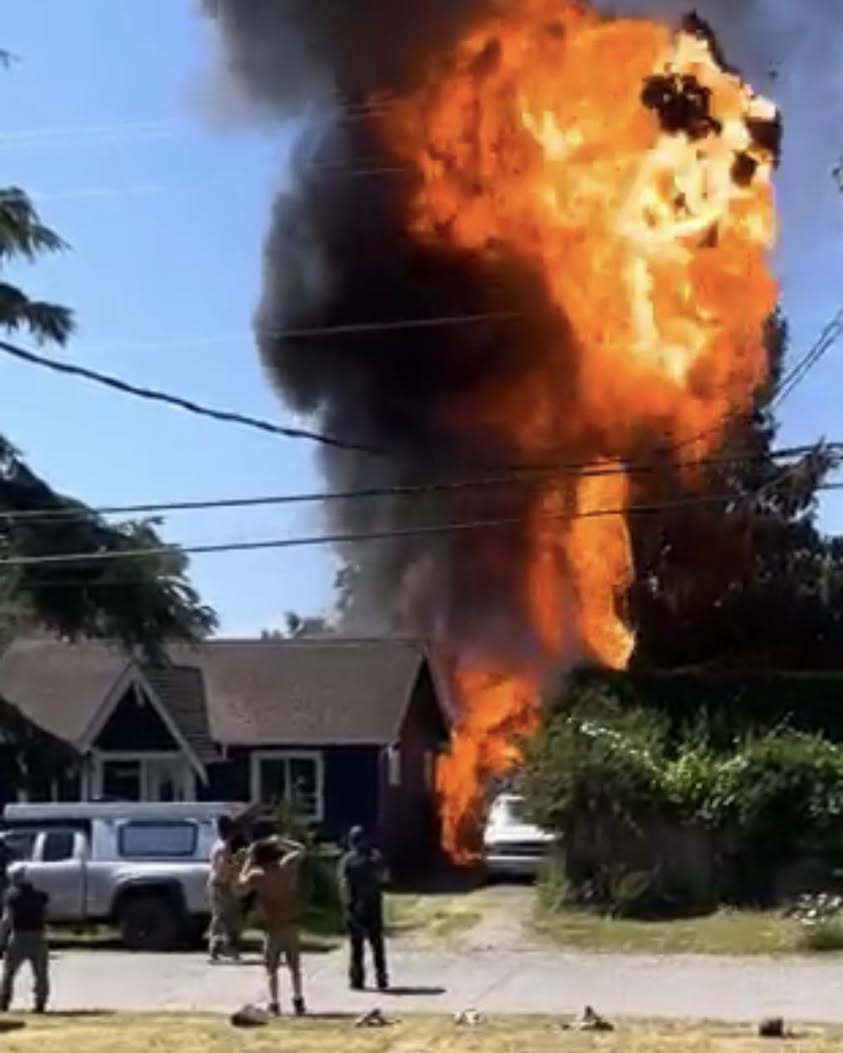
Bellingham firefighters battled a fire Monday afternoon that destroyed two detached garages and caused heavy damage to a home in the Columbia neighborhood, injuring one resident in the process. The blaze, which broke out at approximately 1:26 p.m. on July 6, spread from a detached garage to the neighboring structure and the main residence before crews contained it.
How the Fire Spread
The Bellingham Fire Department was dispatched to the 3000 block of Walnut Street after reports of a residential structure fire. Engine 1 arrived first on scene and found a working fire already burning in a detached garage that had extended to the main residence and a neighboring detached garage.
Crews launched an aggressive fire attack and quickly brought the fire under control, preventing it from spreading further. Additional crews searched the affected structures to confirm no occupants remained inside. All occupants were accounted for. One resident sustained a minor injury, though the department did not release details on the nature of that injury.
The fire destroyed both detached garages and caused heavy damage to the Walnut Street home. The department determined that the fire originated from a wood-burning stove in the detached garage. Fires that begin in detached garage stoves are a persistent risk because garages often contain flammable materials -- sawdust, paint, cardboard, stored fuel -- that can ignite quickly when a stove malfunctions or sparks escape its firebox.
The Columbia Neighborhood and Its Housing Stock
The Columbia neighborhood sits in the northeastern portion of Bellingham, roughly bounded by Meridian Street to the west, Yew Street Road to the north, and Interstate 5 to the east. Like much of Bellingham's older residential fabric, Columbia is characterized by mid-century single-family homes, many of which include detached garages and accessory structures on their lots.
Walnut Street in the 3000 block runs through a quiet residential area where homes sit on lots of moderate width -- close enough that a fire in one structure can reach an adjacent one relatively quickly under the right wind and fuel conditions. The July fire destroyed not only the garage where it originated but the neighboring garage as well, illustrating the lateral spread risk when properties share a fence line or are separated by just a few feet.
Bellingham's summers bring some of the driest conditions of the year. The region's climate produces warm, low-humidity months from July through September that increase fire spread risk for both structure and wildland fires. Even without elevated wind, a working structure fire in dry conditions can extend rapidly through attached or adjacent combustibles.
Wood-Burning Stove Safety
Wood-burning stoves are a common supplemental heat source in Whatcom County homes and garages, but they require consistent maintenance to operate safely. The National Fire Protection Association recommends annual inspection and cleaning of chimney flues by a certified professional, keeping a metal or glass enclosure closed during use, and maintaining a three-foot clear zone around the appliance free of combustible materials.
In detached garages specifically, wood stoves are frequently used as workspace heaters during fall and winter months. The risk increases when flue pipes are not properly supported and sealed, when the stove has not been inspected recently, or when combustible materials accumulate near the appliance over time. The Bellingham Fire Department provides home fire safety education and resources through its community programs office.
What Happens After a Residential Fire
For the residents affected by the Walnut Street fire, the immediate aftermath involves insurance notification, structural assessment, and in many cases temporary housing if the main structure is unsafe to occupy. Major fire damage to a principal residence in Washington typically triggers a formal building inspection before occupants can return.
The American Red Cross Cascades Region provides emergency disaster assistance to fire-displaced residents in Whatcom County, including temporary lodging, meals, and replacement of essential items. Residents who have been displaced by a structure fire can call 1-800-RED-CROSS (1-800-733-2767) at any hour.
The Walnut Street fire comes during a stretch that has kept local firefighters busy. Just days earlier, the Ferndale Fire Department upgraded its Station 41 to 24/7 staffing, reflecting increased demand for emergency services across the northern Whatcom County corridor. Bellingham's fire suppression resources have similarly seen elevated call volumes through the early summer.
What to Watch For
The fire investigation will determine whether any code violations or equipment failures contributed to the ignition or spread of the fire. A formal report from the fire department typically takes several weeks and may inform whether any follow-up enforcement action is warranted.
Residents throughout Bellingham and Whatcom County are encouraged to test smoke alarms and carbon monoxide detectors monthly, replace batteries annually, and have wood-burning stoves and chimneys inspected before the fall heating season begins. The Northwest Clean Air Agency also publishes current outdoor burn ban status for Whatcom County, which applies to recreational fires and backyard burning during dry summer conditions.