The rugged Twin Sisters mountains in central Whatcom County became the focus of one of the most significant search-and-rescue operations in recent regional memory this past weekend, as teams from across western Washington converged to find 34-year-old Gursimran Singh, a British Columbia resident who went missing after a solo hike in late June.
Singh, who also uses the surname Randhawa, entered the United States on June 21 for a hiking trip in the Twin Sisters range. He was expected to return to his Kamloops, British Columbia home by June 28. When he did not, family members reported him missing to the Whatcom County Sheriff's Office, which launched an operation that has steadily expanded over the past week.
Truck Found, Search Perimeter Established
A key development came on June 30, when searchers located Singh's Toyota Tacoma parked approximately six miles up Middle Fork Road -- a rugged Forest Service road accessing the southern Twin Sisters area. The vehicle confirmed Singh had entered the backcountry and helped narrow the initial search perimeter to the area around South Twin Sister and the Sisters Glacier.
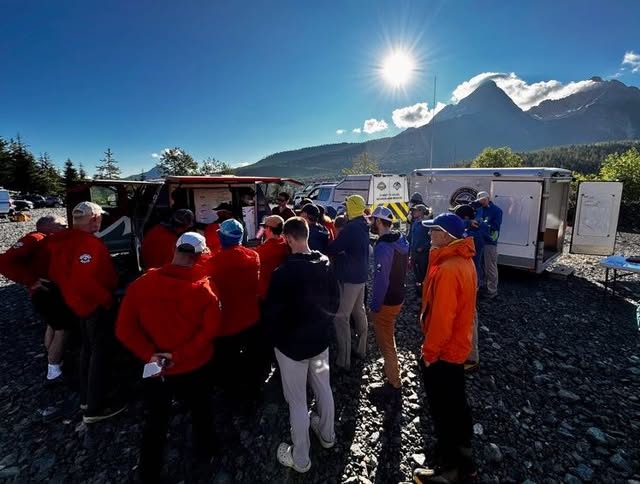
Rescuers from Bellingham Mountain Rescue Council and the Whatcom County Search and Rescue 4x4 Unit began working the terrain in earnest by late June. By Thursday, July 2, the Whatcom County Department of Emergency Management called in additional teams as the search expanded into more technical high-country.
A Multi-State Response in the High Country
By the weekend of July 4-6, the operation had grown into a broad multi-agency effort drawing teams from across the Pacific Northwest. Joining the local volunteers were Skagit Mountain Rescue Unit, Everett Mountain Rescue, Seattle Mountain Rescue, Tacoma Mountain Rescue Unit, and Olympic Mountain Rescue. U.S. Customs and Border Protection Air and Marine Operations, which patrols the remote North Cascades border corridor, has provided aerial support since the search began.
On Sunday, July 5, the Snohomish County Helicopter Rescue Team flew a crew directly to the South Twin Sister to search the Sisters Glacier on foot -- terrain effectively inaccessible without aerial support due to its steep, icy approach. Drone surveillance of the surrounding ridgelines and drainages has also been ongoing, covering ground that would take multiple days to reach on foot.
The scale of response -- more than six mountain rescue teams, helicopter assets from Snohomish County, and federal CBP air support -- reflects how seriously authorities are treating the disappearance. Large multi-agency SAR operations in the Twin Sisters are rare. Most searches in Whatcom County resolve within the first 48 to 72 hours; the duration of this one, entering its second week, drove the expanded aerial effort over the holiday weekend.
The Twin Sisters: Remote and Demanding Terrain
The Twin Sisters range sits roughly 10 miles southwest of Mount Baker, near the community of Acme in southeastern Whatcom County. The North Twin Sister reaches 7,017 feet; the South Twin Sister stands at 6,932 feet. The range is composed largely of dunite, an olivine-rich rock that gives the mountains a reddish-brown color unlike anything else in the North Cascades.
Unlike Mount Baker or the Artist Point corridor, the Twin Sisters area has no paved road access to high elevation and no maintained summit trails. Hikers navigate informal routes across steep talus and through dense fir forest. The Sisters Glacier, the target of Sunday's helicopter search, is a remnant ice field on the southern slopes that requires crampons and rope skills to cross safely. The area falls within the Noisy-Diobsud Wilderness, where motorized vehicles are prohibited on the ground -- making helicopters and trained foot teams the only viable tools at elevation.
Local outdoor safety advocates note that the Twin Sisters are frequently underestimated by visitors unfamiliar with Pacific Northwest non-technical peaks. Unlike the Cascades' more famous volcanic summits, the Sisters don't require ice axes on standard approaches -- which can create a false sense of accessibility. But route-finding is complex, cell coverage is essentially nonexistent past the lower forest, and mid-summer snowmelt creates unstable rock surfaces on the upper ridges. Informing someone of your plans and expected return date before any backcountry trip in Whatcom County is not optional safety advice. It is what gets a search started in time to matter.
How to Help
The Whatcom County Sheriff's Office is asking anyone who may have seen Singh or encountered him in the Twin Sisters area between June 21 and June 28 to call 911 immediately. Independent searches are strongly discouraged -- unauthorized searchers can complicate active operations and put themselves at serious risk in technical mountain terrain.
The Whatcom County Search and Rescue Council operates entirely with volunteer teams who train year-round for exactly these kinds of missions. All WCSO-dispatched SAR members are unpaid volunteers, and the council is supported entirely through community donations. Contributions to support the ongoing search for Gursimran Singh and to help prepare volunteers for future missions can be made at wcsar.org/donations.
The search is active and ongoing as of Tuesday, July 7. No timeline for suspension has been announced. The Whatcom County Sheriff's Office will provide updates as the operation continues.