Whatcom County Health and Community Services released its 2024-2025 Behavioral Health Fund Report Tuesday, showing strong program outcomes across youth prevention, crisis response, and mental health courts even as the underlying funding base faces pressure from slowing sales tax revenue. The report is a public accounting of how the county's dedicated behavioral health sales tax is being spent and what residents are getting for it.
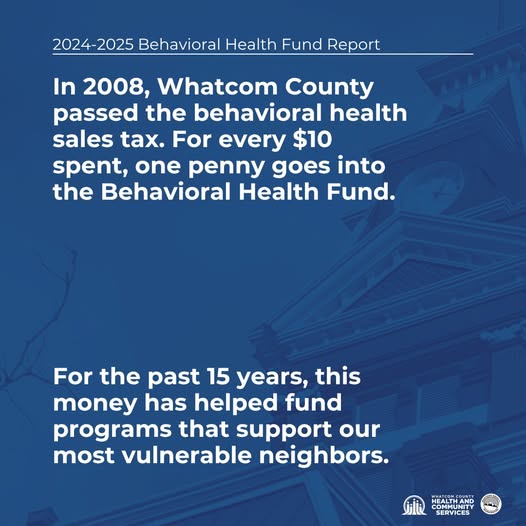
The Behavioral Health Fund has been active since 2008, when Whatcom County voters passed a dedicated behavioral health sales tax. For every $10 spent within the county, one penny flows into the fund, which also draws in state and federal grants. The money is directed toward programs that address mental health and substance use, with a focus on filling gaps in care, reducing reliance on law enforcement for behavioral health calls, and treating root causes before they escalate into more costly public safety situations.
Youth prevention was among the report's most significant highlights. During the 2024-2025 school year, 2,582 young people received direct mental health and substance use support through school-based programs. Notably, 75 percent of those students were located outside of Bellingham proper, in smaller Whatcom County communities where mental health services are often harder to access. County research cited in the report estimates that every dollar invested in these school programs saves approximately $18 in downstream costs related to criminal justice involvement, emergency care, and long-term treatment.
The Alternative Response Team, launched in 2023, continued its rapid growth. In 2025, ART responded to 2,140 unique non-emergency calls. The program dispatches two-person behavioral health teams instead of police officers to non-violent 911 calls involving mental health crises, housing instability, or substance use. By handling calls that do not require law enforcement, ART frees up police capacity for criminal incidents while connecting individuals to appropriate care rather than the justice system.
Mental Health Court, which celebrated its 10th anniversary in 2025, has now served more than 155 participants since its founding. The court operates as an alternative to standard criminal prosecution for individuals whose offenses are tied to underlying mental illness or substance use disorders. Graduates can have charges reduced or dismissed, making it substantially easier to pursue employment, housing, and education without a permanent record hanging over them. The 10-year milestone reflects a decade of sustained county investment in treatment-oriented alternatives to incarceration.
The fund's financial picture is more complicated. Sales tax revenue has slowed as consumer spending softens and fewer visitors come to the county to shop. To keep the fund solvent, Health and Community Services worked with county leadership to eliminate vacant staff positions, renegotiate contracts, and reallocate short-term reserves. Cost-reduction measures are expected to continue through 2027 and 2028. The report describes these steps as precautionary, not crisis-driven, but they signal that the fund cannot grow program capacity indefinitely without a stronger revenue base or additional state and federal support.
For residents, the report offers a detailed look at where behavioral health dollars go and how outcomes are measured. The full 2024-2025 report is available through the county's news release. Those interested in the fund's governance can learn more about the Behavioral Health Advisory Committee, which oversees spending priorities and meets on a public schedule.
The coming year will test whether the county can maintain current program levels while managing the revenue slowdown. County administrators have signaled they intend to protect the highest-impact programs while reducing administrative overhead where possible. Public meetings on the fund's direction are open to community input throughout the year.