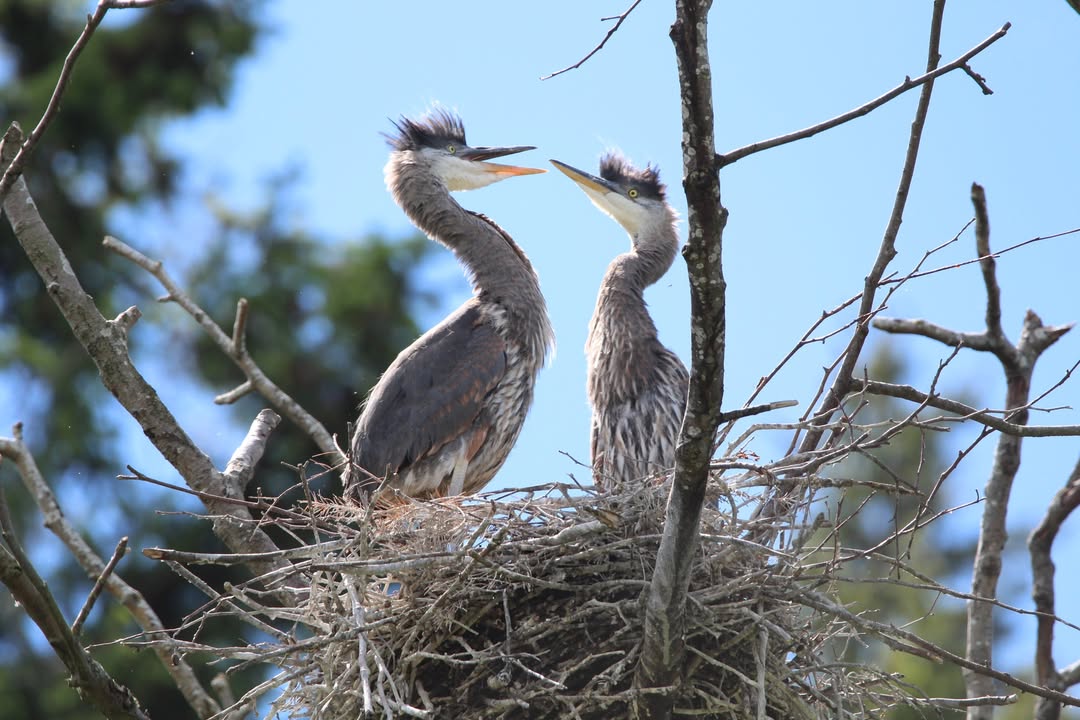
The Great Blue Herons are back at their nesting colonies in Bellingham, and both the City of Bellingham and Bellingham Parks and Recreation are asking residents to give the birds space. Nesting season runs from January 15 through September 1 each year, and May and June represent the most vulnerable stretch -- the period when parent herons are actively feeding chicks still too young to fly or fend for themselves.
Bellingham is home to at least two established heron colonies: one at Post Point, near the wastewater treatment plant and marine park on the south end of Bellingham Bay, and one at Little Squalicum Park to the north. Both sites are monitored by the City in partnership with a local heron biologist who tracks nesting success, colony size, and disturbance patterns over time. The colonies have been present in Bellingham for decades, making the city something of a known sanctuary for this species in Whatcom County.
Great Blue Herons, formally Ardea herodias, are the largest heron species in North America and a fixture of the Pacific Northwest coastline. Standing up to four and a half feet tall with a wingspan near six feet, they are hard to miss wading through the shallows of Bellingham Bay or along the edges of local creeks and wetlands. But their imposing size belies a real vulnerability at the nest. During breeding season, both parents must make constant foraging trips to feed their young, and disruptions -- even brief ones -- can cascade into chick abandonment.
What disturbs herons the most? City guidelines point to three main culprits: drones, off-trail human activity near the colony, and large groups moving noisily through the area. Drones are a particular concern because herons respond to them as aerial predators, triggering the same stress response that a bald eagle circling overhead would cause. Even a brief drone flight within 300 feet of the colony can cause adults to flush from their nests and leave eggs or chicks exposed.
The City's request is specific and practical. Residents should maintain at least 300 feet of distance from herons feeding along the beach or lagoon near the colony areas. Pets should be kept on designated trails or in open lawn areas at least 200 feet from the nesting sites. Group size should be kept small and noise kept to a minimum when passing near known colony locations. Binoculars are the recommended tool for anyone who wants a closer look -- they let you see without being seen, or at least without triggering a disturbance response.
Drone operators should note that the 300-foot buffer is not just a courtesy -- it aligns with FAA drone regulations in sensitive wildlife areas, and the City actively enforces the disturbance guidelines in partnership with Parks staff. If you fly a drone near an active heron colony and disrupt nesting, you are looking at potential violations under both local ordinance and federal wildlife protection law.
For residents who want to observe herons without disturbing them, Post Point Marine Park offers good vantage points from the trails and beach access areas at a respectful distance. Bellingham Parks and Recreation staff can provide information on current colony locations and which areas to avoid. The nesting season runs through September 1, so there is still roughly three months of heightened sensitivity remaining.
Herons have nested in Bellingham for generations, a testament to the quality of habitat the city has preserved around its shorelines. Keeping that going requires a little awareness from everyone who shares those spaces. The City's heron colony page has more detail on both Post Point and Little Squalicum, including maps of the protected zones and tips for the season.