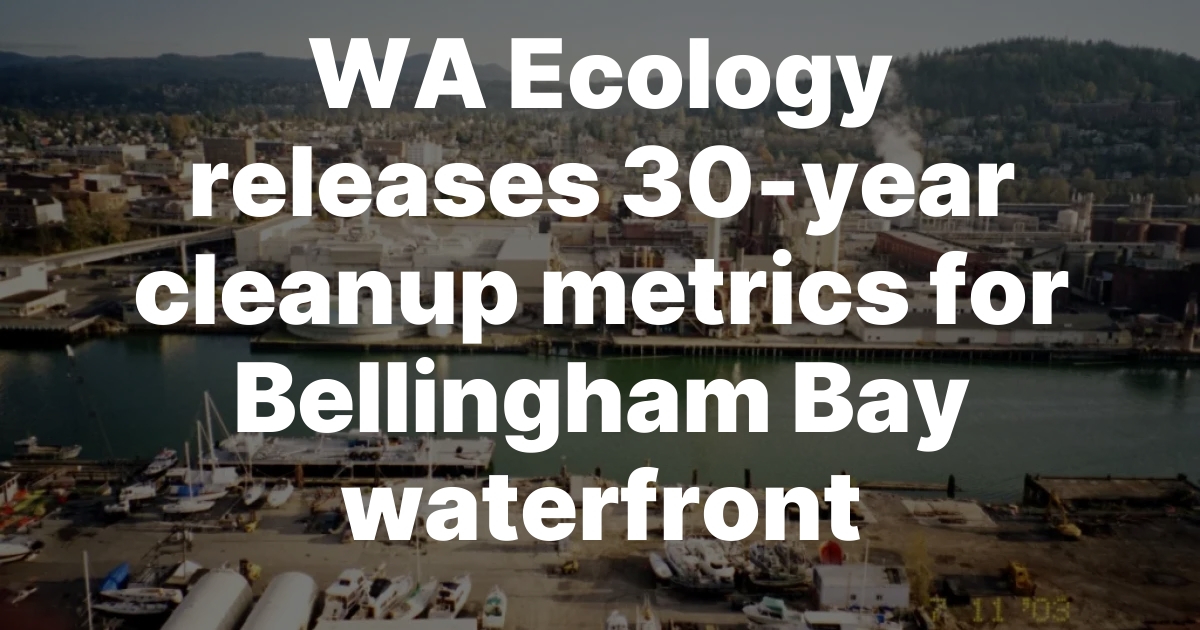
More than $300 million has been invested in cleaning up the Bellingham Bay waterfront over the past three decades, according to metrics released this week by the Washington State Department of Ecology. The figures mark a significant milestone in one of the longest-running and most complex environmental remediation projects in Whatcom County history, tracing its roots to industrial contamination left behind by the Georgia-Pacific pulp and paper mill.
Ecology published the data in a blog post on September 23, 2026, detailing the scope of contamination, the scale of cleanup operations to date, and the roadmap for work still ahead. The numbers are striking: 73,099 tons of upland contaminated material removed, 138,586 tons of contaminated sediment removed from the bay floor, and 145,950 cubic yards of clean fill placed to restore the shoreline environment.
How the Contamination Happened
Georgia-Pacific operated a pulp and paper mill on the Bellingham waterfront for decades. The mill's industrial processes deposited petroleum products, polychlorinated biphenyls, mercury, dioxins, and furans into the soil, groundwater, and marine sediments of Bellingham Bay and the Whatcom Waterway. These are among the most persistent and hazardous industrial pollutants known, capable of remaining in sediment for generations and accumulating in fish and wildlife.
Georgia-Pacific's pulp operations ceased in 2001, but the contamination they left behind did not simply stop when the mill went quiet. PCBs and dioxins in marine sediments continue to move with tidal currents, accumulate in shellfish and fish tissue, and affect the food web that includes species like Chinook salmon and the orca whales that depend on them. The cleanup was not optional; it was a public health and ecological necessity.
In 1996, a coalition of local, state, and federal agencies, the Lummi Nation, the Nooksack Tribe, and Georgia-Pacific came together to form the Bellingham Bay Action Team. The group established the Bellingham Bay Comprehensive Strategy in 2000, a coordinated framework addressing bay sediment cleanup, land use transitions, contamination source control, and fish habitat restoration.
The Port's Role and Public Land Acquisition
One of the most consequential decisions in the cleanup's history came when the Port of Bellingham purchased 137 acres of waterfront property from Georgia-Pacific for the symbolic sum of $10. The purchase came with full legal responsibility for cleanup operations under Washington's Model Toxics Control Act, known as MTCA. Combined with subsequent acquisitions by the City of Bellingham, a total of 220 acres of former industrial waterfront has been brought into public ownership.
That transition from private industrial land to public ownership opened the door for what has since become one of Bellingham's most ambitious waterfront redevelopment efforts. Salish Landing Park, currently taking shape along the shoreline, represents the long-term vision for how this land can serve the community once it is cleaned up and restored.
Funding for the cleanup has come from multiple sources. The Model Toxics Control Act is supported by an excise tax on hazardous substances, including petroleum products, pesticides, and industrial chemicals. Since 2013, Ecology has provided $112 million in MTCA grant funding for the Bellingham Bay cleanup. Of that, $62 million has already been provided in Remedial Action Grants, which cover up to 50 percent of cleanup costs for local governments. An additional $50 million in MTCA grants is planned for future project phases.
Ecology also contributed $3.3 million in grant funding for the Millworks housing project, which was completed in 2024 on a portion of the Georgia-Pacific West site. The Millworks development is one of the first examples of the former industrial land being repurposed for residential use, demonstrating that cleanup and community development can proceed in parallel.
What Comes Next
Significant work remains. Plans call for converting a portion of the 28-acre Aerated Stabilization Basin, a former enclosed waste treatment lagoon for Georgia-Pacific, into an onsite disposal facility for contaminated material from three Bellingham Bay cleanup locations. Using an onsite facility reduces the cost and complexity of transporting large volumes of contaminated sediment to distant disposal sites, a practical consideration when dealing with the quantities involved here.
The cleanup is managed collaboratively by the Washington State Department of Ecology and the Port of Bellingham under the Bellingham Bay Action Team framework. Progress reports and project updates are available through Ecology's website for residents who want to track specific elements of the remediation work.
Thirty years into this effort, Bellingham Bay is measurably healthier than it was when the cleanup began, but the work is not finished. The metrics released this week offer a snapshot of how far the community has come and how much has been invested to get here. They also serve as a reminder that industrial pollution has long-term consequences, and that reversing those consequences requires sustained commitment across multiple generations of decision-makers and funding cycles.
For more on the waterfront transformation underway in Bellingham, see earlier coverage of how Salish Landing Park is taking shape on the former Georgia-Pacific property.