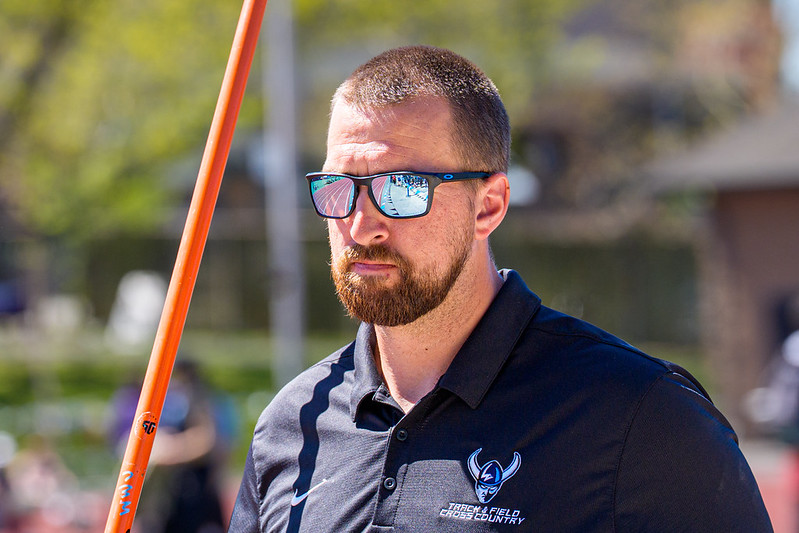
Damien Fisher spent most of his summers for a decade throwing heavy objects while wearing a kilt. That unusual hobby turned into a professional career, and it quietly made him one of the more distinctive strength coaches in college athletics in the Pacific Northwest.
Fisher is the head strength and conditioning coach at Western Washington University in Bellingham, where he also serves as the throws coach for the Vikings track and field team. He is a two-time national champion in the Highland Games, the Scottish festival rooted in Celtic tradition that has competitors flip logs, hurl heavy metal weights on chains, and pitch burlap bags filled with straw over a high bar using a pitchfork. Fisher competed for ten years, qualified for the world championships five times, and placed second nationally in 2023 and third in 2022.
From Bellingham to the Games Circuit
Fisher's connection to the Highland Games began closer to home than most would guess. After completing his education at Western Washington University in 2014, where he was also a reserve on the 2012 national championship basketball team, he and his wife Emma started attending the Highland Games then held in nearby Ferndale, Washington. Emma had a fondness for bagpipes, and the couple decided to check it out together. That casual visit planted the seed for what became a decade-long competitive career.
Fisher transitioned from amateur to professional competitor after just over one season when another competitor asked if he had considered going pro. His initial reaction was disbelief, followed quickly by yes. "They paid me to fly around North America and throw rocks," he said. Competitors on the professional circuit can earn income through performance results, appearance fees, sponsorships, and coaching side work.
The nine events in the Highland Games include the stone put, similar to the Olympic shot put; the caber toss, which involves flipping a long wooden log end over end; throwing a heavy metal weight on a chain for distance; and the sheaf toss, which uses a pitchfork to launch a 20-pound burlap bag over a progressively raised horizontal bar. The games trace their roots to Scotland and Ireland in the 11th century and remain a staple of Celtic cultural festivals across North America.
How Throwing Rocks Makes Better Athletes
Fisher's competitive career overlapped almost entirely with his coaching career at Western, and he says the two fed each other in ways that are hard to replicate in a purely academic setting. Because he was still competing at a high level, he could test different training structures on himself before applying them to student athletes. He experimented with development programs, kept current on mental training techniques, and could speak from direct experience when pushing athletes through difficult sessions.
Coaches who have been recent competitors bring a credibility to the weight room that is difficult to manufacture otherwise. At WWU Athletics, Fisher works across multiple sports, providing strength and conditioning support to programs competing in the Great Northwest Athletic Conference. A photo from the 2025 GNAC Championships shows him working directly with an athlete on the floor, not watching from a distance.
The Highland Games also kept Fisher intellectually engaged. The events require a blend of explosive power, technique, and rotational strength that maps reasonably well onto the demands placed on track and field throws athletes. A caber toss is not so different from the mental discipline required in the discus or hammer throw: the athlete must coordinate full-body power generation with precise timing and direction, and the penalty for a mental lapse is immediate and visible.
Fisher served as Western's throws coach in addition to his strength and conditioning duties, giving him a direct pipeline between the general fitness work he does with all athletes and the specific technical development he manages with throwers. That dual role is relatively uncommon and gives him a fuller picture of each athlete's physical development.
A Career That Came Full Circle in Ferndale
There is something fitting about the fact that Fisher's Highland Games journey started at a festival in Ferndale, a city of roughly 17,000 people about ten miles north of Bellingham on the Nooksack River plain. The Ferndale games no longer operate in the same form, but the region's Celtic community remains active, with the Bellingham Celtic Festival drawing performers and competitors from across the Pacific Northwest each year. Fisher's career arc from Ferndale festival-goer to two-time national champion is a local story as much as an athletic one.
He and Emma both competed for Western's track and field team after meeting in high school, which means their shared athletic history runs deep into the institution he now serves as a coach. That kind of institutional continuity is part of what makes Western's athletics programs feel rooted in the community rather than imported.
Fisher stepped back from Highland Games competition last year after a decade on the circuit, ending a run that took him from a casual Ferndale spectator to a figure well known in the niche but passionate world of Celtic athletics. His retirement from competition does not appear to have diminished his coaching intensity. If anything, it may have freed up the mental bandwidth that competitive prep demands and redirected it toward the student athletes in his charge.
What This Means for WWU's Student Athletes
For Western Washington University athletes preparing for the 2026-27 academic year, Fisher represents an unusual combination: a coach with genuine elite competitive experience, a deep technical background in throwing events, and a philosophy built around staying curious and experimenting rather than defaulting to whatever training template came before.
Western competes at the NCAA Division II level and has a strong tradition in track and field and other sports within the GNAC. The Bellingham campus sits against the backdrop of the Chuckanut Mountains and the Salish Sea, and its athletic department has punched above its weight in recruiting and developing Pacific Northwest talent. A strength coach who once flew around North America throwing rocks for money is, in a way, a perfect fit for a program that values hard work and a certain irreverence about how things are supposed to be done.
More information about Western Washington University's athletics programs and staff is available through the WWU Athletics department website. The Vikings' fall sports season, including cross country and soccer, is now underway.