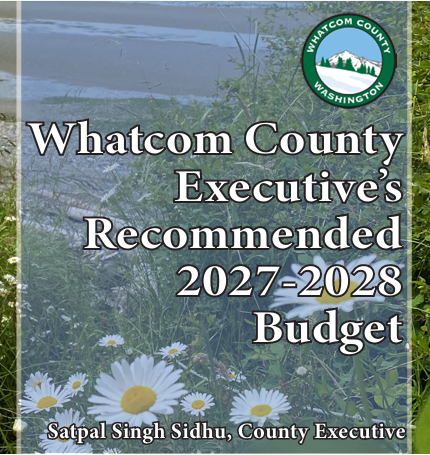
Whatcom County Executive Satpal Sidhu transmitted his recommended budget for the 2027-2028 biennium to the County Council on September 1, setting up months of deliberations before an anticipated adoption vote in late November. The proposal responds to what Sidhu described as an extraordinary fiscal challenge, with county revenues eroded by inflation and sales tax receipts stagnating while operating costs have risen across nearly every department.
The recommended budget includes both significant spending reductions and three new revenue measures, seeking a balance between maintaining core services and putting the county on a more sustainable financial footing heading into the next two-year budget cycle. The challenge is not unique to Whatcom County; municipalities and counties across Washington State have grappled with the same structural tension between post-pandemic cost inflation and revenue streams that have not kept pace, particularly sales tax collections that tend to flatten during periods of consumer caution.
What the Budget Cuts and Why
On the expense side, the Sidhu administration is recommending the elimination of 35 full-time positions, with the county noting that most of those positions are currently vacant. Cutting vacant positions avoids layoffs but still represents a structural reduction in staffing capacity, meaning departments will have less flexibility to fill roles as needs evolve. When a vacant position is eliminated rather than simply left unfilled temporarily, it removes the funding authorization permanently from the budget, making it harder to rebuild capacity in future cycles even if revenues improve. Additional cuts come through reductions to service contracts and individual department budgets, which together are projected to generate approximately $5 million in savings over the biennium.
Sidhu framed the cuts as a matter of aligning resources with priorities rather than an across-the-board retreat. "By aligning our resources with critical priorities, we aim to strengthen the County's financial stability and continue providing equitable, high-quality services, even in uncertain times," he said in a statement accompanying the budget transmission. He also described the recommended budget as a "responsible and balanced approach" that aims to safeguard essential services while addressing long-standing infrastructure issues for delivering those services.
The budget document does not specify which departments will absorb the position eliminations beyond noting they are mostly vacant slots. The County Council's deliberation process, which begins with a formal presentation at the September 15 council meeting, is expected to probe those details and give department heads and the public a clearer picture of where reductions will land. Department heads typically appear before the council during the fall budget review season to explain their spending plans and, in years like this one, to defend the cuts they have been asked to absorb. That process often surfaces tradeoffs that are not visible in the top-line numbers.
The $5 million in savings from position eliminations and contract reductions is significant but not enough on its own to close what Sidhu has characterized as an extraordinary fiscal gap. That is why the revenue side of the proposed budget carries so much weight in this cycle. Without new revenue, the cuts would need to go considerably deeper to produce a balanced biennium.
Three Revenue Measures on the Table
Alongside the cuts, the recommended budget proposes three distinct mechanisms to bring in additional money. The first would use banked capacity in the flood control zone district levy specifically for critical flood-related projects along the Nooksack River. Washington State law allows taxing districts to "bank" unused levy capacity from prior years, meaning a district that has not levied the maximum amount it is legally permitted to collect can carry that unused capacity forward and deploy it in a later year without going through the same voter authorization process that would be required for a brand-new levy. The Nooksack corridor, which runs through Everson, Sumas, and the farmlands of the Lynden area, has experienced repeated severe flooding in recent years, including the catastrophic 2021 flooding that inundated agricultural land and cut off communities for days. The county has long-standing flood infrastructure obligations in that basin, and accessing banked levy capacity would give the flood control district a way to fund critical projects without asking voters for new authorization in this cycle.
The second revenue measure would increase the revenue capacity of the general fund, though the budget documents do not specify the precise mechanism. Options available to Washington counties for general fund revenue increases typically include levying property taxes closer to statutory maximums, accessing banked general fund levy capacity, or seeking voter approval for additional levies. The council deliberations in September and October are likely to clarify exactly what this measure entails and how much revenue it is expected to generate over the biennium.
The third and perhaps most politically significant proposal is a ferry district levy that would free up money in the county road fund and help fund replacement of the 64-year-old Whatcom Chief ferry serving Lummi Island. The aging vessel has been the subject of ongoing discussion about its operational lifespan and replacement cost for years. Ferry vessels of that age require increasingly intensive maintenance and face the risk of unplanned mechanical failures that can strand island residents without vehicle access. A dedicated ferry district levy would give the county a new funding stream specifically tied to that infrastructure need, separating it from the road fund budget competition and providing a more predictable revenue source for what is expected to be a substantial capital expenditure.
Executive Sidhu also placed the budget in a longer-term context, arguing that sustainable local government depends more on economic growth than on tax increases. "The stability and sustainability of our local government will depend not on how much we can tax ourselves but rather on whether we can implement policies that foster economic growth and expand our tax base," he said. That framing is consistent with positions Sidhu has taken throughout his tenure and signals that the administration sees the current budget pressures as partly a symptom of a regional economy that has not generated the commercial and industrial growth needed to keep sales tax revenues growing alongside costs.
What Happens Next and How to Weigh In
The Whatcom County Council will receive the full budget presentation at its September 15 meeting, marking the formal start of the deliberation calendar. Council sessions examining individual department budgets and the revenue measures will follow throughout September and October, with public comment opportunities built into the process. The council has the authority to modify the executive's recommended budget before adoption, and in past cycles has made targeted adjustments to both the spending and revenue sides of the proposed plan. Councilmembers may choose to restore some of the eliminated positions, modify the revenue measures, or add conditions to how banked levy capacity is deployed.
Residents who want to ask questions in person outside of a formal council meeting can attend the county's second annual Government Open House, scheduled for September 30 from 6 to 7:30 p.m. at the County Courthouse at 311 Grand Avenue in Bellingham. The open house format allows attendees to speak directly with county staff and elected officials in a less formal setting than a council meeting, making it easier for residents to get specific questions answered about how the budget affects programs or services they rely on. Staff from individual departments are typically present at events like this, offering a more accessible entry point than the formal testimony process at council meetings.
The full budget documents, along with the Executive's letter to the County Council, are available on the Whatcom County website. Final adoption is anticipated in late November, following what is typically the most intensive period of public engagement in the county's two-year budget cycle. The window between October and late November is when the council makes its most consequential amendments and when public testimony has the greatest likelihood of influencing final decisions. Residents with strong views on any aspect of the budget, whether the position eliminations, the ferry levy, or the flood control spending, are best positioned to have an impact if they engage during that period rather than waiting until after adoption. For context on the county's fiscal picture heading into this budget season, earlier reporting on the initial budget announcement has background on the revenue pressures driving the proposed changes.