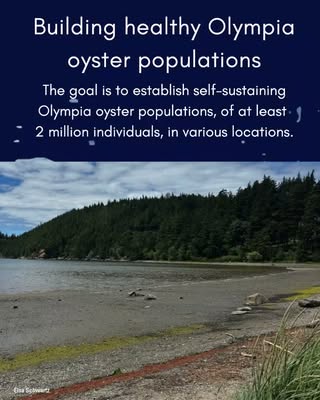
A small but mighty shellfish is making a comeback in the waters off Whatcom County, and local volunteers are playing a central role in the effort. The Whatcom Marine Resources Committee, working alongside regional partners, is running an active restoration program aimed at recovering Olympia oysters, Washington's only native oyster species, at key sites around the county.
Olympia oysters once blanketed the Salish Sea in dense beds from the Fraser River delta to Puget Sound. By the early 20th century, overharvesting had stripped those populations nearly bare. Decades of habitat loss, waterway pollution, and changing water chemistry then prevented recovery. Today, Olympia oyster populations sit at roughly 5 percent of their historical abundance, according to regional restoration partners, making the species one of the Pacific Coast's most significant marine conservation priorities.
Why Olympia Oysters Matter for Whatcom's Shorelines
Olympia oysters, known by their scientific name Ostrea lurida, are far smaller than the Pacific oysters most people picture on a half shell. A mature Olympia rarely grows larger than a silver dollar. But their ecological footprint is outsized. The species acts as a natural water filter, processing algae and suspended particles from the water column and improving clarity and quality for other marine life. Their reef-forming habit also creates three-dimensional habitat for juvenile fish, crabs, and invertebrates, essentially building the base of a complex food web where bare substrate existed before.
For Whatcom County, which includes miles of shoreline along Bellingham Bay, Birch Bay, and the waters of the Lummi Nation, the health of those nearshore ecosystems has direct consequences. Cleaner water benefits shellfish harvesting by tribes and commercial operators alike, supports the salmon populations that enter local streams, and contributes to the tourism economy centered on the county's waterfront communities.
Regional partners in the restoration effort include the Whatcom Marine Resources Committee, which coordinates volunteer efforts and tracks progress through its dedicated Olympia Oyster Restoration Project page. The MRC functions as part of a statewide network of marine resource committees that advise county governments and state agencies on nearshore habitat issues.
How the Restoration Program Works
Restoring a species whose population has been at a fraction of historical levels for more than a century requires patience and precise fieldwork. The Whatcom MRC's approach focuses on establishing self-sustaining populations at select sites in the county rather than transplanting oysters that simply depend on continuous restocking.
Volunteers are a critical part of the work. Restoration crews collect and clean shell material, which provides the hard substrate that oyster larvae, called spat, need to settle and grow. Without this so-called cultch, free-swimming larvae cannot attach and mature. Volunteers also help with monitoring deployed shell bags, recording settlement rates, and maintaining equipment at restoration sites.
The work runs year-round, following the seasonal rhythms of oyster spawning and growth. Summer months, when water temperatures rise and oysters spawn, are particularly active periods for larval settlement monitoring. Fall and winter work focuses on site maintenance and data collection that feeds into multi-year population assessments.
The Salish Sea region has seen a coordinated push on Olympia oyster restoration over the past two decades. Tribal nations, conservation districts, state agencies, and community groups have collaborated on dozens of projects from British Columbia to southern Puget Sound. The Whatcom effort is part of that broader network, sharing data and techniques with partner programs tracking recovery across the species' historic range.
How to Get Involved in Whatcom County
The Whatcom MRC actively recruits volunteers for Olympia oyster restoration work. No prior marine biology background is required, though a willingness to get muddy at low tide is helpful. Past volunteer days have drawn retirees, students, families, and anyone with an interest in hands-on conservation. The committee provides training and all necessary equipment.
Those interested can follow project updates and track restoration progress on the MRC's dedicated project page at whatcomcountymrc.org. The page includes information on upcoming volunteer events, background on the science behind the restoration approach, and data from monitoring efforts at active sites in Whatcom County.
For broader context on the species and its Pacific Coast decline, the Pacific Coast Shellfish Growers Association and regional conservation groups have published extensive resources on Olympia oyster ecology and the factors that drove populations to near-collapse. Researchers from the University of Washington and Washington Sea Grant have also been tracking restoration outcomes across Puget Sound to assess which habitat types are seeing the strongest recovery.
The Whatcom MRC's oyster work is one piece of a larger shoreline stewardship picture in the county. Related restoration and monitoring efforts on the Nooksack River, Lake Whatcom, and nearshore zones of Bellingham Bay reflect the county's sustained investment in the health of its water resources. Residents who want to support that broader mission can start with a volunteer shift shucking old shells and planting the seeds of a native species comeback, one low tide at a time. For a closer look at another recent local conservation effort in the area, more details are available on waterway protection work happening along Whatcom's coastline.