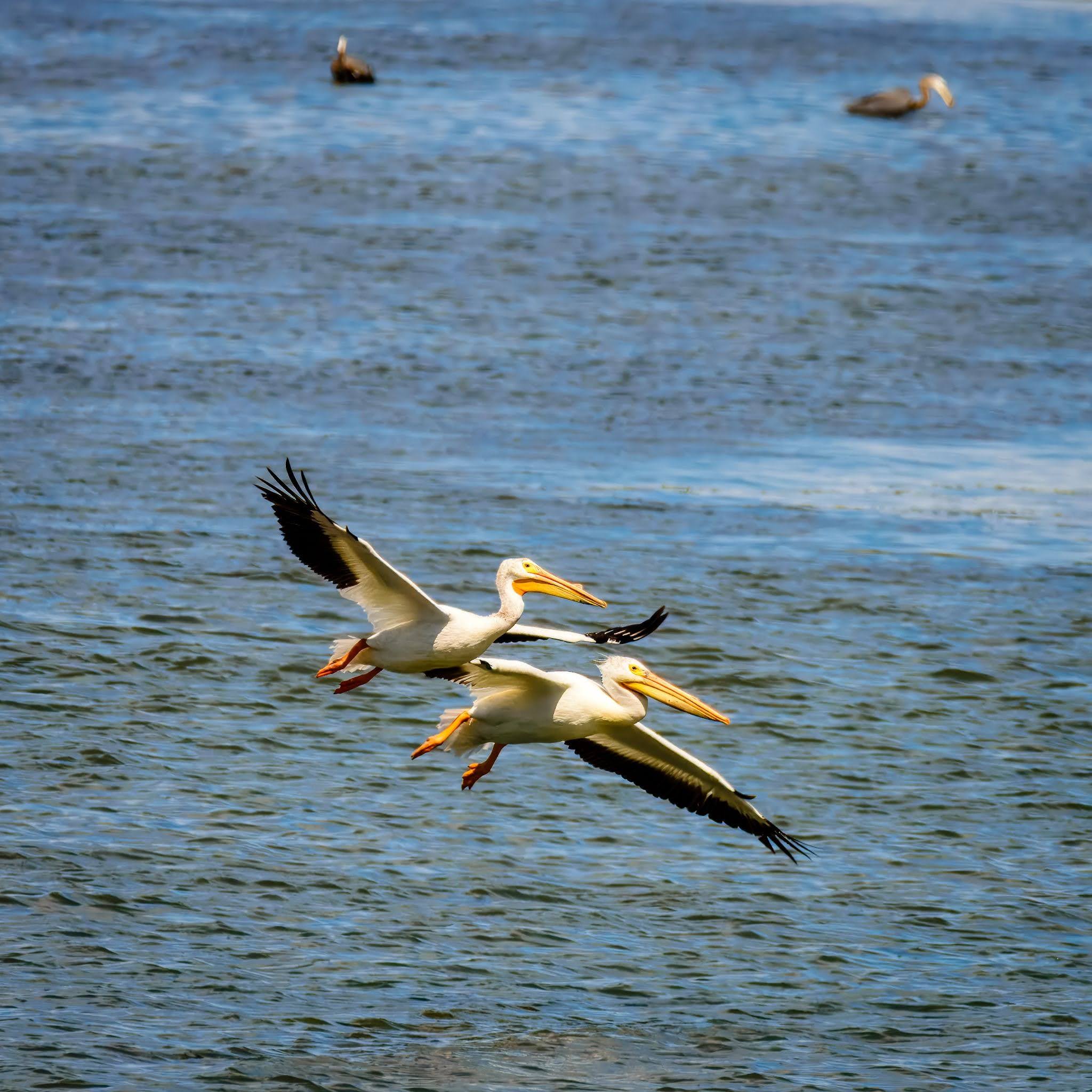
Something unusual has been happening in Padilla Bay, the broad tidal estuary tucked between the Samish Island peninsula and the Skagit flats on the south edge of Whatcom County. American white pelicans, birds that once rarely ventured this far into the Salish Sea, have been arriving in increasing numbers each summer since around 2016. This year, observers estimate that roughly 200 pelicans appear to be living in the bay year-round, with hundreds more arriving for the summer season.
Where They Come From and Why Now
The likely origin of Padilla Bay's growing pelican population is McNary National Wildlife Refuge, Washington's largest pelican breeding colony, located near the confluence of the Columbia and Snake Rivers about 300 miles southeast of the Salish Sea. The refuge was established in 1956, but it took until 1994 for pelican numbers there to stabilize enough to sustain a consistent breeding population. Decades of hunting pressure and pesticide contamination had suppressed the birds' numbers across the region.
Today, McNary supports an estimated 5,500 breeding adult pelicans. That colony has grown to the point where the available food supply and suitable terrain can no longer support unlimited expansion. Juvenile pelicans are increasingly being pushed to find food and potential breeding grounds farther afield, and Padilla Bay, with its broad marshy wetland and relatively low human density compared to many Puget Sound shorelines, looks attractive from a bird's-eye view.
"If you consider the size of the colony on McNary, the fact that they've sort of used up all the potentially good terrain that's available, it suggests that they're simply an offshoot colony, just looking for a new place," said Stephen Chase, a member of the North Cascades Audubon Society. Chase has been tracking the Padilla Bay pelicans this season and described the pattern of arrival as consistent with how pelicans typically scout and colonize new locations. A single "scout" bird often arrives first and is followed weeks later by a much larger group.
Fireworks, Disturbance, and Failed Nesting
Despite the growing population and seemingly ideal conditions, the pelicans at Padilla Bay have not successfully nested. Breeding adults appear to have arrived with the intention of establishing a colony this spring, but the Fourth of July holiday disrupted those plans in a decisive way.
Fireworks displays around the bay and at March Point, a popular beach area that sees heavy boat traffic during summer holidays, generated the kind of noise and human activity that pelicans are notoriously intolerant of during nesting season. The birds abandoned their nests after the holiday weekend. According to Chase, all nests were abandoned after the Fourth of July, and any eggs or young chicks that had been laid were left behind. Since then, the bay's pelican population has consisted almost entirely of first-year birds and non-breeding young adults.
"My hunch is that fireworks spooked them off," Chase said. "All of the nests were abandoned after the Fourth. If there were any young, they were just simply left to starve and die. Since then, it's almost all been first year birds or young adults that aren't interested in breeding."
Pelicans have a long history of abandoning breeding sites in response to human disturbance. Water diversions and agricultural encroachment drove the species out of Moses Lake in eastern Washington in the 1920s, and a subsequent attempt to recolonize that area in the 1930s also failed due to human-caused competition. The same dynamics may now be playing out at Padilla Bay. Seasonal human activity, including fireworks, powerboating, and beach recreation, concentrates precisely during the summer months when nesting birds are most vulnerable.
What Birdwatchers and Scientists Are Watching For
Wildlife photographer Michael McAuliffe was among the first to document the pelicans in Padilla Bay, photographing around 30 birds in 2017 after hearing reports of their arrival. He says he believes the pelicans will continue migrating to Western Washington in coming years, though whether they will ever be able to establish a stable breeding colony is less certain.
"If they keep having nest failures, I think they'll just up and leave," Chase said, drawing the parallel to Moses Lake. "They were dealing with human-caused competition and just quit en masse."
The American white pelican is not a species in crisis nationally, but its potential establishment as a Western Washington breeding population would be biologically significant and a marker of how far the McNary colony's expansion has reached. For birders, Padilla Bay is already one of the region's most rewarding destinations. The Padilla Bay National Estuarine Research Reserve manages much of the bay as protected habitat and maintains trails and an interpretive center near Bay View that are open to the public year-round.
Anyone hoping to observe the pelicans this summer should visit soon. Summer populations have been substantial, but as breeding adults drift elsewhere and the non-breeding juveniles begin to follow, numbers may thin before fall. The reserve's birdwatching resources and North Cascades Audubon Society trip reports are good resources for current sightings and access information. For other recent wildlife and environmental news from the region, environmental stewardship along Bellingham Bay offers related context on how the local shoreline is changing.