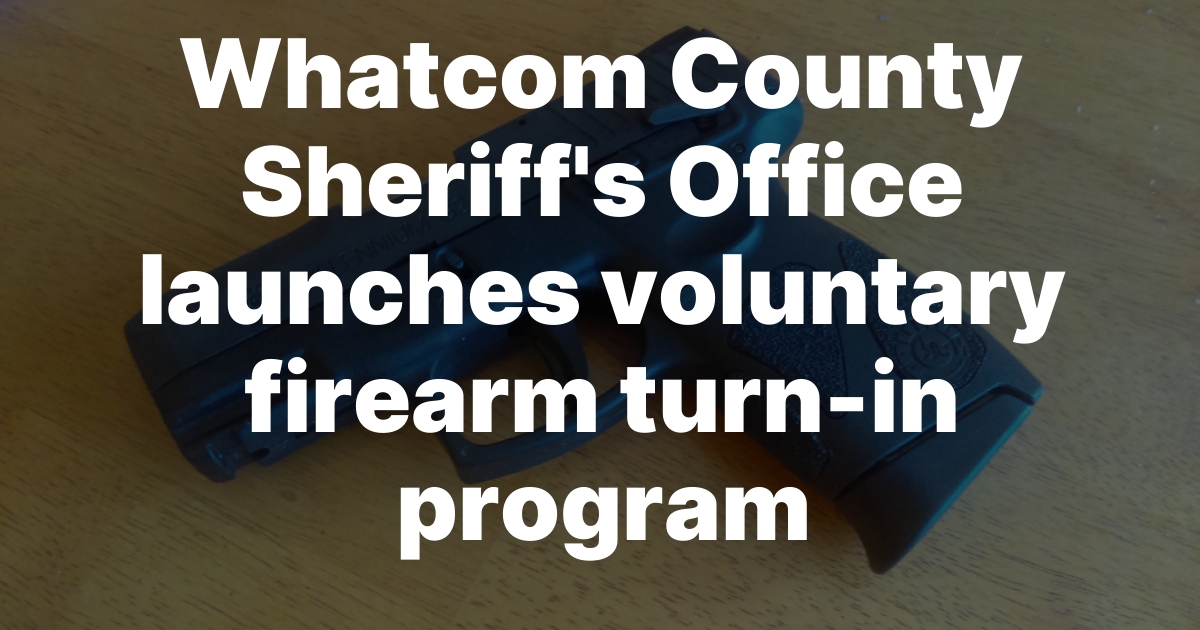
The Whatcom County Sheriff's Office has launched a new voluntary firearm turn-in program that offers residents gift cards in exchange for surrendering unwanted guns, with values ranging from $50 for non-functional firearms up to $300 for AR-15, AK-47, or machine gun-style weapons. The program, called Whatcom Safe Exchange, is funded through a state grant and operates on a strictly anonymous, appointment-based model in downtown Bellingham.
Sheriff Donnell Tanksley announced the program as a way to remove firearms from homes where they may pose risks of theft, accident, or misuse, without requiring residents to explain their reasons for turning in a weapon or face any legal scrutiny in doing so. The launch represents one of the more structured and sustained firearm reduction efforts the county has undertaken, giving residents a full year of scheduled appointment windows rather than a single high-visibility buyback event.
How the Program Works
Residents who wish to participate schedule a Friday morning appointment online, available between 9 a.m. and 11:30 a.m., through a booking link on the Sheriff's Office website. Appointments are available through July 30, 2027, giving the program a full year of operation from its launch. The extended appointment window is a deliberate design choice, allowing community members to participate on their own timeline rather than having to learn about a single event in time to attend it.
On the day of their appointment, participants drive to a Whatcom County Sheriff's Office parking area in downtown Bellingham with their firearm unloaded and secured inside their vehicle. Deputies approach the vehicle, retrieve the firearm, and issue the appropriate gift card. No paperwork is required from the resident, and the process is designed to be anonymous. The curbside, vehicle-based model means participants never have to handle a firearm in a public space or interact with law enforcement in any way beyond the brief exchange at their car window.
Gift card values are set by firearm type: $50 for non-functional firearms, $100 for rifles and shotguns, $200 for handguns and revolvers, and $300 for AR-15, AK-47, or machine gun-style firearms. The tiered structure reflects both market value and the public safety calculus around different weapon categories, with higher-capacity and higher-lethality platforms commanding the largest incentives. The program accepts handguns, rifles, shotguns, assault-style weapons, and antique or inherited firearms. Ammunition and explosives are not accepted. Turned-in firearms are documented and then destroyed according to department policy and state law, with limited exceptions for weapons converted to training or display use.
The appointment-only format also gives the Sheriff's Office the ability to manage the flow of participants predictably, ensuring deputies are available and prepared to handle each firearm safely. Participants are not asked why they are surrendering a weapon, and nothing about the transaction is shared with any other law enforcement database or registry. The Sheriff's Office has emphasized that no legal consequences can flow from participating, regardless of the history of the firearm being surrendered.
Where the Funding Comes From
The program is funded through a $125,000 grant awarded to the Whatcom County Sheriff's Office by the Washington State Attorney General's Office. The grant is drawn from a $3 million settlement with Federal Way Discount Guns, which was found to have violated state law regarding the sale of high-capacity magazines. The settlement funds were distributed to 12 law enforcement agencies across Washington State specifically to support voluntary firearm reduction programs.
The settlement origins of the funding are worth understanding in context. High-capacity magazines are regulated under Washington State law, and their illegal sale was the violation at the center of the Federal Way Discount Guns case. Directing the resulting settlement money toward programs that remove high-capacity weapons from circulation reflects a deliberate policy choice by the Attorney General's Office to connect the remedy to the harm. The $3 million was divided among 12 agencies, with Whatcom County receiving $125,000, one of the larger individual grants in the distribution.
A comparable program funded by the same grant in Federal Way collected 70 firearms in a single buyback event on August 16, 2025, distributing $9,875 in gift cards. That event took in 21 rifles, 18 handguns, 17 shotguns, 6 revolvers, 6 AR or carbine rifles, 1 muzzle loader, and 1 non-functional firearm. The Federal Way results offer a useful benchmark for what Whatcom County's year-long program might expect to collect over time. If Whatcom County's sustained appointment model reaches similar per-event participation rates across multiple months of Friday appointments, the total number of firearms removed could significantly exceed what a single event would achieve.
The $9,875 spent in Federal Way also illustrates how far the grant funding can stretch. At an average of roughly $141 per firearm collected, the $125,000 Whatcom County received could theoretically fund the removal of several hundred weapons if participation is steady and the mix of firearm types remains similar to what Federal Way collected.
Why Voluntary Turn-In Programs Matter
Research on firearm turn-in and buyback programs shows mixed results on their impact on gun violence broadly, but the programs are generally credited with removing specific categories of risk: firearms that are inherited and unwanted by the new owner, weapons that are aging or malfunctioning, and guns held by households where someone's circumstances have changed in ways that make having a firearm feel less appropriate or more dangerous.
Seniors who have lived alone after a spouse's death, families clearing out a relative's home after a loved one passes, and people who have experienced a mental health crisis or significant life transition are among the populations most likely to benefit from a no-questions, no-judgment option to remove a firearm from the home. In each of those scenarios, the person holding the gun may not have sought it out, may not know how to store it safely, and may not know what legal options exist for getting rid of it without creating liability or paperwork. The anonymous nature of the Whatcom Safe Exchange program is specifically designed to lower the barrier for these residents.
There is also a practical argument around gun theft. Firearms that sit unused in homes, particularly in households where no one is actively familiar with safe storage practices, represent a meaningful source of guns that eventually end up stolen and circulated into criminal markets. Removing those firearms through a no-cost, no-hassle program addresses a pipeline that is difficult to disrupt through other means.
Gun safety and storage have been ongoing topics in Whatcom County, where the combination of rural areas with high firearm ownership rates and urban communities navigating issues of gun violence creates a complex public health landscape. Programs that address both ends of that spectrum, from rural households with unwanted inherited weapons to urban households seeking to reduce risk, are part of the Sheriff's Office effort to meet community members where they are. The year-long window of the Whatcom Safe Exchange program, with its recurring Friday appointment slots, reflects an understanding that outreach on this issue requires sustained presence rather than a single media cycle.
Critics of buyback programs often point out that the guns most likely to be surrendered are not the guns most likely to be used in violent crimes, and that argument has merit in the academic literature. But proponents counter that the goal of a voluntary program is not to disarm active offenders, who will not participate, but to address the quieter and more diffuse risks that accumulate in households where firearms have outlasted the circumstances that originally brought them in. Both of those arguments can be true at the same time, and the Sheriff's Office has been careful to frame Whatcom Safe Exchange around the latter goal rather than overstating its likely impact on violent crime statistics.
For residents interested in participating, the full program details and appointment scheduling link are available through the Whatcom County website. Questions about the program can be directed to the Sheriff's Office. More on public safety programs and community resources in Whatcom County is available in earlier coverage of local law enforcement initiatives.