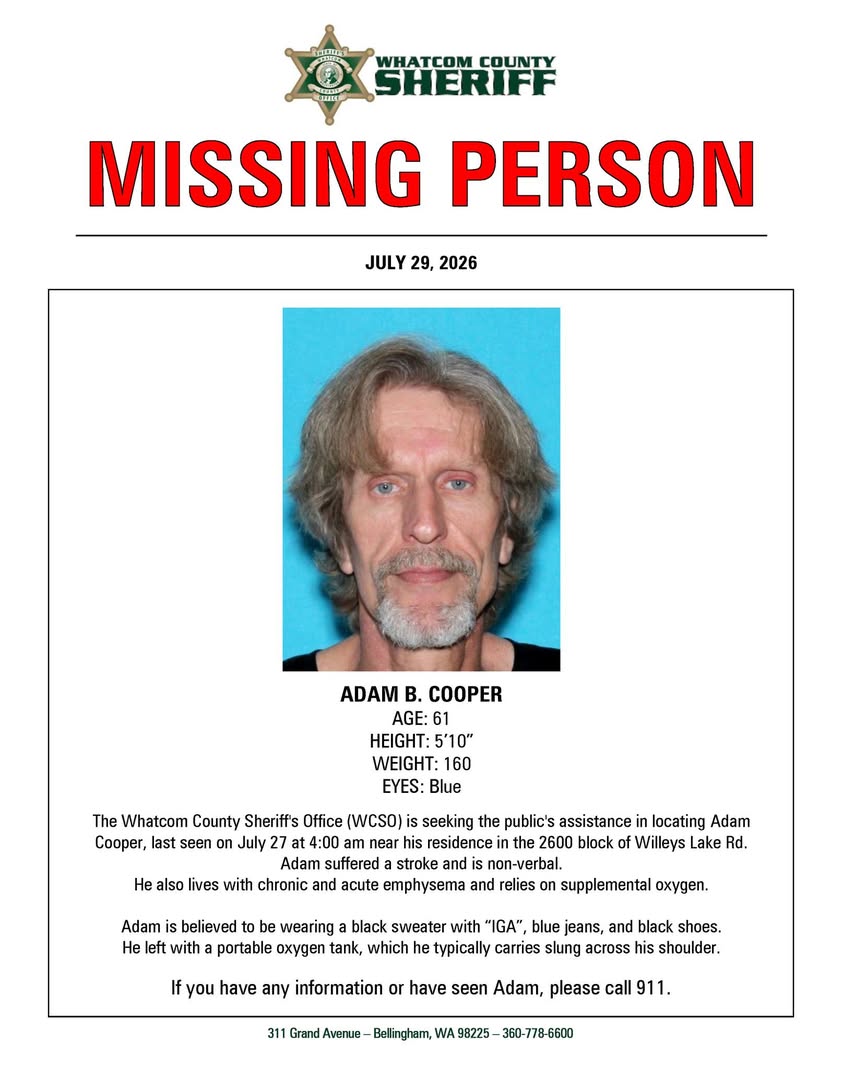
A missing person alert issued by the Whatcom County Sheriff's Office was resolved on Tuesday afternoon when the subject of the search, 61-year-old Adam B. Cooper, was located safe. The sheriff's office confirmed at approximately 12:30 p.m. on July 29 that Cooper had been found, thanking the public for its assistance in the effort.
Who Was Missing and Why It Was Urgent
Cooper was last seen on July 27 at 4 a.m. near his residence in the 2600 block of Willeys Lake Road, a rural stretch in the Custer area in northern Whatcom County. He had not been seen for more than two full days before the alert went out, a timeframe that made the search increasingly urgent given his health conditions.
Cooper had suffered a stroke and is non-verbal, meaning he could not call out for help or communicate his location if he became lost or disoriented. He also lives with chronic and acute emphysema and relies on supplemental oxygen to breathe. He was believed to have left home with a portable oxygen tank, which he typically carries slung across one shoulder. Deputies described him as wearing a black sweater with the letters "IGA" on it, blue jeans, and black shoes at the time of his disappearance.
The combination of non-verbal communication, oxygen dependency, and a history of stroke placed Cooper in a high-risk category for missing persons cases. Rural northwest Whatcom County contains significant stretches of farmland, tree lines, and ditches that can complicate searches, especially when a missing person is unable to signal rescuers.
How the Search Unfolded
The Whatcom County Sheriff's Office issued the public alert on July 29, providing a physical description and contact information. The sheriff's office asked anyone with information or who had seen Cooper to call 911 immediately. The public response was direct and effective. Within hours of the alert going out, Cooper was located and confirmed safe.
The case echoes patterns seen in several recent missing person incidents in Whatcom County involving individuals with medical conditions who went missing from rural addresses. In each case, early public notification and community awareness have proven to be among the most effective tools available to deputies. Willeys Lake Road is in the Custer vicinity, an unincorporated community roughly 10 miles north of Ferndale and close to the Canadian border zone, where properties are widely spaced and neighbors may not have regular visual contact with one another.
Resources for Families of Vulnerable Missing Persons
Families of individuals with cognitive or physical conditions that could lead to wandering or disorientation are encouraged to register their loved ones with programs designed to speed emergency response. The Whatcom County area has resources available through the sheriff's office for pre-registering individuals at high risk of becoming lost, which can shorten search timelines significantly by giving deputies background information before an emergency occurs.
Washington State also participates in Silver Alert, a notification system modeled on Amber Alert that can broadcast descriptions of missing at-risk adults across highway signs, media outlets, and wireless emergency alert systems. Activation of Silver Alert is evaluated case by case based on the vulnerability of the missing person and the circumstances of the disappearance.
The Whatcom County Sheriff's Office also encourages residents in rural areas to sign up for emergency alerts at WhatcomReady.org, the county's emergency notification platform. Staying connected to that system ensures residents receive timely alerts about missing persons, road closures, and other public safety matters that may require their awareness or assistance.
Cooper's safe recovery is welcome news for his family and the community. The swift resolution is a reminder of how effective a well-targeted public alert can be when the community responds quickly, particularly in cases involving vulnerable adults in rural northwest Whatcom County.