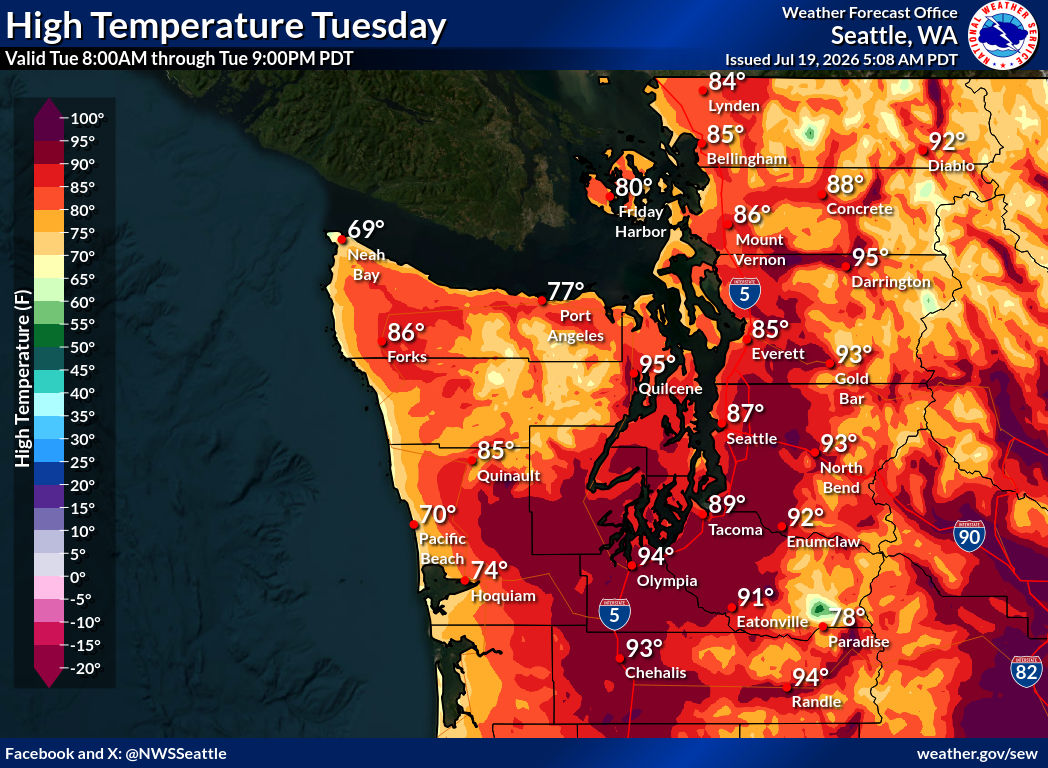
Residents of Bellingham and Whatcom County are heading into one of the warmer stretches of the summer, with a moderate heat advisory in effect for the lowlands of western Washington beginning Tuesday morning and running through 11 p.m. Wednesday. The National Weather Service Seattle office issued the advisory Sunday, July 19, and forecasts temperatures between 80 and 87 degrees in the Bellingham area from Monday through Thursday, with some inland locations expected to push higher.
Layered on top of the heat is a smoke advisory tied to wildfires burning in British Columbia. Beginning Monday, Fraser River valley outflow winds are expected to carry wildfire smoke southward into northwestern Washington. The smoke is forecast to be most concentrated in areas north of Snohomish County, which puts Whatcom County, and particularly communities near the Canadian border such as Blaine, Sumas, and Lynden, in the zone most likely to experience degraded air quality.
Temperature Forecast by Location
The heat will not hit every part of Whatcom County equally. Coastal and waterfront locations tend to run cooler due to marine influence off Bellingham Bay and the Strait of Juan de Fuca. Inland communities in the Nooksack Valley and eastern portions of the county typically see higher peak temperatures. According to the meteoblue forecast cited by Whatcom News as of Sunday morning, Bellingham is expected to reach 80 degrees Monday, 85 Tuesday, and 83 Wednesday. Further inland, Lynden could hit 85 Monday, 89 Tuesday, and 87 Wednesday. Sumas and Everson are projected near 86 to 90 degrees at peak, with Deming and Maple Falls also approaching 90 Tuesday.
Coastal areas will see meaningfully lower readings. Lummi Island is forecast in the mid-70s for most of the week, and Point Roberts, exposed to cooler water temperatures on both sides, may not exceed the low 70s. Sandy Point and Birch Bay are expected in the upper 70s to low 80s.
Stage 2 Burn Ban Remains in Effect
The continuing dry conditions mean Whatcom County's Stage 2 Burn Ban, which took effect July 16, is not expected to be lifted any time soon. The ban prohibits all outdoor burning across unincorporated Whatcom County, including yard debris fires, land clearing burns, and recreational fires such as campfires and fire pits. The Whatcom County Fire Marshal issued the ban citing low fuel moisture levels and persistently dry weather that increases the risk of a fire escaping control.
Anyone caught violating the Stage 2 Burn Ban can face fines and liability for suppression costs if a fire spreads. Residents with questions about what is and is not permitted under the ban can contact the Whatcom County Fire Marshal's office directly.
Three active fires were recently discovered in the North Cascades National Park Service Complex near the Whatcom County border, a reminder that the regional fire risk is not abstract. The Border 1, Border 2, and Luna fires prompted suppression efforts by park service crews, and the smoke drifting down from British Columbia this week adds to the picture of a fire season that is well underway across the broader region.
Staying Safe in the Heat
The National Weather Service and local public health officials recommend several precautions during heat events of this kind. The most important is staying in air conditioning if possible, especially during the hottest part of the afternoon, typically between noon and 6 p.m. People without air conditioning at home should identify a nearby cooling center; Whatcom County libraries and many community centers offer air-conditioned spaces that are open to the public during regular hours.
Hydration is critical. The Occupational Safety and Health Administration recommends workers doing outdoor labor schedule frequent rest breaks in shaded or air-conditioned environments. For anyone spending time outdoors, loose-fitting, light-colored clothing helps reduce heat absorption, and sunscreen should be applied before extended exposure.
Heat stroke is a medical emergency. Symptoms include a body temperature above 103 degrees, hot and dry skin, rapid pulse, confusion, and unconsciousness. Anyone showing signs of heat stroke should be moved immediately to a cool and shaded location and 911 should be called. Heat exhaustion, a less severe precursor, involves heavy sweating, weakness, cold or pale skin, and nausea; moving to a cool area and drinking water can resolve heat exhaustion before it progresses.
Pets are vulnerable to heat as well. Dogs should not be left in parked vehicles, even with windows cracked, and walks should be shifted to early morning or evening hours when pavement temperatures are lower. Asphalt can reach temperatures well above ambient air temperature and can burn paws.
Air Quality and Smoke Outlook
The wildfire smoke arriving from British Columbia this week adds a second layer of concern beyond the temperature. Residents with respiratory conditions, including asthma, COPD, or heart disease, should pay close attention to air quality readings. The Northwest Clean Air Agency, which monitors air quality across Whatcom County, posts daily readings and advisories on its website. When air quality degrades to unhealthy levels, the recommendation is to stay indoors with windows closed, run air filtration if available, and avoid vigorous outdoor exercise.
Real-time air quality data for specific Whatcom County locations is also available through the AirNow.gov platform, which aggregates readings from monitoring stations across the region. Smoke conditions can shift quickly depending on wind direction, so checking readings throughout the day rather than relying on a single morning forecast is advisable.
The heat advisory is expected to lift Wednesday night, with temperatures moderating toward the mid-70s by Friday. Whether the smoke persists into the back half of the week will depend on wind patterns and fire activity in British Columbia. Residents should continue monitoring NWS Seattle for updated forecasts and any extensions to the advisory period.