A new Washington State law redefining the legal boundary between electric bicycles and electric motorcycles took effect on June 11, and the Bellingham Police Department is urging parents and riders to get familiar with the changes before their kids hit the streets this summer.
Senate Bill 6110, which passed during the 2025-26 legislative session, addresses a growing gray area in Washington traffic law. As electric two-wheelers have proliferated, the existing three-class e-bike framework had not kept pace with increasingly powerful bikes that function more like motorcycles than pedal-assist bicycles. The new law preserves the three e-bike classes while creating a separate category for higher-powered electric motorcycles that exceeds the speed and power limits defined for e-bikes.
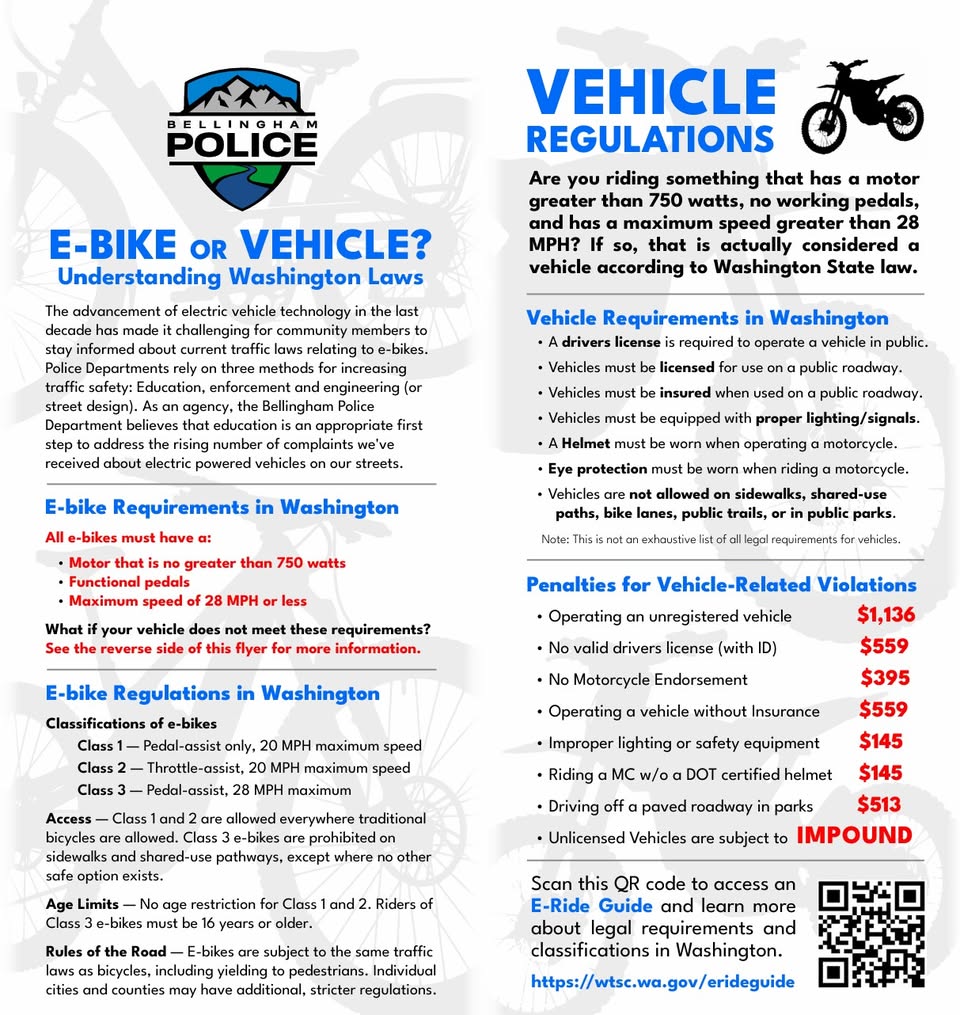
The Bellingham Police Department issued a public notice this week summarizing the key rules. Under the new law, children under 16 are prohibited from riding Class 3 e-bikes and are also barred from riding electric motorcycles on city streets entirely. Riders 16 and older may operate electric motorcycles, but must have the vehicle registered, hold a valid driver's license, and carry a motorcycle endorsement.
The distinction matters because Class 3 e-bikes can reach assisted speeds of up to 28 mph, while electric motorcycles can be significantly faster and heavier. Parents who purchased what they thought was an e-bike may not realize their child's vehicle crosses the line into electric motorcycle territory under the new definitions.
BPD notes that officers will initially focus on education rather than enforcement, stopping young riders to inform them of the new rules before beginning to issue infractions. That grace period will not last indefinitely, and police have not specified how long it will run. The department is also clarifying that electric motorcycles are not permitted on pump tracks in Bellingham city parks, a reminder aimed at a popular activity that has increased as e-motorcycles have become more common.
For parents trying to determine which category their child's vehicle falls into, the Washington Traffic Safety Commission's e-ride guide offers a breakdown of the three e-bike classes and what distinguishes them from electric motorcycles. The full text of SB 6110 is also available on the Washington State Legislature website. BPD noted that a QR code on their informational flyer is currently non-functional, so residents should use the direct links rather than scanning.
E-bike use has grown substantially in Bellingham over the past several years, driven by the city's cycling infrastructure, college population, and hills that make pedal-assist an attractive option for everyday commuters. The new law is expected to have the most immediate impact on families with middle and high school-aged children who use e-bikes for school commutes or recreational riding.
The bottom line for Bellingham parents: if your child's electric bike tops out over 28 mph or lacks functional pedals, it likely qualifies as an electric motorcycle under the new law, and a teenager under 16 cannot ride it legally on city streets. For riders 16 and up on those more powerful machines, registration and a motorcycle endorsement are now required. When in doubt, the WTSC guide linked above is the clearest reference available.