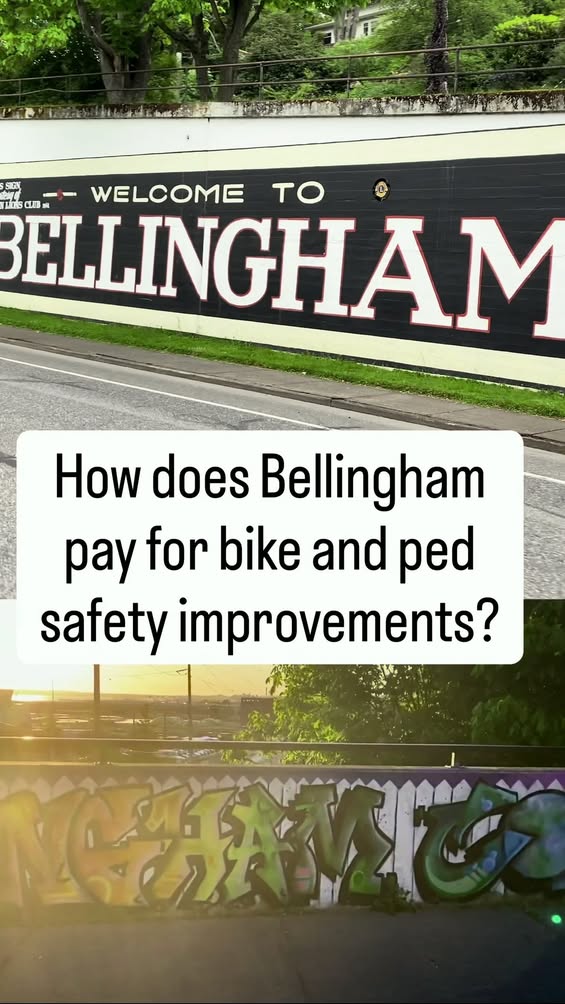
Every time you cross Bellingham on a marked bike lane, step on a push-button activated flashing crosswalk, or ride the new James Street multimodal path under construction north of Telegraph Road, you are using infrastructure funded by a specific mechanism most residents rarely think about: a voter-approved 0.02% transportation sales tax combined with state and federal grants. City Public Works Assistant Director of Transportation Tim Hohmann recently explained how the system works in a video shared by the City of Bellingham.
The dedicated transportation tax was approved by Bellingham voters and specifically earmarks revenue for bike, pedestrian, and transit improvements across the city. At 0.02%, the tax adds two cents for every $100 spent within city limits, generating a steady, predictable stream of local funding that the city can use for smaller spot improvements without competing against general fund priorities like roads, utilities, or public safety.
That predictability matters more than the raw dollar amount. The city is able to improve a dozen or more locations each year using this dedicated stream, targeting intersections, trail gaps, and crossings identified in the Bellingham Bicycle Master Plan and the companion Pedestrian Master Plan, both updated in 2024. Without a dedicated fund, these smaller projects would frequently be deferred as budget cycles tighten.
The bigger impact, however, comes from what local funding unlocks: an average of $17 million per year in state and federal grants. That multiplier effect is the engine behind larger capital projects. Federal transportation programs, including those administered through the Washington State Department of Transportation, typically require a local match from applicants. Having a dedicated local funding stream both satisfies match requirements and signals to granting agencies that Bellingham has the institutional commitment to see projects through to completion.
The James Street multimodal path, now under construction north of Telegraph Road, is one example of that larger-project tier. The corridor connects neighborhoods to downtown and Whatcom Community College, serving cyclists, pedestrians, and transit riders along one of the city's busier arterials. Projects of that scale require planning horizons measured in years, environmental review, right-of-way acquisition in some cases, and construction budgets well beyond what the local tax alone could fund. The grant leverage makes them viable.
Bike Month, which runs through May, serves as an annual touchpoint for the city to highlight transportation investments and encourage residents to try commuting or running errands by bike. Bellingham's terrain, which ranges from flat bay-level corridors to steep Sehome Hill grades, means the infrastructure improvements matter most in the areas that would otherwise deter less confident cyclists from trying.
For residents who want to know what improvements are planned for their neighborhood or corridor, the City of Bellingham Public Works department maintains project lists and maps online. Community input is also part of the planning process, particularly for larger projects where design choices affect adjacent property owners and trail users.
The James Street path construction is ongoing. Residents using the corridor can expect some disruption during active work periods. When complete, it will be one of the more substantial additions to the city's multimodal network in recent years.