The Whatcom County Marine Resources Committee has launched a pilot Olympia oyster restoration project in Drayton Harbor, deploying roughly 200,000 baby native oysters in a coordinated effort to restore one of the Salish Sea's most ecologically important species. It marks the first major oyster restoration effort of its kind in Drayton Harbor and represents years of planning between local, state, and nonprofit partners.
Olympia oysters, known scientifically as Ostrea lurida, are the only oyster species native to Washington State. Once abundant throughout Puget Sound and the Salish Sea, their populations collapsed over the past 150 years due to a combination of overharvesting, habitat loss, and pollution from industrial activities. The species provides a disproportionate ecological benefit relative to its small size: dense beds filter enormous volumes of water, create structured habitat for juvenile fish and invertebrates, and support the broader food web. According to the Whatcom County MRC project page, the Washington Department of Fish and Wildlife identified Drayton Harbor and North Chuckanut Bay as historically significant Olympia oyster sites before commercial exploitation wiped them out.
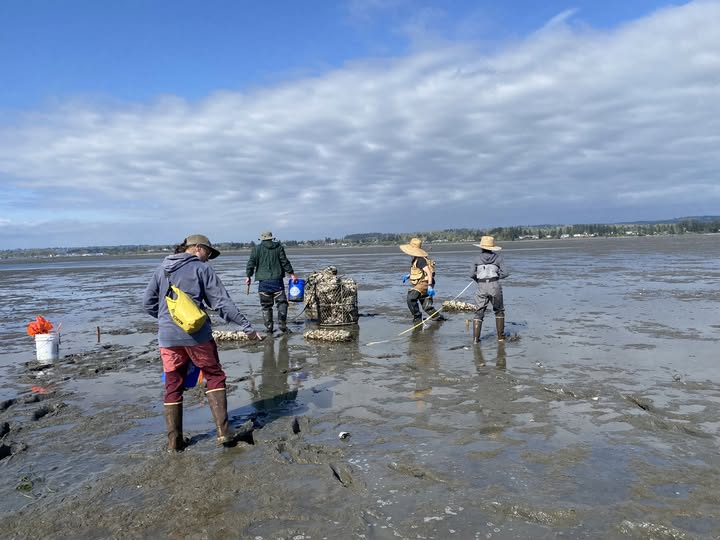
The MRC deployed 150 bags of Olympia oyster cultch, a substrate made from Pacific oyster shells that provides a surface for oyster larvae to attach and grow. Packed into those bags were approximately 200,000 baby Olympia oysters, set and ready to begin establishing themselves on the harbor floor. The deployment was carried out in partnership with the state Department of Fish and Wildlife, the Puget Sound Restoration Fund, Drayton Harbor Oyster Company, and community volunteers who helped place the bags at several locations throughout the harbor.
Drayton Harbor sits just south of Blaine, WA, and is well-known locally for its recreational shellfish harvesting and its role in the broader Drayton Harbor estuary ecosystem. The harbor feeds into Semiahmoo Bay and ultimately connects to the Georgia Strait portion of the Salish Sea. Restoring native oysters there has implications not just for the immediate water quality but for the health of salmon and other species that depend on the nearshore habitat the oysters help build and maintain.
The project will enter a monitoring phase next summer, when MRC staff and partners will return to the deployment sites to assess population establishment and survival. They will be looking at whether the oysters are surviving, reproducing, and beginning to build the dense beds that characterize healthy wild populations. If the pilot shows promise, the effort could be scaled up and potentially expanded to North Chuckanut Bay.
This restoration work is part of a longer regional effort coordinated through the Northwest Straits Initiative, which has been supporting marine resource work in Whatcom County and six other northwestern Washington counties for over two decades. Volunteers and community members who want to follow the project's progress can find updates through the Whatcom County MRC website.
The Olympia oyster restoration represents the kind of tangible, science-driven conservation work that can make a real difference for Whatcom County's shorelines. With Drayton Harbor historically one of the most productive shellfish areas in the region, bringing native oysters back is both an ecological and cultural restoration, reconnecting the harbor to its past while investing in a healthier future for the water quality and marine life that residents value.