The Whatcom Marine Resources Committee (MRC) has launched an Olympia oyster restoration project in Drayton Harbor, deploying approximately 200,000 baby native oysters across several locations in the harbor. The project, conducted in partnership with the Washington Department of Fish and Wildlife, the Puget Sound Restoration Fund, Drayton Harbor Oyster Company, and community volunteers, marks a significant step in efforts to bring back a species that was once abundant along Washington's shoreline.
Olympia oysters are the only oyster native to Washington State and historically formed dense reefs throughout Puget Sound, including in Drayton Harbor near Blaine. Their populations collapsed over the past century due to a combination of overharvesting, habitat loss from shoreline development, and pollution. Today, natural populations are largely gone from their historic range, and restoring them is considered a priority by marine conservation scientists and state agencies alike.
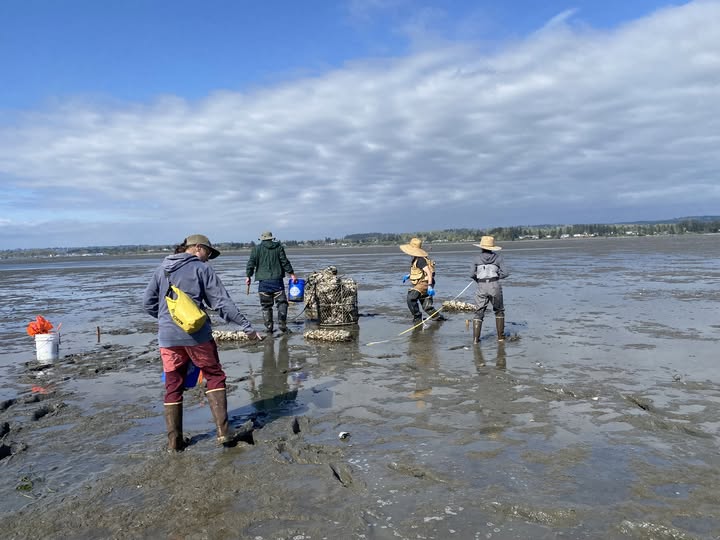
The restoration team deployed 150 bags of oyster cultch, which consists of Pacific oyster shell that has been seeded with baby Olympia oysters grown at the Puget Sound Restoration Fund's Kenneth K. Chew Center for Shellfish Research and Restoration. Each bag contained roughly 1,300 to 1,400 juvenile oysters, bringing the total deployment to around 200,000 individuals. The cultch was placed at multiple sites throughout Drayton Harbor to give the restoration effort the best chance of establishing self-sustaining populations.
The Washington Department of Fish and Wildlife identified Drayton Harbor as a promising restoration location after a historical analysis of where large natural oyster beds existed in Puget Sound before exploitation. The harbor's protected geometry and relatively cold, clean water make it a suitable candidate for re-establishing the species.
Olympia oysters play a critical ecological role that goes well beyond serving as food. Dense beds of living oysters create complex three-dimensional habitat used by dozens of other marine species, from juvenile fish to crabs and invertebrates. Oysters are also powerful water filterers, with a single adult capable of processing up to 50 gallons of water per day. At population scale, a restored oyster bed can meaningfully improve water clarity and reduce algae blooms in the surrounding area.
The Whatcom MRC's project page documents the effort in detail, including the scientific rationale for choosing Drayton Harbor and the monitoring methods the team will use to assess success over time. The MRC is a volunteer citizen advisory body that works with Whatcom County Public Works on marine resources issues across the county's shoreline.
Drayton Harbor is a small embayment within the city of Blaine, about 25 miles north of Bellingham along Interstate 5. It is home to the Drayton Harbor Oyster Company, which farms Pacific oysters commercially and has been a partner in this restoration work. The harbor has faced water quality challenges in past years related to stormwater and agricultural runoff, and the county has invested in improvements to keep the shellfish beds viable.
The restoration team plans to return to the deployment sites next summer to assess how the Olympia oysters are doing. Researchers will look at survival rates, growth, and whether the oysters are reproducing naturally, which would indicate the population is establishing itself rather than just surviving. The project is considered a pilot, and results will inform decisions about whether and how to scale up restoration efforts in Drayton Harbor and potentially other Whatcom County locations.
Community volunteers played a role in the deployment, helping place the cultch bags at the target sites. The Northwest Straits Initiative, a regional marine conservation organization that supports and coordinates MRC work across the Puget Sound region, was also involved in the effort. More information about the project and future volunteer opportunities is available through the Whatcom County Public Works office.