After nearly four weeks of emergency stabilization work, northbound Interstate 5 south of Bellingham reopened this morning, April 16, 2026, restoring a critical transportation corridor that had been severed since a major landslide on March 19. For Whatcom County commuters, freight carriers, and travelers who spent weeks navigating detour routes, the reopening brings long-awaited relief.
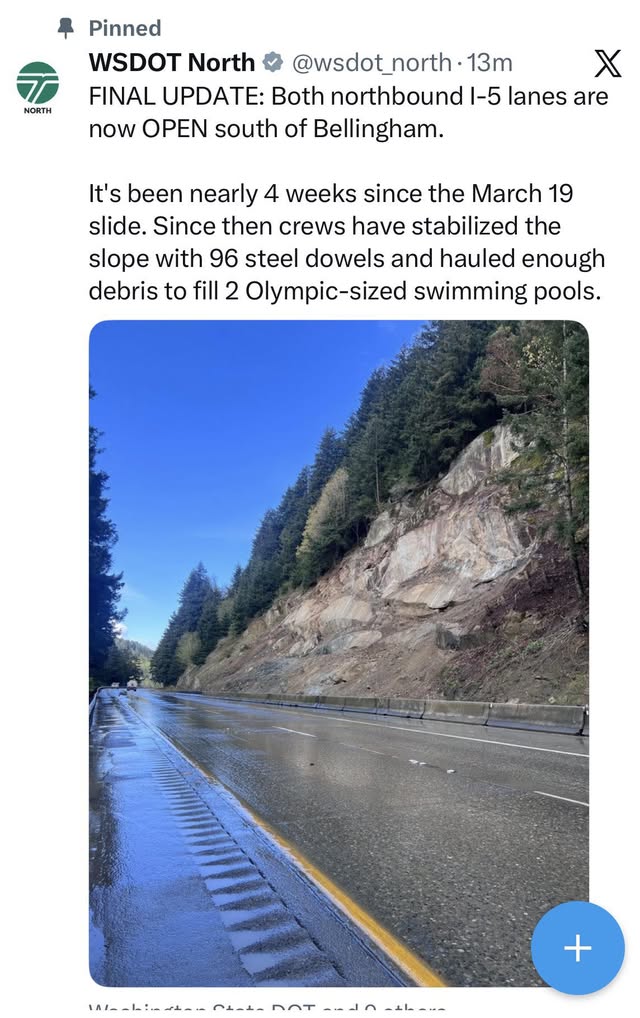
The closure affected the stretch of I-5 between North Lake Samish Road and State Route 11 (Chuckanut Drive), a segment that runs through a narrow corridor flanked by steep terrain. When the slope gave way on March 19, thousands of cubic yards of debris buried the northbound lanes, making the highway impassable and triggering an emergency response from the Washington State Department of Transportation.
WSDOT activated an emergency contract within days of the landslide, bringing in specialized geotechnical engineering crews to assess the stability of the hillside and develop a repair plan. The work was complex: before any debris could be removed from the roadway, engineers had to ensure the slope above would not give way again. Crews drilled and anchored steel dowels deep into the rock face, pinning unstable material in place and preventing further movement.
Throughout the closure, the Whatcom County Department of Public Works and the Whatcom County Sheriff's Office coordinated traffic management and kept the public informed through social media and local media briefings. Travelers were directed to use State Route 11 (Chuckanut Drive) and State Route 9 as alternate routes. SR 9 served as the primary freight corridor during the closure, handling volumes it was not designed to sustain over a nearly four-week period.
The timeline for reopening shifted several times as geotechnical engineers evaluated the slope and waited for conditions to stabilize. WSDOT announced April 16 as the target reopening date on April 10, noting it was contingent on final safety evaluations by geotechnical engineers. Those evaluations were completed overnight, and the northbound lanes opened by 5 a.m. Thursday morning.
The closure had a broad economic impact on Whatcom County. Freight carriers routing through SR 9 faced longer haul times, added fuel costs, and scheduling disruptions. Local businesses dependent on regular deliveries from south of Bellingham absorbed some of those costs. For commuters, the added time on Chuckanut Drive and SR 9 accumulated into hours of lost time over weeks.
Chuckanut Drive, while a scenic route beloved by cyclists and tourists, is a winding two-lane road not built for heavy commercial traffic. Its use as a freight detour during the closure highlighted the region's vulnerability when its primary north-south corridor is disrupted. Bellingham and Whatcom County have only a handful of viable alternate routes, and none approach the capacity of I-5.
The slide site sits in a zone that geologists have long identified as prone to movement, particularly during periods of sustained rainfall. The Pacific Northwest's wet winters regularly saturate hillsides along the I-5 corridor, and this stretch south of Bellingham has seen slope instability before. The March 19 event was notable for its scale and for the damage it caused to the roadway surface itself.
WSDOT has not yet released a timeline for additional long-term slope reinforcement or rockfall mitigation work at the site. The emergency stabilization was intended to make the highway safe for reopening, but ongoing monitoring and potential follow-up work may affect the area in coming months. Travelers can check current conditions and any future updates at wsdot.wa.gov.
For Whatcom County residents who rely on I-5 daily, whether heading to Skagit County, Seattle, or points beyond, the reopening marks the end of one of the most disruptive transportation events in recent local memory. The county will be watching closely to see what long-term measures WSDOT proposes to prevent a repeat at this geologically sensitive stretch of highway.